

Lahore has always been a city that prefers its history to be alive. It does not so much carry the past as wear it on its sleeve - sometimes literally, in the form of chipped Mughal tiles or the faint echo of a qawwali leaking out of a Sufi shrine at dusk. Even before Partition, Lahore was a cultural engine: poets, painters, radicals, and romantics brushed elbows (and sometimes egos) in its courtyards and cafes. It is a city where history is not archived; it is ambient. Art here is not an imported luxury, it has been part of the daily air for centuries. And yet, for a city that has birthed generations of artists, thinkers, and bricklayers of aesthetic language, its present-day infrastructure for art feels oddly threadbare. Like someone forgot to build a staircase after laying the first floor.
This is not due to a lack of talent – far from it. Lahore’s art schools are machines of creative abundance. The National College of Arts (NCA), originally the Mayo School of Industrial Arts (established in 1875, in case you like your institutional memory served Victorian), has produced some of the region’s most significant artists. Punjab University’s Fine Art department began training young practitioners in the 1940s, while Beaconhouse National University (BNU) has more recently positioned itself as a node for contemporary critical inquiry in the region. Every year, these institutions graduate cohorts of wildly inventive, ambitious, and sometimes beautifully confused artists (including all creatives from various disciplines). But here is the rub: they are stepping out of fertile studios into a barren field. It is like training Olympic swimmers and sending them to a desert.
The city, with all its cultural bragging rights, offers only one state-run museum. A few historic homes have been retrofitted into museums, though “retrofitted” might be generous. As for contemporary art? A scattering of commercial galleries bravely keeps the lights on. Of those, only a handful actively engage with the questions contemporary artists are asking. Lakir Gallery, Haam Gallery, Articulate Studios, and the COMO Museum (which, depending on the day, is either a gallery pretending to be a museum or vice versa) form a tiny but essential constellation. That is it. That is the list. The discrepancy between what is being produced and what is being platformed is stark. It is not that Lahore lacks imagination, it is that the scaffolding has gone missing.
This gap is only widened by Pakistan’s political and economic woes. Inflation? Spiralling. Currency? Tumbling. Cultural budgets? Somewhere between vanishing and non-existent. In such an environment, the artist is no longer the visionary perched on the margins. They are the gig worker of cultural production. Expected to make, survive, and somehow not go mad in the process. Risk, in such a setting, becomes a luxury. Many artists trade in experimentation for work that might, just might, sell. And still, astonishingly, they persist. To make art today in Pakistan is not just a practice, it is an act of low-grade rebellion. Each new body of work says, quietly but insistently: I am still here. I am still trying.
But perhaps the most under-appreciated shift in this landscape is happening not in the artist’s studio, but in the space between; where the curator lives. In contexts like ours, where the art scene often oscillates between the quietly resilient and the completely exhausted, curators are emerging as the unlikely risk-takers. Think of them as cultural paramedics, arriving after the explosion, trying to patch things together with criticality and gaffer tape. They are not just presenting work - they are reanimating it. Curators are becoming translators, provocateurs, and sometimes the only ones willing to ask difficult questions.
This is no small ask. Curating here is not about adding wall text and calling it a day. It is about taking works; sometimes familiar, sometimes inert, and asking: what happens if I make them sit next to each other? What new thing might they say, even if they do not want to speak? In a moment when artists cannot always afford to be radical, curators are attempting to radicalise the encounter itself.
Which brings me, with some admiration, to Lakir Gallery’s recent exhibition “And Lack Thereof,” curated by Waleed Zafar, an artist himself. The show pulled together works orbiting the idea of portraiture. But don’t be fooled! These were not portraits in any traditional sense. No oil-slicked power poses or soulful eyes gazing into the void. Instead, Zafar offered something stranger: a meditation on absence, distortion, and the impossible politics of being seen.
His curatorial note sets the tone with sharp simplicity: “To look at a face is to ask: who are you? But also: who were you allowed to be?” That double question of being and being permitted haunts the entire show. Zafar was not chasing coherence. He curated for instability, for ambiguity. And in doing so, he made a radical gesture: he trusted the viewer. No handholding. No summary statements. Just an invitation to dwell in the in-between.
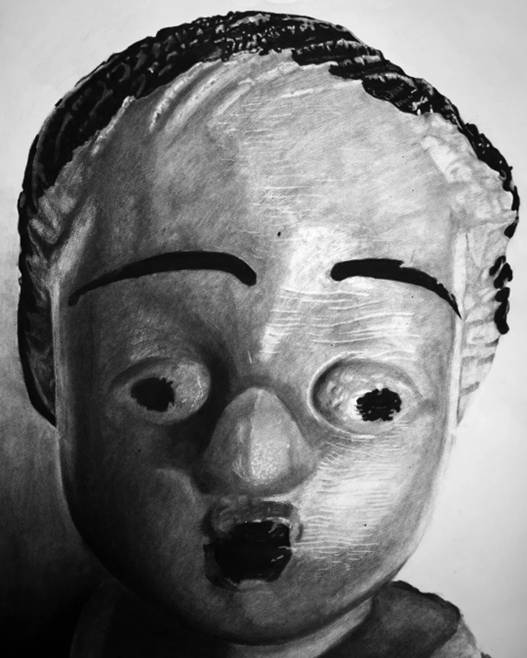
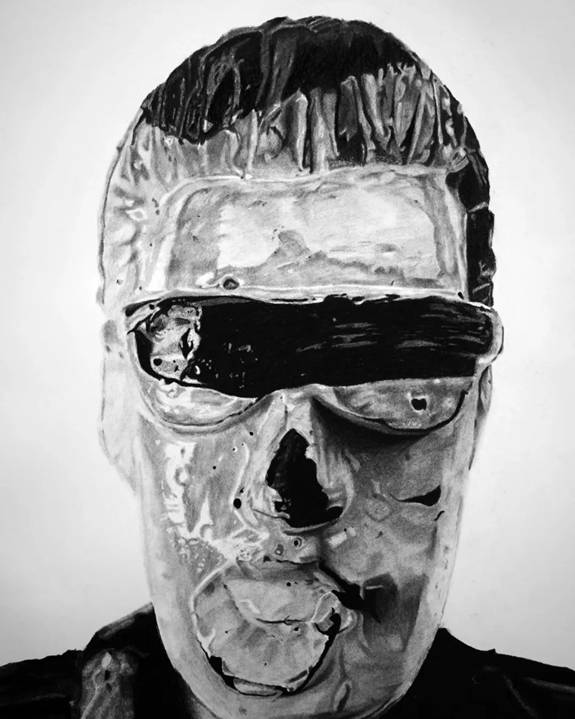
Take Haider Ali Jan’s charcoal series of cheap, melted plastic dolls. They are tragic, iconic, kitschy, and weirdly sublime all at once. Fighter pilots, white babies, toy soldiers; all frozen mid-melt in the synthetic aesthetics of disposable culture. They whisper of the American dream, via Chinese manufacturing, curated in a Pakistani gallery. Not exactly your standard lineage. Zafar placed these works at the conceptual entry point of the show - a curatorial sleight of hand that said: this is what you wanted? Well, here it is. Already broken. American Dream made in China.
Opposite these, Inaam Zafar’s oil portrait glows with a very different kind of resonance. It depicts what appears to be a 1990s Arab commander. Less a person than a media afterimage. The real subject is not the figure; it is how we remembered him: mythologised, televised, and hollowed out by repetition. The portrait does not show us a face. It shows us a ghost. And again, Zafar the artist and Zafar the curator seem in eerie harmony, both asking: What does it mean to be seen through the fog of ideology?
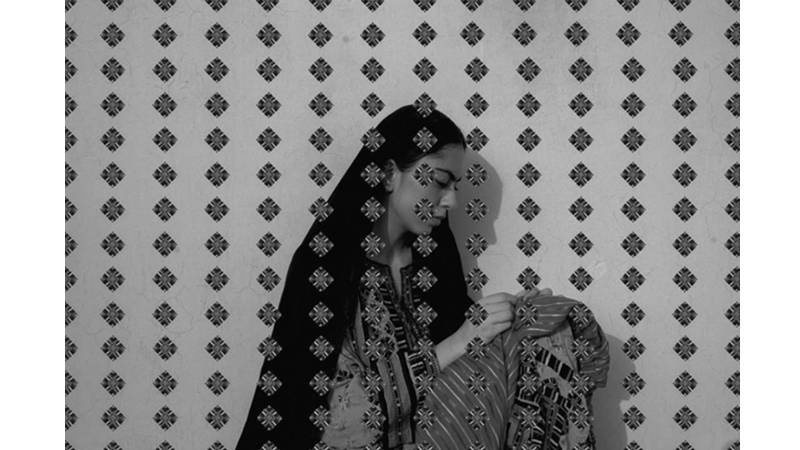
Nearby, Aiman Amin’s diptych of self-portraits embroidered with Balochi motifs offers a quieter, more tactile resistance. The thread does not just decorate the face. It pierces it. This is not self-representation so much as self-inscription. Identity here is stitched, claimed, and made vulnerable. Hung next to Inaam’s broadcast portrait, Amin’s work creates a friction between the handmade and the mass-mediated, the deeply personal and the globally politicised. The mass-consumed versus the meticulously handmade, the global affair versus the rooted symbolic.
And this is where Zafar’s curatorial hand really shines. He does not arrange by theme. He arranges for conversation. For tension. These are not just “juxtapositions.” They are negotiations. He curates adjacency as a method. Works do not illustrate a point; they irritate each other into meaning.
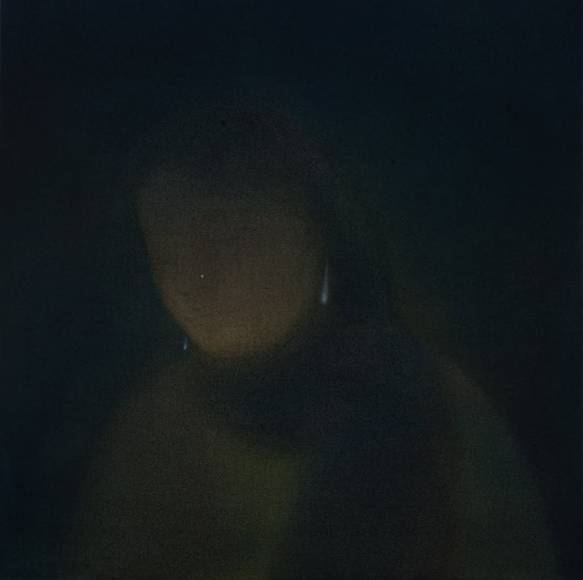
Toward the far wall, the exhibition modulates its register. Ahsan Mehmood’s dreamlike canvases whisper of female presence through barely-there gestures. An earring, a veil, a pause. They are gentle, but not fragile. Directly opposite them hangs a loud, messy, visceral painting titled “All the Rage of That Time Was Returning to My Breast.” If the former murmurs, the latter howls. It is raw, maybe even a little overconfident. But Zafar uses this imbalance intentionally. By placing these two energies in dialogue, he creates a rhythm: quiet resistance on one side, loud irresolution on the other. Together, they do not answer his curatorial premise. They enact it.
What makes “And Lack Thereof” a success is not just the individual strength of the works, though several are memorable. It is the way they have been asked to speak. Zafar curated not to illustrate identity, but to complicate it. To show that being seen is never simple, never whole, and rarely fair. He stages the exhibition as a thinking space, not a lecture or documentation. And in a context as fragile as ours - economically, politically, institutionally - that is no small thing.
In Pakistan today, to curate is to actually care. Not in the sentimental sense, but in the radical sense: to construct temporary shelters where reflection is possible, even when everything else feels urgent, broken, or monetised. To say to artists: I see you. I believe in your work. Let’s try something weird.
“And Lack Thereof” did precisely that. It offered no resolution, no final image of the self. But it opened a window. And in current times, even that is radical.