

Since the Customs Act stands extended to GB, all the duties under the said Act (customs duties, regulatory duties, additional customs duties, etc.) will be collected on all imports through the Customs Station at Sost, regardless of intended use. FBR reiterates that these measures collectively provide a strong, technology-driven, and enforceable framework to prevent leakage or misuse of tax-exempt goods. The business community and traders across Pakistan are assured that the exemption regime is carefully designed, closely monitored, and will not harm fair competition or legitimate trade interests in the rest of the country—FBR’s press release of December 30, 2025.
What is unfolding in Gilgit-Baltistan (GB) today is not a technical dispute over customs procedures or tax exemptions. It is a perpetual constitutional crisis disguised as fiscal administration. The Federal Board of Revenue’s insistence that the Customs Act “stands extended” to GB and that all duties will be collected at the Sost Customs Post “regardless of intended use” is emblematic of a deeper malaise: the exercise of sovereign power without constitutional validity, and governance without citizenship.
This is not how constitutional democracies function. It is how emperors or dictators behave, even when a country has a written constitution. The Supreme Court of Pakistan, in Civil Aviation Authority v Supreme Appellate Court, Gilgit-Baltistan and others [PLD 2019 Supreme Court 357], while referring to Article 257 of the Constitution of the Islamic Republic of Pakistan (“the Constitution”), noted: Therefore there can be no prejudice to Pakistan’s position on the plebiscite issue if the men, women and children living in GB are guaranteed basic human rights and a role in their own governance within a framework of a constitutional nature. Indeed, full rights for the people of GB can only bolster Pakistan’s case for the right of self-determination for all the people of Kashmir.
It is unfortunate that even after the lapse of 78 years and clear judgments of the superior courts, the residents of GB are deprived of their fundamental rights and, for decades, have been victims of the high-handedness of the FBR.
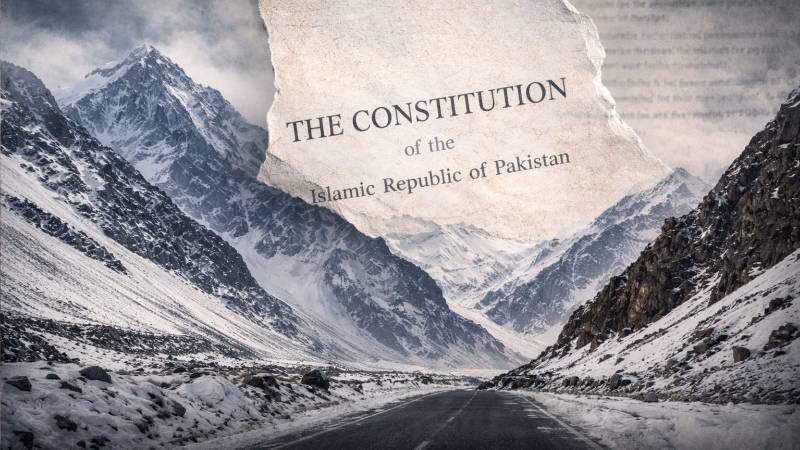
The constitutional position is clear. Article 1(2) of the Constitution of the Islamic Republic of Pakistan (“the Constitution”) defines the territory of Pakistan. Gilgit-Baltistan is not included in it. This omission is not accidental, nor has it been cured by any constitutional amendment comparable to the 25th Constitutional Amendment, which absorbed the former Federally and Provincially Administered Tribal Areas (FATA/PATA) into the federation and extended federal laws passed by Parliament by omitting Article 247 of the Constitution.
GB’s governance continues to rest on executive orders and administrative arrangements, not constitutional incorporation. This single fact has far-reaching consequences. Federal laws apply by default only within the territory defined by Article 1(2) of the Constitution; otherwise, the State must demonstrate a constitutionally valid mechanism for extension. Administrative assertions, circulars, or press releases cannot substitute for constitutional competence. Yet this is precisely what the FBR has attempted to do—assert extension by declaration.
GB Chief Court Order of July 2024
The constitutional fiction created by the FBR collapsed when, on July 20, 2024, the Gilgit-Baltistan Chief Court restrained Pakistan Customs from collecting income tax and sales tax on goods imported for local consumption through the Sost Dry Port and declared its very presence unlawful.
By continuing to post Collectors of Customs in GB, the State is not administering law; it is normalising illegality through repetition
The GB Chief Court recognised what the federal executive prefers to ignore: these federal tax laws were never validly extended to GB, and therefore their enforcement in the said territory lacks legal authority.
The order of the Chief Court of GB goes far beyond the immediate relief it has granted to traders. It confirms a constitutional principle: federal fiscal authority does not arise from administrative convenience. It arises from constitutional inclusion or lawful extension; in the absence of either, enforcement becomes ultra vires.
FBR’s high-handedness and unconstitutional acts in GB can be exposed by a simple example: if an investor in GB wishes to establish a manufacturing concern to export fruit juices and other products after value addition, why should the company pay customs and other duties and taxes even on capital goods alone worth Rs. 5 billion, ordered from China through Sost?
In its press release, the FBR has observed: “However, to ensure fiscal discipline and prevent misuse, a strict annual ceiling of Rs. 4 billion has been imposed on the goods imported for GB under this arrangement.” This ceiling has neither any economic rationale nor any legal sanction. It nevertheless exposes the FBR’s mindset—that it is not a revenue-collecting entity but a growth-slayer.
FBR’s Exemptions, Without Authority
On January 1, 2026, the FBR notified through SRO 01(I)/2026 the ‘clearance of goods from Customs Dry Port at Sost’ rules, introducing “special procedures” at the Sost Dry Port and exempting over 2,400 Chinese-origin items from sales tax, income tax, and federal excise duty. When these laws do not apply to GB, what is the authority to grant an exemption? Customs control, with the presence of a Collector of Customs stationed in GB by the FBR, is a fatal contradiction, as highlighted in the order of the Gilgit-Baltistan Chief Court. Unfortunately, this order, like many others of even Pakistani courts, is violated with impunity by the FBR.
If federal tax laws do not lawfully apply to GB, on what basis does the FBR grant exemptions from those very laws? This was the question before the Gilgit-Baltistan Chief Court.
If GB lies outside the constitutional command of Pakistan, what is the legal status of Pakistani customs officers operating there at all? An exemption presupposes jurisdiction. One cannot exempt what one has no authority to impose.
When the Customs Office Itself Is Illegitimate
The Collectors of Customs are not advisory figures. They are statutory officers exercising coercive powers under the Customs Act, 1969, within a defined territory. Their authority is territorially bounded. Where the Constitution does not extend, neither can the office.
If Gilgit-Baltistan is not part of Pakistan under Article 1(2) of the Constitution, then the presence of a “Collector Customs, Sost” is constitutionally indefensible unless the State first demonstrates a valid legal bridge extending the Customs Act and the office it creates to GB.
Recolonisation through administration is not governance; it is abdication of constitutional responsibility
No Statutory Regulatory Order (SRO) can perform that miracle. Delegated legislation cannot cure constitutional absence. By continuing to post Collectors of Customs in GB, the State is not administering law; it is normalising illegality through repetition. It is a well-established legal rule that what cannot be done directly cannot be done indirectly.
The above legal tangle clearly establishes that all the actions of the FBR and customs authorities are coram non judice. The superstructure built on an unlawful foundation cannot be sustained.
Customs Control Is Sovereign Power, Not Technical Service
There is a dangerous tendency to trivialise customs as a technical border function. It is not. Customs control is an assertion of sovereignty. Declaring customs stations, appointing officers, prescribing clearance procedures, and imposing conditions are all exercises of State power over territory and people. To exercise that power without constitutional inclusion is to govern without consent.
Post-colonial ‘Recolonisation’
This brings us to the uncomfortable but unavoidable frame: post-colonial recolonisation. Colonial governance was marked by a familiar triad—rule without representation, taxation without citizenship, and administration without constitutional obligation.
Gilgit-Baltistan today fits this description with unsettling precision. GB’s people are expected to: (a) comply with federal regulatory regimes; (b) submit to customs controls and conditional clearances; and (c) accept the authority of federal officers. GB residents are compelled to do all these acts while being denied: (i) representation in Parliament; (ii) inclusion under Article 1(2) of the Constitution; and (iii) equal constitutional citizenship.
This is not federalism. It is administrative colonialism—governance by notification rather than by consent.
The Indian-Occupied Kashmir Contrast
The contrast with India’s approach to Occupied Jammu and Kashmir after August 2019 is instructive, even if politically uncomfortable. India revoked the region’s special status and declared it a Union Territory—an act all freedom-lovers and advocates of self-rule rightly criticise. Yet from a constitutional standpoint, India claimed to have opted for clarity over ambiguity. It redefined the territory’s status within its constitutional framework and extended federal laws accordingly.
Pakistan, by contrast, has opted for permanent limbo: control without ownership, authority without responsibility. This ambiguity weakens our legal position internationally and erodes legitimacy domestically. The so-called experts advising those who matter in the Land of the Pure should study in detail the illegal acts of Modi and file a case in the International Court of Justice, rather than forcing the people of GB not to import goods worth more than Rs. 4 billion.
Economic Costs and Strategic Damage
The consequences of constitutional inaction are not abstract but concrete. It is forcing economic uncertainty for GB businesses subjected to arbitrary conditions, creating legal instability as courts intervene sporadically against executive overreach, causing political alienation of a population that has repeatedly demanded integration, not exception, and producing strategic incoherence in a region central to the China-Pakistan Economic Corridor (CPEC) and regional connectivity. A State cannot indefinitely demand compliance while denying belonging and ownership.
FBR Cannot Impose “Conditions” on GB Businesses
FBR’s claim that it may impose conditions on GB traders—even where taxes are exempted—is constitutionally untenable for three reasons: (1) no territorial competence, as GB is not part of Pakistan yet; (2) no valid extension, as federal tax laws and the Customs Act, 1969 lack a constitutionally valid extension to GB; and (3) no lawful office, as Collectors of Customs in GB lack jurisdiction ab initio. Conditions imposed by the FBR without constitutional footing are void, not merely irregular.
The Only Sustainable Solution: Citizenship First
There is only one principled way forward. Pakistan must accept the legitimate, long-standing demand of the people of GB to be declared full citizens of Pakistan. This requires making GB a province after a resolution by the GB Assembly and through a constitutional amendment, and thereafter granting full representation in the National Assembly and the Senate. This alone will justify the application of federal laws. Anything less perpetuates a colonial relationship incompatible with Pakistan’s constitutional ethos.
Conclusion
SROs cannot substitute for constitutional command. Exemptions cannot replace equality. Administration cannot stand in for citizenship. Gilgit-Baltistan does not need more “special procedures”. It needs recognition. The era of ruling without inclusion must end.
Recolonisation through administration is not governance; it is abdication of constitutional responsibility. If Pakistan wishes to exercise authority in Gilgit-Baltistan, it must first extend citizenship, representation, and constitutional dignity. Until that day, every notification issued, every condition imposed, and every tax collector posted in GB will remain a reminder not of State capacity—but of constitutional failure and extreme fiscal high-handedness.