

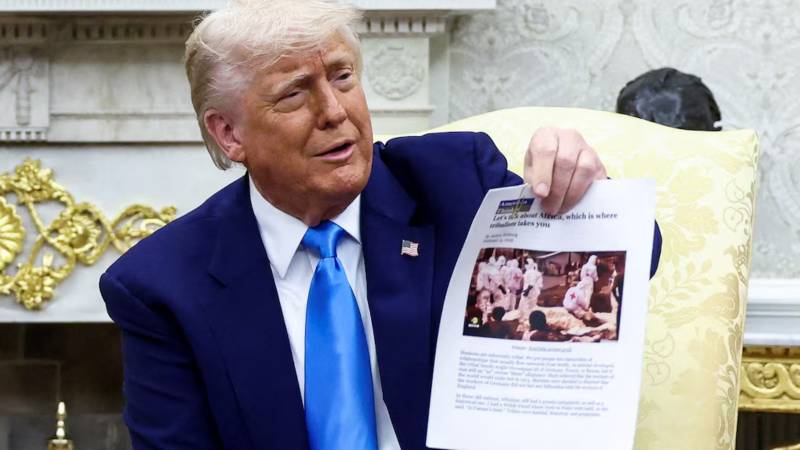
On 21 May, during his meeting with the visiting South African President Cyril Ramaphosa, the U.S. President Donald Trump demeaned his guest by showing a video and photos about the alleged genocide of white farmers at the hands of black South Africans. When Ramaphosa tried to intervene and deny such accusations, he was snubbed by President Trump. The drama at the Oval Office reminded one of the disgrace suffered by visiting Ukrainian President Volodymyr Zelensky on 28 February at the hands of Donald Trump and Vice-President J. D. Vance, when both blamed him for unleashing war with Russia. On both occasions, print and electronic media present in the Oval Office covered the events, which reflected how humiliating the American leadership was towards the visiting Ukrainian and South African Presidents.
Reflecting his alleged racist bias against the black population of South Africa, President Trump asserted: “They are white farmers, and they are fleeing South Africa, and it’s a very sad thing to see. But I hope we can have explanations of that, because I know you don’t want discussing genocide.” Along with Trump, multi-billionaire Elon Musk—originally from South Africa and part of Trump’s team—was also present in the Oval Office on the occasion of Ramaphosa’s visit. Musk criticised South Africa’s land appropriation law, accusing the black majority population of persecuting white farmers. He and President Trump overlooked the fact that the white population of South Africa constitutes only 7.3% of the country’s demography but controls most of the farmlands.
According to Al Jazeera’s report of 22 May: “During the meeting, Trump repeatedly claimed that genocide against white farmers is taking place in South Africa, an allegation denied by Ramaphosa.” Earlier this month, 59 white “refugees” were flown from South Africa to the U.S. as part of a relocation plan for white South Africans devised by the Trump administration.
Trump told Ramaphosa that these were white farmers fleeing violence directed at them in South Africa. “We have many people that feel they’re being persecuted, and they’re coming to the United States,” said Trump. “People are fleeing South Africa for their own safety. Their land is being confiscated, and in many cases, they’re being killed.” But Ramaphosa denied allegations of a “white genocide” in South Africa. “If there was Afrikaner farmer genocide, I can bet you these three gentlemen would not be here,” the South African President said, referring to Els, Goosen and Rupert, the three white men who were part of his delegation.
Showing videos and photos of white farmers allegedly persecuted by the black population in front of the visiting South African President was the height of diplomatic embarrassment and contrary to diplomatic norms
It was not only the accusation of black persecution of white farmers that stirred controversy. The Trump administration became furious when Ramaphosa accused Israel of genocide in Gaza at the International Court of Justice (ICJ). Trump announced a 31% tariff and expelled the South African ambassador after he criticised Trump’s ‘Make America Great Again’ movement. It is strange that Trump is willing to accept white South African farmers' applications for asylum in the U.S. while simultaneously pursuing a strict anti-immigration drive for others. According to NPR: “Despite the South African delegation's attempts to explain the facts to the U.S. leader, Trump again and again repeated a right-wing conspiracy theory that there is systematic persecution and 'genocide' of white South Africans, using disinformation to support his allegations. He misrepresented a video showing a protest, where people placed white crosses in a field to commemorate a farmer and his wife who were murdered in a 2020 home robbery, as a ‘burial site.’” South African news site News24 clarified that there are no bodies at the site and the number of crosses does not correspond to the number of killings.
The visit of South African President Cyril Ramaphosa to the U.S. has triggered racist attacks by Trump on the black majority without any concrete evidence. Showing videos and photos of white farmers allegedly persecuted by the black population in front of the visiting South African President was the height of diplomatic embarrassment and contrary to diplomatic norms. Similar behaviour by Trump was observed during the visit of the Ukrainian President, when he and the Vice-President repeatedly accused him of starting the war and failing to pursue peace with his Russian counterpart.
One needs to examine Trump’s allegation of black genocide against white farmers from a historical perspective, based on three facts. First, the West, including the United States, was supportive of the policy of apartheid, which was based on the genocide of the black majority by the white minority. For a long period, successive American administrations labelled the African National Congress (ANC), led by the legendary and imprisoned South African leader Nelson Mandela, as a terrorist organisation. While Third World countries and the Communist/Socialist bloc were opposed to apartheid and supported the ANC in its struggle against the white racist minority regime, the U.S. and most Western countries refrained from condemning the white minority’s genocide against the black majority led by the ANC. Until 1990, when the Botha regime in Pretoria was replaced by De Klerk, ushering in the dismantling of apartheid, the West remained supportive of the white minority regime.
By supporting white farmers in South Africa, Trump seeks to reinforce his support base among white supremacists, who form the core of his faction within the Republican Party
Thousands of black protestors were massacred by the white police and military in different towns and cities of South Africa, including Soweto. The genocide of the black majority by the white minority drew worldwide condemnation, leading to the imposition of sanctions against the white minority regime by the United Nations. Even the United States, until 1965, pursued a policy of apartheid, depriving black and coloured populations of voting rights and equal access to education, public parks, housing, transport and restaurants. When the United States itself practised apartheid, how can it now raise its voice against the alleged black genocide in South Africa?
By publicly expressing his racist feelings against the black population of South Africa and sympathising with the so-called white farmers—who still control the majority of land ownership—Trump has exposed the racial prejudice he and Elon Musk harbour against the black population. For decades, South Africa was ruled by the white minority, and the black majority was persecuted. Images of genocide against the black majority by South African white police and security forces illustrated how apartheid was a state policy supported by the West and the United States. Now, South African white farmers, who still own the majority of farmland, raise allegations of genocide against the black majority.
Second, the Trump administration has no right to raise the so-called issue of white farmer genocide in South Africa when racial discrimination and persecution against the non-white population persist in America. By supporting white farmers in South Africa, Trump seeks to reinforce his support base among white supremacists, who form the core of his faction within the Republican Party. By projecting alleged acts of genocide against white farmers in South Africa, Trump is deepening the racial divide in his own country. According to critics, Trump has no right to speak about the so-called persecution of white farmers in South Africa when his own country failed for decades to support the anti-apartheid movement and when its non-white population has long felt discriminated against. Will African leaders now condemn apartheid in the U.S. against the black minority and the centuries-old persecution of African Americans, who were once derogatorily called “Negroes” and “niggers”?
Third, Trump spares no opportunity to voice his inner bias against non-whites. His claims of genocide of white farmers in South Africa are widely rejected as a bundle of lies, particularly in light of the black majority’s commitment to tolerance and multiculturalism, following the teachings of former President Nelson Mandela—despite the inhumane treatment inflicted upon them by the white minority. Mandela’s famous quote, “It is not our diversity which divides us; it is not our ethnicity, or religion or culture that divides us. Since we have achieved our freedom, there can only be one division amongst us: between those who cherish democracy and those who do not,” continues to shape the policy of the South African government.
In that case, despite the allegations by Donald Trump and Elon Musk that the black majority in South Africa is engaged in the genocide of white farmers, the reality on the ground is quite different. Had South Africa followed the path of Prime Minister Robert Mugabe of Zimbabwe and expelled white farmers and traders from the country, the situation would have been entirely different. Yet, adhering to Nelson Mandela’s vision of national reconciliation and democracy, successive governments—even amid allegations of corruption and nepotism—have refrained from promoting the victimisation of the white minority, which for decades enforced apartheid and committed genocide against the black majority. Is the white minority of South Africa not guilty of genocide against the black majority and the pursuit of racial discrimination under past apartheid policies? And is white America not guilty of persecuting Native Americans and its black population for centuries?