

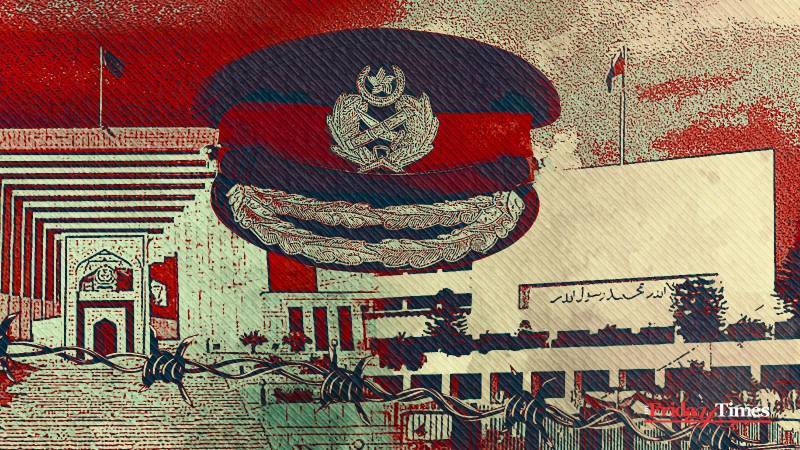
In the post-Musharraf period, the Pakistani military and its leadership have played a prominent and decisive role in national life. It acted as a bulwark against terrorism and militancy. Its leadership played a decisive role in the country’s diplomacy, with the incumbent COAS acting as the diplomat-in-chief of the country. During this period, the important world capitals were interested in keeping an eye on Pakistan’s internal security situation. How effective was the military campaign that the Pakistani military was running in the Pak-Afghan border areas? Do the Taliban have the capability to knock on the doors of Islamabad? Are Pakistan’s strategic weapons in safe hands? Do the militant groups pose a serious challenge to the authority and writ of the Pakistani state? Can Pakistan-based militant groups compel Pakistan and India into a full-fledged war?
Nobody in Pakistan has been in a better position to answer these questions than the military leaders and the military-led intelligence services, and the world capital wanted to remain connected to the Pakistani military as a power center. The military used these international connections to consolidate its hold on power domestically. The public perception that the military dominates the governance structures and decision-making processes in Islamabad dominates the media as well as political circles. In public perception, no government in Islamabad came to power or was sent home without the approval of the military leaders.
Our political discourse is generally focused on the military's power in the power structure within Pakistani society. Our society, both opponents and supporters of the military, generally perceives the military to be in possession of mythical powers. They are the go-getters, they make and break governments, and they seem to be in possession of some magical powers to do things that ordinary mortals cannot do. If we do an analysis of our public discourse about the military—gossip, rumors, and media reports—we will come to the conclusion that people do have a realisation that the military is in control of the coercive machinery of the state, which allows them to influence outcomes and force people to change sides, may be simply to change or upload the new “software” into people’s heads—as the new political slang describe the situation when anti-military political leaders appear on Television to express their solidarity with the military. However, the jargon used to describe the deeds of the ghost men of the military is projected in a highly mythologising term. The anti-military wave in the wake of Imran Khan’s arrest has dramatically changed the tenor and content of our political discourse.
Our political discourse, however, never debates what is the role of the Pakistani military in the formation of national power at the regional and international level. In modern political and military literature, an organised military is often described as a force that protects the citizens of society from organised military-scale violence. The military is usually described as the most important component of national power. In a large country, the military exists as the largest organised body of men trained in military-scale violence—the military could be described as a state's tool to maintain a monopoly of violence in its society.
The decision-making on internal security is purely political, as the groups against whom the Pakistani military operates basically consist of Pakistani citizenry
During the last 40 years—the period during which the Pakistani state gradually lost its monopoly on violence—the Pakistani military has assumed other non-violent political roles within the governance structures of the society. It dominates the foreign policy-making processes, especially when it comes to relations with India, the United States, and Afghanistan. With India, we don’t have any economic or political relations, it's purely in military terms that the two South Asian rivals interact. In US-Pakistan relations, the military and intelligence component still dominate, and during 2008 US wanted to expand the relations into the economic realm, Pakistani military leaders shot down the proposal by opposing the Kerry-Lugar Bill. Afghanistan has recently emerged as Pakistan's biggest security threat, and now it is obvious that the military will dominate Pakistan’s Afghan policy.
In the post-Musharraf period, the military leaders dominated the decision-making process related to internal security situations. The decision-making on internal security is purely political, as the groups against whom the Pakistani military operates basically consist of Pakistani citizenry. The areas in which the military carries out military operations are populated by Pakistani people. The reaction of the people to the military's actions and the impact of the military operations in different parts of Pakistan would be purely political in nature with which Pakistan’s political government would have to deal. It seems political leadership has conceded its constitutional and political authority to decide on internal security situations for the military. This speaks volumes not only to the fact that the military dominates the power structures but also indicates deep-seated incompetence on the part of civilian leaders.
Why and how our political discourse doesn’t discuss Pakistan's military as a component of national power at the regional and international levels is not very difficult to judge. Our military is too preoccupied and too overwhelmed by its role in the domestic political and security situation to be able to project its power at the regional or national level. Projecting national power at the regional level doesn’t mean military aggression. Take the example of the Indian military: Back in the first decade of this century, India was dubbed a net security provider at the regional level by American security officials. Since then, India has been selling its military as a counterpoise to Chinese military power, which has been seen as a threat and force attempting to dominate Southeast Asia by regional countries with a pro-American tilt. In simple words, India is projecting its military as a force at the regional level.
Maybe the heyday of the Pakistani military is behind us, when during the Cold War and with Washington’s backing, the Pakistani military used to project its role as a regional stabiliser, leader of the Muslim world, and provider of security to Arab Sheikhdoms. Lack of American support may be one reason why we are not projecting the military as a component of our national power at the regional and international levels. The other more potent reason could be found in the domestic mess, which is the creation of successive Pakistan military leaders in domestic politics. They take sides in political disputes and conflicts. They engage in military operations against their population. They engage in destroying and demolishing popular political parties and political leaders who represent popular aspirations. The arguments of just or unjust war don’t apply; war within the territory is a civil war and it is immensely destructive and could prove to be an immense distraction for the national leadership.
The institution of the military in any powerful state is considered a tool or mechanism to maintain a monopoly of the state on violence in the society it is governing
Theorists of International politics envisage a situation where countries’ comprehensive power capabilities, including military capabilities, become redundant when they lose strategic credibility at the regional and international levels. I think Pakistan is facing such a situation. Since the Musharraf period, we have been dubbed as liars by our closest ally in the war against terror, we have on many occasions during the last twenty years been on the verge of defaulting on our international debt obligations, and our prime ministers and Army chiefs have repeated visited foreign capitals in search of political support for securing IMF loan to ensure continued financial viability of Pakistani state. Tanks, aircraft, and other weapons don’t constitute strategic credibility—it is judged by your ability and your capacity to fulfill your international commitments, hold on to your strategic interests, and be truthful to your allies and friends. What will be the value of our capabilities if we lose our strategic credibility at the regional and international levels? This is especially a dangerous situation if seen in the light of a new development on the international stage—that is the international taboo against military aggression has lost its value in the wake of Russian aggression against Ukraine and Israel's aggression against Gaza.
They say General Yahya Khan was drunk when he told the then US National Security Advisor, Henry Kissinger that one Muslim soldier is equal to ten infidel soldiers and that the Pakistan military would get the hell out of the Indian military in East Pakistan. Similarly, General Musharraf told his audience in Serena Hotel main hall during Ramzan Iftar that he would create hell for the Baloch rebels, “They (rebels) would be shocked by what had hit them,” he said. I am still surprised why a pious man (and memoriser of the Holy Quran) like General Asim Munir repeated the same mistake of telling the Baloch rebels they would not be able to snatch Balochistan from Pakistan for ten generations. Was he threatening India? He was not clear in his meaning of whom he was addressing. Baloch rebels? Are India's military and intelligence services who are surely interfering in Balochistan? Or somebody else? Whatever may be the case, General Asim’s speech was deeply problematic from two perspectives. First, General Asim’s statement admitted that the Pakistani state was facing a military-scale insurgency in Balochistan. The way he made this assertion makes it clear that the rebels, for the first time, are posing a serious threat to the Pakistani state. Pakistan military chiefs usually don’t give so much attention to subnational security problems.
Secondly, the 1500 rebels that he talked about, who are they? Are they Pakistani citizens? If they are outlaws in the eyes of the state, how does the Baluch society perceive them? If the Baloch society is sympathetic toward the cause of these 1500 men, then General Asim Munir’s statement is deeply problematic. That means the Baloch society which perceives these rebels as their own will also perceive General Asim Munir’s speech as deeply threatening. A speech that might be delivered just to satisfy a political constituency or people under his command might aggravate the deeply sensitive situation of Balochistan. And lastly, this speech points towards the nature of Pakistan's military power, which, most of the time in our history, has been exercised without any civilian oversight. We don’t know the nature of international commitments our military and political leaders have given, but one thing is sure: with our actions and statements, we are pushing this society towards an unending spate of violence.
There is no doubt that the Pakistani military is a very important component of our national power. But there is equally no doubt that our acts, decisions, and assertions have transformed this national institution—an institution that is supposed to be completely neutral in political and ideological conflicts—into a somewhat disruptive force. The institution of the military in any powerful state is considered a tool or mechanism to maintain a monopoly of the state on violence in the society it is governing. To maintain a monopoly on violence, the state should have legitimacy for the violence it perpetuates against miscreant groups. Pakistan's state has lost both the monopoly and legitimacy of violence—a major chunk of its population does not consider the violence the Pakistani state carries out in their areas as legitimate. This is a recipe for a civil war—several segments of the population are armed, and do not consider state-directed violence as legitimate. In such a situation, making loud claims about ten generations is not warranted.