

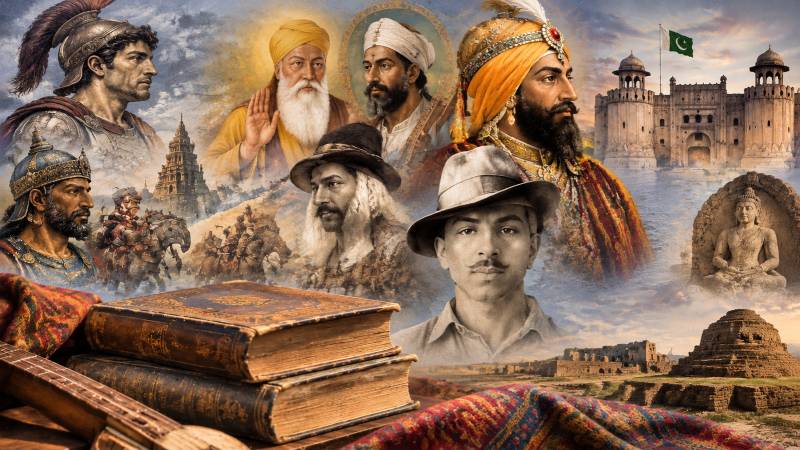
Over the last few months, I've been poring over three books of folklore collected from bards and storytellers of Punjab. One was compiled by Charles Swynnerton, who sat by the fire on winter nights writing down what Muslim storytellers told him about people like Rasalu, Nek Bakht, and Gul Badshah. Without people like him, many of these stories would’ve been lost. Then I read his introduction, and I almost threw up.
In his telling, Islam came to Punjab as a flood of "Arab fanatics" who slaughtered a people made soft and unwarlike by their gentle religion, then offered the survivors Islam or the sword. This was a man introducing us, Muslim Punjabis, to an English-reading world that had little other access to us at that time. He isn’t the only one telling our story. Across the border, a version says we were always one people until we were converted away.
At home is the version we grew up with in which our history begins with the Indus Valley Civilization and jumps a void to Muhammad bin Qasim. I can’t recognize myself fully in any one of them. The old books are full of people who lived, or were believed to have lived, on these very lands, in the void that our textbooks left. And a question keeps circling in my mind: ‘Why do we, Pakistanis, especially Pakistani Punjabis, shy away from our past?’ I wonder if it's because we don’t want to admit we were once non-Muslim. That if we owned our non-Muslim ancestors, we’d be negating the two-nation theory. Looking for an answer, I've started noticing how our selective forgetting works: who we remember, who we forget, and why.
Let’s start with Alexander the Great, whom we so proudly own, though he was a Greek pagan. Porus, who fought him bravely at the Jhelum, survives only a paragraph in our textbooks. Menander, a Greek king of Sialkot, remembered in Buddhist tradition as Milinda, isn't there at all. Raja Rasalu, a ready-made fairytale hero from Sialkot, was sung by bards for centuries, and even converted to Islam when needed. Yet he doesn’t sit on our children's shelves beside Percy Jackson, whose Greek gods we hand them without a second thought.
Faith can’t explain this. Alexander was as much non-Muslim as Menander. It's as if we decided that everything before Muhammad bin Qasim is pre-history, and definitely not ours, with Alexander a token for the void. Jaipal and Anandpal, the Hindu Shahi kings, fought Mahmud of Ghazni and lost, and we let their memory fade. Meanwhile, we named our missiles Ghaznavi, Ghauri, Abdali, and Babur, the men who invaded our land.
Yet being an invader doesn’t guarantee a place in memory either. Mihirakula, the Hun king, came from outside and, unlike Mahmud, he stayed and ruled from Sialkot. We don’t remember him at all. Ahmad Khan Kharal and Bhagat Singh both fought the British invaders, but we only remember Kharal as a hero. Yet Dulla Bhatti and Sarang Khan, who resisted Akbar and the Suris, were Muslims, and we quietly distanced from them too. So neither faith nor invaders versus resisters consistently decide whose memory we keep.
In late 2024, amid open tension with Afghanistan, a Pakistani minister called Mahmud a thief and a plunderer who had been mistakenly treated as a hero. Let that sink in: the same Mahmud whose name we put on a missile became a looter the moment it suited us. No new facts about him had surfaced in a thousand years. Only our convenience had changed. That seems to be the real rule: we remember whoever is comfortable to remember, in the way that suits us, for as long as it suits us.
Still there are names that are neither convenient to remember nor forget. Guru Nanak was born in Nankana Sahib and lies at Kartarpur. We couldn’t erase him so we set him apart and look after his places as if safeguarding a guest's heritage rather than our own. Compare that to Bhai Mardana, born into a Muslim mirasi family, who travelled with Nanak and played the rabab while he sang. His descendants, the rababis, sang kirtan at Sikh shrines, the Golden Temple among them, until Partition. One of the last masters, Bhai Ghulam Muhammad Chand, died in Lahore in 2015. Most of us didn’t even know he existed.
It’s another kind of inconvenience when someone loves across the line. Amrita Pritam, born in Gujranwala, called out to Waris Shah to grieve with her when partition tore Punjab apart. We read her and admire her, but we don't consider her our own. Another inconvenient name but impossible to dismiss is Ranjit Singh. He was born in Gujranwala. He unified Punjab by fighting Sikh chiefs, Muslim nawabs, and Afghans alike, and ruled from Lahore, where his samadhi still stands. In 2019, his statue was installed in Lahore Fort, but it was vandalized repeatedly until it had to be moved to Kartarpur, as if he belonged to the Sikhs and not to us. We happily claim the Mughals and the Suris, who came from outside, but not the maharaja born here?
Bhagat Singh was born near Lyallpur (Faisalabad) and hanged in Lahore. When people petitioned to name Shadman Chowk after him, the Lahore High Court asked the government to decide. The city said no, leaning on a retired officer's report that called Bhagat a criminal rather than a revolutionary (contrary to the Quaid's own view). The case is still dragging through the court. Yet the Punjab government opened a gallery for him at Poonch House, where his trial documents are kept.
Remembering that we were once ‘not Muslims’, that we converted, and later drifted apart as two nations with different ideologies, shouldn’t feel like an uncomfortable truth. But perhaps this discomfort is better than forgetting. That we still bother to argue over our disowned ancestors tells me some part of us knows they belong to us.