

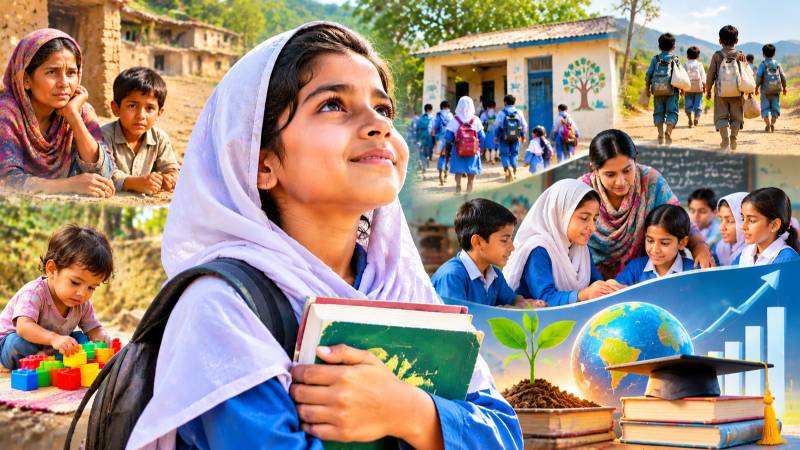
They say education is the bridge that connects our children’s present to their future. For two decades, Pakistan has been trying to build that bridge by getting as many children as possible into school. Official figures tell us that enrolment has risen. The government’s claim deserves a closer look, but whatever the figures may say, the central question is where this bridge is taking us.
According to the World Bank, 77 per cent of children in Pakistan cannot read and understand a simple passage by the age of ten. The 2025 Annual Status of Education Report (ASER) found that only 7 per cent of children in Grade 3 could read a simple story in Urdu or Sindhi. Even in Grade 5, only about half could read a passage meant for Grade 2. Meanwhile, more than 25 million children between the ages of five and sixteen are out of school. Here lies the central contradiction of our education crisis. Access to school has widened, but learning has scarcely improved.
The World Bank’s 2026 report, Building Human Capital Where It Matters, says that children’s test scores in low- and lower-middle-income countries are now worse than they were in 2010. Why should this be so? The report offers an answer. We have assumed that a child’s ability to learn is formed in the same place where the child is taught. We make policies for separate sectors, such as education, health and social protection, or for separate age groups. Each ministry works within its own patch. Yet human abilities develop at home, in the neighbourhood and at work. A child spends most of the day outside the classroom. What happens there can build on a teacher’s efforts or undo them.
The home and the neighbourhood matter especially. Home is a child’s first classroom. By the age of five, before most children have reached school, differences are already visible. Children whose mothers went only as far as primary school know about half as many words as children whose mothers completed secondary school.
Pierre Bourdieu called it cultural capital. Children bring to school the language, habits and ways of behaving they have learnt at home. Schools often take these for merit and reward them. According to the 2023 census, the literacy rate among women in Pakistan is about 53 per cent. Among rural women it is below 42 per cent. The girl who finds the school door shut today may, as a mother tomorrow, struggle to help her own child with schoolwork.
A school is a garden bed, and children are the seeds we plant in it. The soil in which they take root is the world they grow up in: their homes and neighbourhoods. Until we tend to that soil, filling classrooms will bring little change.
However, much attention a child receives at home, the world beyond the doorstep has a hand in bringing that child up. In Brazil, children from low-income families who grow up in prosperous neighbourhoods go on to earn almost twice as much as children from similar families who grow up in poor neighbourhoods. In Pakistan, 92 per cent of children attend a school within a fifteen-minute walk of home. The school may be close by, but the quality of education can change from one village to the next.
The neighbourhood makes its presence felt even in the air a child breathes and the water a child drinks. In November 2024, air pollution in Lahore and Multan reached a hundred times the limit recommended by the World Health Organization. According to UNICEF, the school closures disrupted the education of around 16 million children in Punjab. The 2018 National Nutrition Survey points to another burden on learning. Children who do not get the nutrition they need to grow also struggle to learn. The departments responsible for clean air, safe water and sanitation seldom see their work as part of education. That is where the weakness of our policy shows. Can these departments work together to change things?
Indonesia brought the work of 23 ministries together at village level and appointed a worker in every village. In Pakistan, the Benazir Income Support Programme provided cash assistance alongside nutritional support for mothers and children during the first thousand days. An independent evaluation by Aga Khan University found that among children who benefited from the programme, stunting was 22 per cent lower at six months and 18 per cent lower at one year. The World Bank calls this approach ‘cash plus’.
The gains in Indonesia and Peru took years of political commitment. In Pakistan, priorities change with governments. Education is a provincial responsibility, and programmes that offer guidance to parents have proved difficult to run on a large scale. Then there is the question of resources. The Economic Survey puts education spending at 0.4 per cent of GDP, down from 1.5 per cent a decade earlier. Even if departments work together, they cannot make up for a shrinking budget.
The World Bank report holds four lessons for Pakistan. First, judge educational progress by what children learn. Look district by district at how many words children know when they are young and what they can read and understand by the end of primary school. Second, make use of the systems we already have. About 84 per cent of the population is listed in the National Socio-Economic Registry. It can help us reach the poorest households with cash assistance, guidance for parents and opportunities for young children to learn. Third, concentrate resources in districts where weak schools, poor nutrition and unsafe surroundings are holding children back at the same time. Let the departments concerned work together there. Fourth, regard girls’ education as the most effective investment in a family’s future. A literate mother is her child’s first teacher, and what she teaches stays with the child for life.
A school is a garden bed, and children are the seeds we plant in it. The soil in which they take root is the world they grow up in: their homes and neighbourhoods. Until we tend to that soil, filling classrooms will bring little change.