

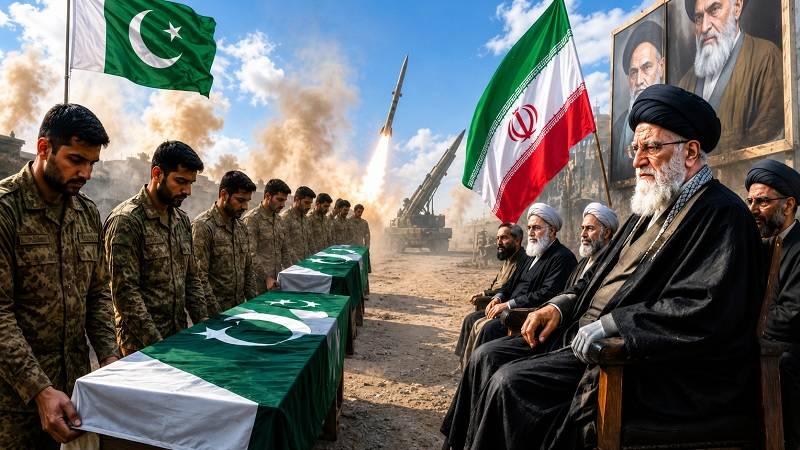
When Houthi missiles once again targeted Saudi Arabia earlier this month, Pakistan reacted with unusual clarity and resolve. Prime Minister Shehbaz Sharif condemned the attacks, reaffirmed Pakistan's support for the Kingdom's security and reiterated Islamabad's longstanding commitment to Saudi Arabia's territorial integrity.
The public statement was followed by an even more consequential revelation. Reuters reported that during the recent Iran-Israel conflict, Pakistan privately conveyed to Tehran that any attack on Saudi Arabia would be treated as an attack on Pakistan. Following Iranian strikes on Saudi energy infrastructure in early April, Islamabad deployed a Pakistan Air Force fighter squadron, thousands of troops and an air defence system. Whether intended primarily as deterrence or preparation, the message was unmistakable: Pakistan was prepared to stand by Riyadh if the conflict widened.
Tehran ultimately chose not to open a new front against Saudi Arabia. Yet the episode exposed something far more significant than military signalling. It revealed a familiar divide within Pakistan itself. While the Pakistani state firmly backed its strategic partner, sections of public opinion openly sided with Iran, even as Tehran's regional policies increasingly conflicted with Pakistan's own security and diplomatic interests. This divide did not emerge overnight. Nor can it be explained simply by sectarian identity. Its origins lie in a political transformation that began nearly half a century ago, and whose consequences continue to shape regional politics and conflicts today.
The 1979 Iranian Revolution fundamentally altered the relationship between religion and politics in the Middle East. Before the revolution, Iran certainly possessed religious influence among Shia communities abroad. The revolution, however, transformed that influence into a transnational political project. Through the doctrine of Wilayat al-Faqih—the Guardianship of the Jurist—Iran presented itself not merely as a nation-state but as the centre of an ideological movement transcending national borders.
The revolution inspired millions across the Muslim world. For many, it represented resistance against dictatorship, foreign intervention and injustice. Yet it also encouraged political loyalties that, in some cases, extended beyond citizenship and national identity. The distinction between religious solidarity and political allegiance gradually became blurred. Pakistan offers one of the clearest illustrations of this phenomenon.
Pakistan and Saudi Arabia had established close strategic ties long before Ayatollah Khomeini returned to Tehran. Their defence cooperation dates back to the 1960s. Pakistani military advisers served in the Kingdom for decades. Saudi Arabia consistently supported Pakistan during economic crises, while millions of Pakistani workers found employment there, making remittances one of Pakistan's most important sources of foreign exchange. Intelligence cooperation, military training and diplomatic coordination became enduring pillars of the relationship.
These ties were never built upon sectarian affinity. They evolved from converging national interests. The Iranian Revolution introduced a different framework altogether. It sought to unite followers around a revolutionary vision that challenged existing regional orders. Over time, Iran developed a network of political and military partners across the Middle East who increasingly viewed Tehran not merely as another capital but as the ideological centre of what later became known as the Axis of Resistance.
Lebanon's Hezbollah became the most successful example of this model. Established with Iranian support during Israel's occupation of southern Lebanon, Hezbollah gradually evolved into a powerful political movement, military force and ideological partner of Tehran. Iraq witnessed the emergence of several armed groups closely aligned with Iran after the fall of Saddam Hussein. In Yemen, the Houthis expanded from a local insurgency into a regional actor with growing Iranian backing. Similar concerns emerged elsewhere, including Bahrain, where governments increasingly viewed domestic political movements through the prism of Iranian influence.
The consequences extended beyond security. The revolution unintentionally politicised Shia identity across much of the region. Communities that had historically participated within their own national political systems increasingly came to be viewed—fairly or unfairly—through the lens of Tehran's revolutionary agenda. Many Arab governments began to suspect political loyalties that had not previously been questioned to the same degree.
This perception often proved unjust to large sections of Shia populations who remained fully loyal to their respective countries. Yet perceptions matter in international politics. Once Iran projected itself as the guardian of a transnational revolutionary movement, governments across the region inevitably began reassessing the political implications of religious affiliation. Pakistan has not been immune to these dynamics. The overwhelming majority of Pakistani Shias have always remained patriotic citizens whose commitment to Pakistan has never been in doubt. Thousands have served with distinction in the armed forces, civil services, academia, business and every sphere of national life. Reducing an entire community to external political influences would therefore be both inaccurate and unfair.
Nevertheless, a small but vocal segment has gradually embraced Iran's revolutionary narrative as part of its own political identity. Events in Iran increasingly generate stronger emotional responses than developments affecting Pakistan's own national interests. Iranian strategic objectives sometimes came to be viewed as Islamic causes transcending state boundaries. This distinction is crucial. Religious solidarity is neither unusual nor objectionable. Muslims everywhere naturally feel concern for fellow Muslims facing war or persecution, just as people of other faiths express solidarity across national borders. Such empathy enriches rather than weakens societies.
Political loyalty is an entirely different matter. Every sovereign state expects the ultimate political loyalty of its citizens. National security, foreign policy and defence cannot function if competing external political centres command equal or greater allegiance. States may tolerate ideological diversity, but they cannot sustain divided political loyalties without undermining their own cohesion. The ongoing war has once again brought this issue into sharp focus.
The distinction between religious solidarity and political allegiance gradually became blurred.
Iran today confronts perhaps its most difficult strategic environment since the revolution. The war with the United States and Israel has exposed vulnerabilities that remained largely concealed for decades. Ayatollah Ali Khamenei and numerous senior military commanders and nuclear scientists were eliminated. Critical military and civilian infrastructure has suffered significant damage.
The United States has shifted its campaign to southern Iran, targeting coastal military infrastructure and IRGC assets to deny Tehran the ability to threaten shipping through the Strait of Hormuz. The campaign has further exposed the limits of Iran's deterrence despite decades of investment in missiles and proxy capabilities.
At the regional level, Tehran's strategic environment has deteriorated even further. Hezbollah has been severely degraded, with much of its senior leadership eliminated and its military capabilities significantly reduced. The fall of the Assad regime and the emergence of Ahmad al-Sharaa have transformed Syria from Iran's closest Arab ally into a state that is increasingly aligned with the Arab world and could actively work to dismantle Iran's remaining regional networks, particularly the supply routes and logistical infrastructure that have long sustained Hezbollah in Lebanon.
In Iraq, the new government under Prime Minister Mohammed Shia al-Sudani is showing increasing determination to bring Iran-backed militias under full state control, further constraining Tehran's influence. Even the Houthis, despite continuing attacks in the Red Sea, are operating under sustained military pressure and growing strategic isolation.
Yet strategic decline has not necessarily weakened revolutionary conviction among Iran's most committed supporters abroad. History often demonstrates the opposite. When ideological movements come under external pressure, dedicated followers frequently become more emotionally invested rather than less. Military setbacks are sometimes interpreted not as policy failures but as evidence that the revolutionary project requires even greater commitment.
Iran's regional strategy has also relied heavily on the Palestinian cause. Support for Palestine has been central to the Islamic Republic's ideological identity since 1979. By placing the Palestinian struggle at the heart of its so-called Axis of Resistance, Tehran sought to present itself as the principal defender of Muslim interests against Israel and the West. This undoubtedly resonated with millions across the Muslim world, including Pakistan, where support for Palestinian self-determination has always enjoyed overwhelming public sympathy.
Yet support for Palestine should not be confused with support for every aspect of Iran's regional strategy. The Palestinian cause belongs to the Palestinians and enjoys support across the Islamic world irrespective of political or sectarian affiliation. It neither requires nor justifies political allegiance to any external state. Conflating the two has often obscured important distinctions between genuine solidarity with an occupied people and endorsement of a broader geopolitical project pursued by Tehran.
Pakistan's position has remained remarkably consistent. It has supported Palestinian statehood, opposed Israeli occupation and consistently voted in favour of Palestinian rights in international forums. At the same time, Pakistan has maintained close strategic relations with Saudi Arabia and other Gulf states while seeking stable and cooperative relations with Iran. This balanced approach reflects Pakistan's national interests rather than ideological preferences. Those interests are enduring.
Saudi Arabia remains one of Pakistan's closest strategic partners. Millions of Pakistanis live and work in the Kingdom. Their remittances contribute billions of dollars annually to Pakistan's economy. Saudi Arabia has repeatedly extended financial assistance during periods of economic distress, invested in Pakistan's development and remained an important security partner. Defence cooperation between the two countries spans several decades, encompassing military training, intelligence cooperation and institutional linkages that long predate the Iranian Revolution.
Iran, by contrast, is undoubtedly an important neighbour with whom Pakistan shares a long border, historical ties and significant economic potential. Peaceful relations with Tehran remain essential for border security, regional connectivity and energy cooperation. Pakistan therefore has every reason to maintain constructive engagement with Iran and avoid unnecessary confrontation. But geography does not erase strategic realities.
Pakistan today faces its gravest security challenge not from the Middle East but from terrorism along its western frontier. Cross-border militancy emanating from Afghanistan has imposed enormous human and economic costs on the Pakistani state. At such a moment, Islamabad requires stable relations with all neighbouring countries while simultaneously preserving its longstanding strategic partnerships elsewhere in the region. Becoming entangled in ideological rivalries that do not advance Pakistan's national interests would serve no useful purpose.
The recent regional crisis demonstrated that the Pakistani state understands this distinction clearly. Islamabad condemned Israeli attacks on Iran while simultaneously making clear that it would honour its security commitments to Saudi Arabia if the Kingdom itself came under attack. Far from being contradictory, these positions reflected a mature foreign policy based on national interest rather than ideological alignment.
But when national interests and external revolutionary projects diverge, the political loyalty of every Pakistani must rest with Pakistan alone.
The public debate inside Pakistan, however, suggested that not everyone shares this perspective. Sections of social media and parts of the political discourse increasingly framed the conflict through ideological rather than national lenses. Iran's military fortunes were discussed not merely as developments affecting a neighbouring country but as victories and defeats personally shared by some Pakistanis. The language employed often suggested an emotional investment in Tehran's strategic objectives that exceeded concern for Pakistan's own foreign policy priorities.
Such sentiments deserve careful reflection, not condemnation. Individuals in every society are free to admire foreign political leaders, revolutions or ideological movements. Democracies accommodate diverse opinions. Citizens may express solidarity with causes abroad and criticise their own governments. These freedoms are integral to open political systems. The question arises only when political loyalty itself becomes transnational.
History offers numerous examples of ideological movements seeking to transcend state boundaries—communism during the Cold War, pan-Arabism under Gamal Abdel Nasser and various revolutionary movements elsewhere. Most ultimately encountered the same limitation: the modern international system remains organised around sovereign states. Governments are accountable to their own citizens, responsible for protecting their own territories and obliged to pursue their own national interests. No ideology has fundamentally displaced this reality. The Iranian revolutionary project is no exception.
Nearly five decades after 1979, Iran undoubtedly retains influence across parts of the Middle East. Yet its regional reach has contracted significantly as military setbacks, the loss of key allies and growing pressure on its proxy network have narrowed Tehran's strategic space. Its economy continues to struggle under sanctions and structural weaknesses, further limiting its ability to project power. Ironically, as Iran's external strategic space has narrowed, emotional attachment among some of its ideological supporters abroad appears to have intensified. Strategic setbacks often reinforce rather than diminish ideological conviction among committed believers. Yet emotional commitment cannot alter geopolitical realities.
For Pakistan, the lesson is straightforward. The country's foreign policy must continue to be guided by Pakistan's own interests. That means maintaining cordial and stable relations with Iran as an important neighbour while preserving and strengthening the strategic partnership with Saudi Arabia and other Gulf states. It means supporting the legitimate rights of the Palestinian people without becoming a participant in regional ideological confrontations. Above all, it means ensuring that Pakistan's domestic political discourse remains anchored in Pakistan's own security, prosperity and sovereignty.
The Iranian Revolution will remain one of the defining political events of the modern Middle East. It reshaped regional politics, inspired millions and profoundly influenced the strategic landscape. But its legacy also includes the emergence of political loyalties that sometimes transcend national boundaries and complicate the relationship between ideology and citizenship.
Every nation ultimately confronts the same question: where should political loyalty reside? For Pakistan, the answer should be unequivocal. Citizens may admire foreign revolutions, sympathise with distant struggles and hold diverse ideological beliefs. These are matters of personal conviction. But when national interests and external revolutionary projects diverge, the political loyalty of every Pakistani must rest with Pakistan alone. That is not merely sound statecraft. It is the essence of national sovereignty.