

In 1975, Karachi hosted a major conference on Sindh’s history, an event championed by Prime Minister Zulfikar Ali Bhutto. As a Sindhi himself, Bhutto saw the conference as a cornerstone of a policy shift his administration had been developing since 1972.
The regime’s strategy was born from the trauma of 1971, when East Pakistan seceded following a surge in Bengali nationalism. To prevent further fragmentation, the government sought to strengthen Pakistani federalism through a state-sponsored appropriation of ethnic identities.
The plan aimed to neutralise separatist ethnic movements by absorbing their symbols into a broader national framework. The government intended to take distinct cultural expressions from the Sindhi, Baloch, and Pakhtun communities and recontextualise them as parts of a unified Pakistani identity. Since Punjab already held political and economic dominance, the state viewed Punjabi regionalism as a non-threat. By adopting non-Punjabi ethnic narratives into the official state discourse, the regime hoped to strip these of their separatist tendencies.
Sindh served as the primary testing ground for this experiment in political and cultural engineering. GM Syed, a prominent Sindhi nationalist ideologue, emerged as a leading antagonist to Zulfikar Ali Bhutto and the Pakistan Peoples Party (PPP) in Sindh. The tension peaked in 1972 when Syed formally demanded Sindh’s secession from Pakistan.
To counter this separatist momentum, the Bhutto administration implemented two major strategic concessions designed to integrate Sindhis into the state fabric:
- The government opened up significant employment opportunities for Sindhis within federal and provincial government institutions
- The Sindhi language was made a compulsory subject in schools across Sindh, addressing a core grievance regarding cultural identity
Through these measures, the regime aimed to undercut Syed’s nationalist appeal by proving that Sindhi interests could be protected within the Pakistani federation. The Bhutto administration further extended its strategy by co-opting Sindh’s ‘Sufi heritage’ and the ‘pluralistic character of its people.’ Ironically, this narrative was originally crafted by Sindhi nationalists. The regime effectively distilled it, stripping it of its separatist leanings and integrating it into the broader framework of Pakistani nationalism.
In an earlier era, the right-wing Urdu press claimed that ‘Punjabiyat’ was being used by Punjabi leftists as a way to undermine Islam in Pakistan
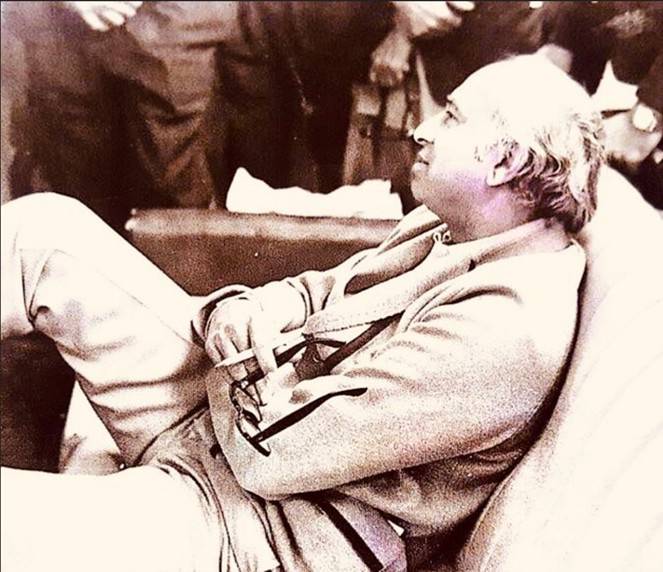
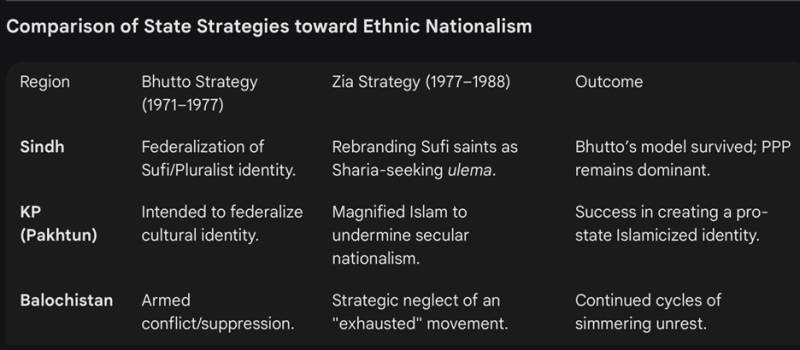
While Bhutto intended to apply this same federalising model to Pakhtun and Baloch nationalisms as well, his efforts were cut short by General Zia-ul-Haq’s 1977 military coup. Zia replaced Bhutto’s cultural federalism with a rigid ‘Political Islam,’ a doctrine that had been gaining traction within the military since the loss of East Pakistan in 1971. Zia’s approach to neutralising ethnic nationalisms varied by region.
He magnified the ‘Islamic’ elements of Pakhtun culture to suppress the culture’s more secular manifestations. This successfully created a pro-state, Islamised Pakhtun identity, but one which, in the coming decades, would mutate and become fodder for anti-state Islamist militancy. Following a grueling armed conflict with the Bhutto regime in the 1970s, Zia left Baloch nationalism to simmer, as the state viewed it as temporarily exhausted.
In Sindh, Zia attempted to rewrite Bhutto’s narrative. He sought to relabel Sindhi folk heroes and Sufi saints as ‘ulema’ (religious scholars) who supposedly campaigned for a Sharia-based state. But Zia’s attempt to Islamise Sindhi identity largely failed. Bhutto’s version of a federalised Sindhi nationalism remained the dominant political/cultural ethos in the province.
By 2008, as the PPP began to lose its electoral foothold in Punjab, the party Chairperson Asif Ali Zardari pivoted the party's core strategy. He placed Bhutto’s distilled Sindhi nationalism at the centre of the party’s platform. By combining focused economic initiatives with this federalised Sindhi ethnic identity, the PPP successfully established an enduring electoral hegemony within the province outside its capital Karachi.
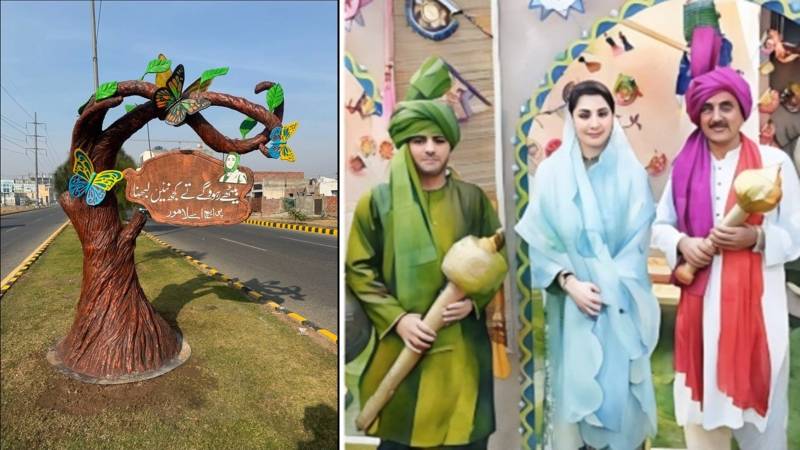
In a significant shift for Pakistan’s largest province, Punjab’s current Chief Minister, Maryam Nawaz Sharif of the Pakistan Muslim League-Nawaz (PML-N), announced that the Punjabi language will become a mandatory subject in all provincial schools.
This move highlights a strategic pivot in the political landscape of Punjab, which holds the majority of seats in the National Assembly. While the PML-N was historically challenged by the PPP in this region, since 2013, the primary threat to their dominance has been Imran Khan’s populist Pakistan Tehreek-i-Insaf (PTI).
The concept of Punjabi nationalism, often referred to as ‘Punjabiyat,’ has traditionally been a subtle element of the PML-N’s identity, but it has surfaced aggressively at key historical moments.
During the 1988 elections, Nawaz Sharif (Maryam’s father) openly weaponised regional identity. He portrayed the PPP as a strictly ‘Sindhi party,’ arguing that while Punjabis were inclusive enough to vote for the Sindhi Bhuttos, Sindhis remained unwilling to support Punjabi Sharifs.
This tactic was not without controversy. Hanif Ramay, a Punjabi intellectual and founding member of the PPP, famously condemned Sharif’s rhetoric as a "vulgar expression" of ethnic politics. However, ironically, in the 1980s, it was Hanif Ramay who had emerged as a fervent advocate for ‘Punjabiyat,’ a concept he framed as a progressive identity rooted in Punjab’s Sufi heritage.
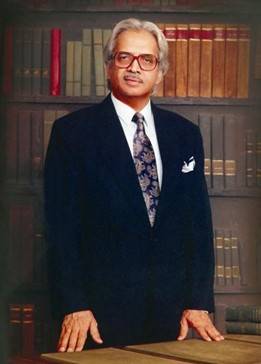
Ramay argued that Punjab’s cultural traditions and the Punjabi language had been systematically marginalised, first under British colonial rule and later by the state's promotion of Urdu. The intellectual roots of this narrative stretched back several decades, though. In the 1950s, a Punjabi Cultural Council was formed to lobby for Punjabi as a subject in schools, though the effort was ultimately unsuccessful.
According to linguist Tariq Rahman, the ‘Punjabi language movement’ expanded rapidly during the 1960s. Much like other ethnic movements in the country, it too adopted a leftist/progressive orientation, leading to friction with the state. In the 1980s, during the Zia dictatorship, the movement shifted from a cultural endeavour to an overtly political one.
A pivotal moment occurred in 1985 when 139 scholars and intellectuals signed a formal charter. Their demands were groundbreaking for the time:
- They insisted that the Punjabi language and literature be taught in all provincial schools.
- Crucially, they demanded the inclusion of Punjabi literature produced by non-Muslims, specifically the Sikh community, to preserve the holistic history of the region.
By advocating for these changes, the movement sought to reclaim a regional identity that had been suppressed in favour of a monolithic national narrative. Obviously, this did not go down well with the Zia regime.
The scholars of the movement advised that it should ally itself with working-class Punjabis, because the Punjabi elites and middle-class Punjabis had shunned Punjabi language and culture. The right-wing Urdu press claimed that ‘Punjabiyat’ was being used by Punjabi leftists as a way to undermine Islam in Pakistan.
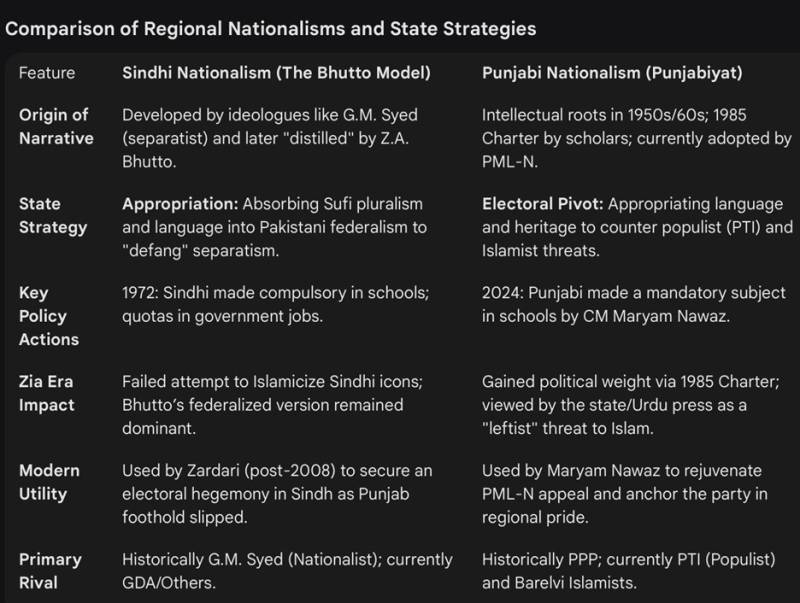
Sindhi nationalism that was distilled by Bhutto and then placed in the context of Pakistani federalism went a long way in aiding the PPP to develop an almost monopolistic electoral supremacy in Sindh. When Maryam became CM Punjab in 2024, PML-N’s hold in Punjab was weakening. So one can conclude that the party might now be trying to rejuvenate its appeal in Punjab by a combination of economic initiatives and the appropriation of Punjabi nationalism.
However, Punjabi nationalism was never separatist. What Zardari and the PPP did with ZA Bhutto’s federalised Sindhi nationalism, PML-N too, is shaping Punjabi nationalism as an electoral ploy. Ethnic nationalisms in Pakistan were inherently progressive, as demonstrated by the case of even the distilled Sindhi nationalism. Such variants have the ability to merge seamlessly with Pakistani federalism. They can also deter radical religious and political threats.
By mandating the Punjabi language in schools, Maryam appears to be formalising a more structured version of Punjabi identity. This mirrors the ‘Bhutto model’ used in Sindh, attempting to anchor PML-N’s electoral base in a distinct regional pride to counter the populist appeal of the PTI, even though the appeal seems to be gradually waning in the province.
At the time of Maryam’s appointment as CM, PML-N had found itself cornered in Punjab by the PTI from one side, and by Barelvi Islamists from the other. Applying the Punjabi nationalist card may turn out to be a sound political ploy by Maryam.