

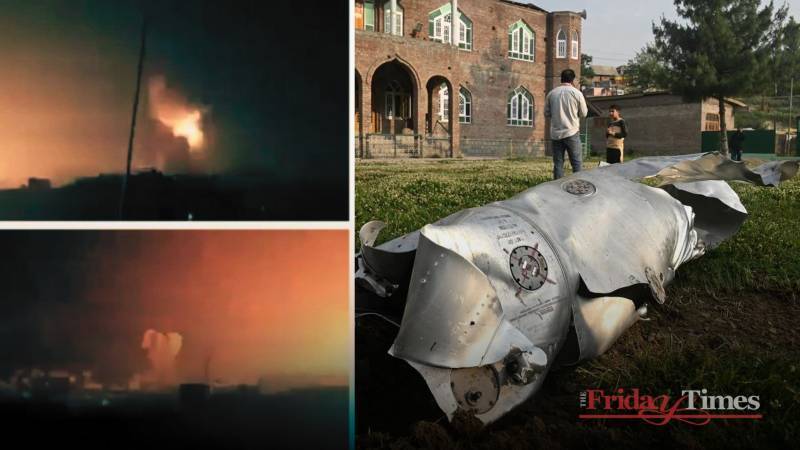
Pakistan and India have been pulled back from a big catastrophe. Apparently, President Donald Trump saved India from further strategic degradation. At this stage, it is immaterial to speculate who sought his active intervention and who had an edge over whom in the lethal exchanges or who was right or wrong in the war. The war is won by none but those who survive. “War does not determine who is right – only who is left”, Bertrand Russell warned his fellow Europeans. F.S. Aijazuddin rightly says that India’s true enemy is not Pakistan: it is hubris, the arrogance of a born bully. Born bully -yes. Nehru saw India as the successor of the British Empire and wanted all peripheral countries to form part of an Indian confederation. India has bullied all the South Asian countries except for Pakistan into submission to its hegemonic will.
With the transformation of the Bharatiya Junta Party as the ideological flag bearer of Rashtriya Swayamsevak Sangh (RSS), the arrogance of the Indian ruling class has skyrocketed, with Narendra Modi masquerading as a strong bulwark against Pakistan, perceiving its involvement in every terrorist act within his country. He eschewed investigation in both the Pulwama and Pahalgam events without an iota of evidence. In 2019, he wanted to win a second term for himself. This time around, he obviously had no justification to push the two countries to the hair-edge of catastrophe as the legislative elections in Bihar are many months away.
Did Mr. Modi and his jittery Minister for External Affairs, Jaishankar, miscalculate the war-worthiness of Pakistan being economically and financially in a straitjacket, politically divided, and faced with acute security challenges from the Indian-supported BLA and TTP, and choose to push it to speedy disintegration at the behest of some hostile powers? Also, speculations abound that this was a sinister Hindu-Jew plan, known to the Trump administration, to destroy the military power of Pakistan and force it into surrendering its Nukes. The Indian Defence Minister’s recent lament imparts credence to these speculations.
India, grappling with several secessionist movements, cannot blame Pakistan for every terrorist act within its territory, throwing 1.8 billion people into the flames of war
Their Rafale, SU-30, and MIG-29 Jets and Israeli drones would have played havoc with our strategic facilities were we not in the possession of JF-17, J-10C, PL-15, and technological capacity to blind, jam, and seize or bring down their birds. It was not a traditional dogfight in the skies to the taste of Laborites. It was a silent battlefield of cyber-powered forces monitored by Pakistan Air Force Chief Air Marshal Zaheer Ahmed Babar Sidhu himself. He was not worried over the 72 or 80 Indian Air Force planes clouding our skies. He was fully focused on the processing data from a web of assets, including ‘spy satellites, early warning radars and jamming systems - all feeding into our National Intelligence, Surveillance, Reconnaissance and Integrated Air Operations Centre’ to enhance the capacity of our 42 Jets. This is how his Eagles stunned the world's strategic planners, downing 6 IAF planes.
The post-ceasefire speech of Prime Minister Narendra Modi has dashed all hopes for peace and good neighborliness. “War has been paused and not ended; they have established a new normal against terrorism; there will be no talks outside terrorism and the Jammu and Kashmir occupied by Pakistan; terrorism and peace, terrorism and trade cannot go together; water and blood cannot flow together”. Earlier, the Indian Minister for External Affairs and Foreign Secretary carefully avoided referring to any foreign intervention for the ceasefire. The latter naively credited the Director General (Military Operations) of Pakistan with the initiative of bringing about the ceasefire. The Indian leaders have not so far admitted the US role in a ceasefire.
Notwithstanding the Indian leader’s belligerent, hostile, and bullish statements, Pakistan has a clear stance on the post-ceasefire talks, if any. Consistent with its historic stance, Pakistan would like the proposed talks to focus on the core dispute of Jammu and Kashmir, terrorism, the Indus Water Treaty, and trade. The ever-festering Jammu and Kashmir issue has been the root cause of all the past wars and military conflicts. It has been resurrected as an international issue. It needs to be resolved in accordance with the UN Security Council resolutions. The people of Kashmir deserve to have self-determination.
Terrorism is an international phenomenon. Pakistan has faced more terrorist attacks and lost more human lives. Both countries blame each other for aiding and abetting terrorist groups within their territory. Would the two nuclear neighbors remain hostage to the agenda of terrorists squandering their scarce resources on military preparations and plunging their populations into further depths of poverty? ‘The event of Pahalgam on 22 April, as put it by F.S. Aijazuddin, has a sinister precedent in history. In February 1933, Hitler had used the Reichstag fire to blame the communists, releasing Nazism. In 2025, Prime Minister Modi (with an equal lack of evidentiary justification) blamed Pakistan for Pahalgam. And now he says he has established a new normal to stem terrorism. India, grappling with several secessionist movements, cannot blame Pakistan for every terrorist act within its territory, throwing 1.8 billion people into the flames of war.
No doubt, water and blood cannot flow together. Pakistan, consistent with international law, conventions, and norms, has always respected International Treaties, including the Indus Water Treaty. India violated it by constructing three dams on River Chenab; it stalled the regular meetings of water commissioners and other institutional forums functioning under IWT which too has a historic precedent from 1923 – worthy of emulation - on the distribution of waters among the 9 high riparian states including Tanzania, Uganda, Kenya, Rwanda, Burundi, Ethiopia, Eretria, South Sudan and two low riparian states - Sudan and Egypt - with a permanent commission of water experts to avoid any accidental flare-up. The Egyptian President Hosni Mubarak had threatened Ethiopia with war when the latter announced plans to construct a dam on the River Nile in 1984.
Narendra Modi cannot kill 250 million people by stopping their water. He would be better advised to begin talks on IWT to examine each other’s reservations.