

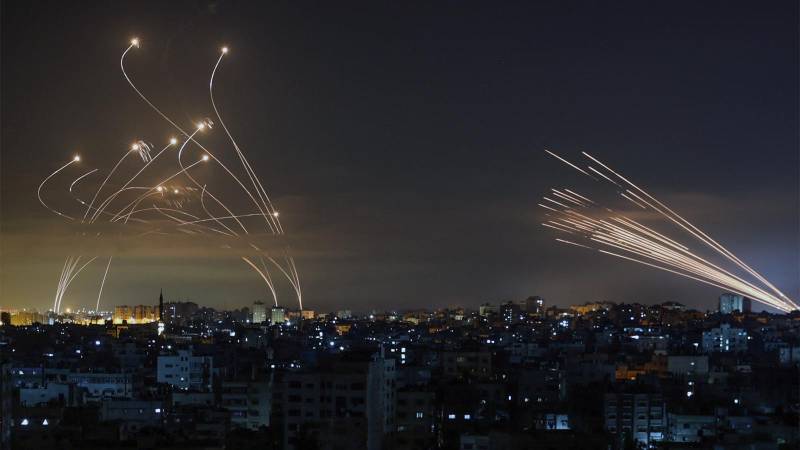
The apparent success of the Israeli so-called defensive system, the “Iron Dome”, in the recent Israel–Iran conflict has unnecessarily convinced many security analysts—including United States President Donald Trump—of the need to develop their own version of the Iron Dome. This has been dubbed the “Golden Dome”.
For example, Matthew Kroenig, an American security analyst and a member of the recent Congressional Commission on the Strategic Posture of the United States, argued that “for decades, critics have argued that missile defences do not work, but the facts have changed. Missile defence technology has greatly improved in recent years.”
Kroenig further asserted, “The world has witnessed the remarkable success of Israel's Iron Dome system, which successfully defended Israel against massive Iranian salvos of missiles and drones.”
Reflecting this sentiment, Trump signed an executive order titled “The Iron Dome for America”, announcing a next-generation missile defence shield to protect all US territory against potential adversary attacks. He had already stated in January 2025, “Ronald Reagan wanted to do it many years ago… We didn’t have the technology then… Now we have phenomenal technology. You see that with Israel, where out of 319 rockets they knocked down just about every one of them. So, I think the United States is entitled to that.”
However, there are several plausible factors why serious strategic thinkers remain unconvinced by such an imperative.
First, the geographical area of Israel is small enough to be protected by a layered combination of deployed defensive systems.
Second, Iran’s missiles had to traverse vast areas, including multiple countries and parts of its own territory, before reaching their targets.
Third, in the defence of Israeli territory, the United States and its allies played a significant role in intercepting incoming Iranian missiles, even before they reached Israeli defences.
Finally, most of Iran’s offensive missiles were relatively slow and weak in trajectory, with only a few possessing hypersonic capability that could challenge Israeli systems.
Many security analysts have warned of a false sense of security when it comes to ballistic missile defence systems, especially against more sophisticated, long-range, nuclear-capable missiles. Offensive countermeasures, such as hypersonic weapons and Multiple Independently Targetable Re-entry Vehicles (MIRVs), can penetrate even the most advanced deployed defensive systems. Crucially, such systems have not yet been tested in real time against these emerging threats.
India may be able to protect select parts of its territory, but it remains implausible that it could shield the entire country, despite its investments in costly defensive infrastructure
Even if defensive systems achieve a high interception rate, say 90 percent, the remaining 10 percent of incoming long-range, nuclear-capable missiles successfully striking their targets would be strategically unacceptable. From a strategic calculus perspective, the offence–defence framework suggests that offensive systems are cheaper and more effective than defensive ones. In this regard, the defence remains both weaker and costlier.
Since the United States' withdrawal from the 1972 Anti-Ballistic Missile (ABM) Treaty in 2002, it has continued to invest billions of dollars in the development and deployment of ballistic missile defence systems. However, these systems have not yet been tested under real-time conditions against highly sophisticated offensive countermeasures, which are explicitly designed to defeat them.
With increasing economic capabilities, countries such as the United States, India, and Israel have been pursuing expensive strategic ventures aimed at acquiring both a “shield” to protect themselves and a “sword” to strike their adversaries.
Such developments have several strategic implications.
First, they risk accelerating arms races, increasing crisis instability, and raising the chances of conflict escalation.
Second, countries possessing defensive systems may undergo doctrinal shifts in force posture. This could lead to a temptation to strike first, emboldened by misplaced confidence in the protective shield, thereby increasing the risk of miscalculation and escalation.
Third, adversaries whose second-strike capability is perceived to be undermined may feel compelled to develop more potent offensive capabilities designed to penetrate or overwhelm defensive systems.
For instance, neither China nor Russia is convinced by the US justification that its withdrawal from the ABM Treaty and subsequent missile defence developments are aimed solely at countering threats from non-state actors. Both countries are believed to have developed advanced offensive systems and countermeasures specifically designed to defeat American and allied missile defences.
A similar dynamic is visible in South Asia. Pakistan has already developed sophisticated countermeasures—emphasising speed, range, penetrability, and lethality to defeat India’s deployed missile defence systems. While India may be able to protect select parts of its territory, it remains implausible that it could shield the entire country, despite its investments in costly defensive infrastructure.
This dilemma is likely to extend to other states aspiring to develop or procure missile defence systems. For every new technology, there emerges a counter-technology. Nuclear-armed states with limited economic resources may opt to invest in effective offensive systems specifically designed to neutralise their adversaries’ defensive capabilities.
In sum, it is not a viable long-term strategy to continuously invest in expensive missile defence systems that may never fully protect a country’s territory. Instead, such systems may place direct strategic pressure on adversaries to develop powerful countermeasures, fueling a spiralling arms race.
Unless some form of strategic restraint regime is institutionalised to discuss, manage, and ultimately resolve such issues—the fallacy of relying on ballistic missile defence systems will persist. Only through meaningful dialogue and strategic stability frameworks can rivals hope to reduce risks and avoid catastrophic miscalculation.