

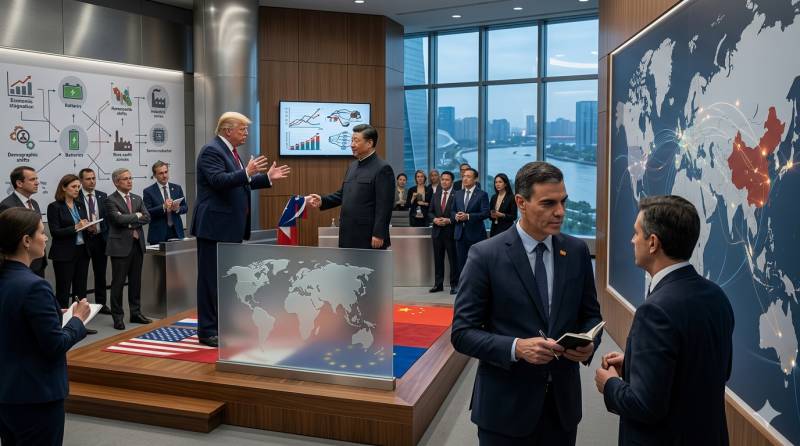
Spanish Prime Minister Pedro Sánchez’s diplomatic balancing act during his visit to China last month exposed a growing tension within the European Union, struggling to respond to geopolitical fragmentation and economic stagnation. According to Wang Hanyi, a research fellow at Shanghai International Studies University, the Spanish leader “achieved a delicate equilibrium between high-level strategic rhetoric and pragmatic cooperation.”
“The equilibrium provides a viable blueprint for European countries navigating their ties with China,” Wang argued. Yet critics dismiss Spain’s approach as little more than a “compliment sandwich” praise wrapped around selective criticism unlikely to alter Beijing’s strategic behaviour.
That debate has now collided with a far larger geopolitical drama. When U.S. President Donald Trump arrived in Beijing this week for talks with Xi Jinping, he framed the encounter in stark civilisational terms: “We’re the two superpowers.” Xi responded with a warning about the Thucydides Trap, the historical tendency toward confrontation when an emerging power threatens an established one. Watching from the margins, Europe fears strategic irrelevance once again.
This would not be Europe’s first descent from the centre of world politics. The Cold War reduced the continent to a frontline theatre between Washington and Moscow. Today, the rivalry between the United States and China risks marginalising Europe economically rather than militarily.
Rare earth minerals and battery technologies have become the strategic assets of the twenty-first century, much as nuclear arsenals were during the twentieth. China controls the overwhelming share of global rare earth processing capacity and dominates key segments of Europe’s battery supply chain. Brussels seeks access to these resources, yet Trump’s preference for bilateral transactional deals raises fears that Europe could once again find itself bypassed by the very alliance system it helped build.
For decades, the Western world believed democracy was not only a moral ideal but also the engine of modern progress. The expansion of liberal economic systems was presented as an inclusive global project: markets, technology, and prosperity would spread together, gradually uplifting societies across the world. Democracy became both a domestic political structure and a diplomatic narrative.
Three major powers, China, Russia, and Iran, are pursuing models of progress that do not rely on liberal democratic frameworks
The model delivered undeniable successes, helping countries from Singapore to India emerge as major economic powers. Yet globalisation also produced an unintended consequence: the diffusion of industrial and technological capacity weakened the relative dominance of the very Western economies that had designed the system.
China fundamentally disrupted the assumption that democratic governance was a prerequisite for economic modernity. Unlike the West, Beijing did not attempt to universalise its political model or market ideology as a moral mission. Instead, it embedded itself deeply within global supply chains, mastered industrial scale, and became indispensable to multinational corporations.
China did not persuade the world through ideology; it supplied products, infrastructure, and manufacturing capabilities that the world could not function without. In doing so, Beijing challenged one of the central intellectual assumptions of the post-Cold War order: that economic progress would inevitably lead towards Western-style political liberalisation.
The contrast with the former Soviet Union is striking. Moscow’s model relied heavily on ideology, presenting itself as the liberator of the global working class. But revolutionary rhetoric failed to compensate for economic inefficiency, shortages, and bureaucratic stagnation. China drew a different lesson from that collapse. Pragmatism replaced ideological rigidity; integration replaced isolation. Through special economic zones and entry into the World Trade Organization, Beijing modernised while avoiding many of the structural burdens that had crippled the Soviet system. Hundreds of millions were lifted out of poverty without political liberalisation accompanying economic expansion.
Iran presents yet another variation of non-democratic modernisation. Its theological state structure depends on ideological cohesion rather than electoral legitimacy, yet it has demonstrated notable technological and military resilience during the recent United States–Iran confrontation.
At the same time, Iran has permitted substantial female participation in higher education and professional sectors, provided activity remains within the ideological boundaries of the constitutional system.
Unlike China, Iran remains largely excluded from Western capital networks and financial integration, but it nevertheless challenges the argument that only liberal democracies are capable of scientific, technological, or institutional advancement.
This leaves the West facing a profound strategic dilemma. Containment of rivals risks economic self-harm, while coexistence risks the gradual erosion of Western influence. Unlike the Cold War, there is no clear ideological battlefield with a definitive path to victory.
The struggle is increasingly centred on supply chains, industrial dependency, financial systems, technological ecosystems, and control over strategic resources. Europe’s greatest fear is not military conquest but geopolitical irrelevance, becoming a spectator to history for the second time in a century.
Today, three major powers, China, Russia, and Iran, are pursuing models of progress that do not rely on liberal democratic frameworks. If these systems continue to consolidate technological, economic, or military strength in the coming decades, the assumptions underlying the global human rights movement will face increasing pressure.
Political activists advocating freedoms, participatory governance, and civil liberties may find themselves operating in a world where power and prosperity are no longer seen as naturally linked to democratic norms. The emerging international order may not abolish democratic ideals, but it could force them into coexistence with alternative political models that claim legitimacy through performance, stability, and strategic endurance rather than electoral representation alone.