

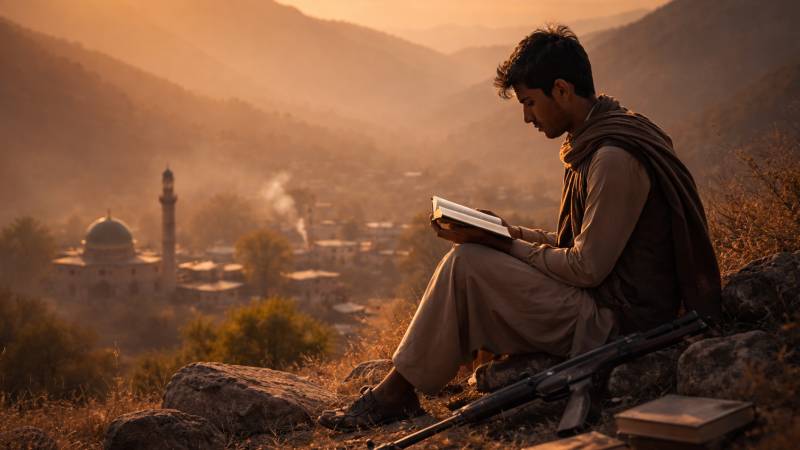
This is a true story. By reading it, you will come to understand how various factors combine to push our youth toward terrorism and religious extremism. In this story, instead of using our character's real name, we will refer to him by his childhood nickname, “Hill Child.”
He was still a child when his grandmother taught him to say prayers. Once he learned to say prayers, he became so devoted that he would reach the mosque at two in the morning for the dawn prayer. In the freezing cold of January, when water in the mosque’s washrooms would be frozen solid, the Hill Child would break the ice, perform his ablution, and then pray.
Not only this, but even in the forest, he would wash with snow, call people to prayer, and then lead the prayer. At such a young age, he became so religious that people in the neighbourhood began calling him “Pir Sahib.” Up to this point, everything was perfectly fine. However, when the preachers of the local missionary group, Tableeghi Jamaat, noticed this holiness in him, they encouraged him to join them in their daily afternoon visits and to invite those who did not pray to come to the mosque.
Under their influence, the Hill Child began reading aloud to people from a book called Fazail-e-Amaal after the afternoon and evening prayers. This book, once part of the missionary lessons, was available in Pashto translation. This was his first experience not only with written Pashto but also with any book outside the regular school textbooks.
The Hill Child came to regard this book as the most sacred after the Holy Qur’an.
Under the influence of these simple and sincere preachers, the Hill Child began going on preaching trips lasting three to ten days and continued attending yearly and regional meetings of the preaching group.
In the main village of his area, there were three large mosques. Two of which this group called bid’ati, or “deviant.” The third mosque was the place where weekly plans for preaching trips were made. This mosque actively spread what it called the “true religion” and often invited scholars from other areas, such as Panch Pir in Swabi.
Because of a religious decision that Friday prayers in his own village were “invalid,” the Hill Child would go to this Deobandi mosque every Friday. After the prayer, he would sit for hours listening to lessons. Among the missionary group, these lessons meant reading hadiths from Fazail-e-Amaal after prayers.
When he topped his school and region in the matriculation examination, his reputation spread among student religious organisations such as Jamaat-e-Talaba-e-Islam (JTI) and Islami Jamiat-e-Talaba (IJT), which approached him for ideological guidance
The Hill Child deeply desired that one day he, too, would be able to deliver such teachings in that central mosque. Eventually, that day came, and he began reading hadiths from Fazail-e-Amaal to others in what he considered the mosque of the “true and great Muslims.”
While still in the eighth grade, he had already decided to remove “false beliefs” from the world. Since there were strong, and often angry and even violent disagreements among the followers of the three mosques over issues such as whether making supplication after Sunnah prayers was permissible or not; whether it was obligatory to keep trousers above the ankles; and whether reciting the Qur’an collectively for the deceased was permissible; and many other such “serious” matters, the Hill Child, influenced by this environment, began to see those from the “old sect” as polytheists. He would argue with village elders, calling them ignorant, heretics, and polytheists.
When he reached the ninth grade, he developed a strong love for the inspiring Islamic poetry of Allama Iqbal. He would stick Iqbal’s famous picture, which shows him as a heroic figure with a falcon on his shoulder, on all his books. He memorised Shikwa and Jawab-e-Shikwa and even started writing poetry in Iqbal’s style and rhythm. He became so fascinated with the idea of the Shaheen (eagle) that he began to see himself as Iqbal’s Shaheen.
By the time he finished intermediate studies, he had joined the Iqbal Academy Lahore, which regularly sent him books about Iqbal and other scholars. Sometimes, he also read Tafheem-ul-Qur’an and Maarif-ul-Qur’an. He would receive the magazine Tarjuman-ul-Qur’an from senior members of Jamaat-e-Islami and try to understand it, though he often felt frustrated by its difficult Urdu.
During college, he stayed loosely connected with student groups of these religious organisations, but because of his unique language background and difficulty in speaking Pashto well, these relationships never became close. Because of this, he avoided socialising and preferred solitude.
By this time, he had become capable of leading prayers in his neighbourhood mosque. However, when someone addressed him as “Mullah” (a local word for cleric), he disliked it, even though he performed all the duties of one.
When he topped his school and region in the matriculation examination, his reputation spread among student religious organisations such as Jamaat-e-Talaba-e-Islam (JTI) and Islami Jamiat-e-Talaba (IJT), which approached him for ideological guidance.
For some time, he stayed a member of both groups. However, what deeply upset him during this time was his father’s poverty and the shame that came with it. He hoped for a day when his father would be known and respected in his area.
He believed that in our country, studying on your own is often more helpful than formal education because it teaches you to ask questions without fear of being punished
To reach this goal, he not only studied but also worked hard alongside his father in the fields, fully aware of the financial difficulties around him. His father was a tenant farmer with very little land of his own, often farming others’ land on lease. Being a peasant also weighed heavily on the Hill Child.
Under such circumstances, continuing education seemed nearly impossible. Yet his father did not give up. He arranged the necessary funds and allowed him to enrol in a college located 70 kilometres away.
Before finishing his first year of intermediate, however, he was attacked by a local bully and his relatives. The conflict lasted for a month, making him feel even more socially inferior and unfairly treated. After completing intermediate studies, the Hill Child began teaching at a private school for a monthly salary of nine hundred rupees.
During this time, he became friends with a local leader of Jamaat-e-Islami, who was fairly well educated. This person, with a dramatic style like the Urdu Islamic novelist Naseem Hijazi, would give speeches on different issues and talk about the “glorious” history of the party.
This local Amir had the first computer in the area and sometimes showed videos of claimed attacks against Muslims in places like East Timor and Palestine. He also showed videos of protests during Atal Bihari Vajpayee’s visit to Lahore, where activists faced police violence.
Around this time, the movement led by Sufi Muhammad—Tehreek-e-Nafaz-e-Shariat-e-Mohammadi—was growing stronger. Influenced by this, the Hill Child and his friends founded a group called Anjuman Jan Nisarān-e-Islam, i.e. Association of Devotees of Islam, aiming to address social evils.
Satellite TV dishes had also started appearing in the area, which this association saw as a “moral evil.” Their group tried to stop this trend but failed.
At that time, he remained in contact with both the missionary group and the Deobandi mosque. He wanted to reach the highest level of faith by actively fighting evil, even by using force if needed.
The movement of Sufi Muhammad gave him the perfect chance. The Hill Child became an active member, attended rallies, and eventually took up arms when the movement launched an armed struggle in Malakand and Swat. However, the government soon crushed the movement, leaving him and others disappointed and angry.
Life, however, continued.
Teaching in private schools paid little but kept his desire to learn alive, especially to master English. As an English teacher, he had to study many books, which slowly broadened his thinking. He produced simplified versions of literary works, including stories by William Shakespeare adapted by Charles Lamb and novels like Great Expectations and David Copperfield by Charles Dickens.
While students may not have gained much, the teacher certainly did. This experience helped him keep learning on his own.
He continued his studies, completing his Bachelor’s degree and later pursuing a Master’s in English Literature as a private student. During this time, he read the works of Bertrand Russell, which deeply affected him and changed his view of the world. This book is part of the Master’s in English course, but most English departments in Pakistan at that time did not teach it, as the examination could be passed through very selective readings.
Later, he discovered the works of Ali Abbas Jalalpuri, which introduced him to Western philosophy. He went on to read Russell’s History of Western Philosophy and Will Durant’s The Story of Philosophy and The Pleasures of Philosophy.
This marked the beginning of a deep transformation.
Gradually, his friends and students joined him on this learning journey. They started collecting books, often from scrap markets, and filling their shelves.
After a long time, I met Hill Child again at a private meeting. It was a pleasant surprise to see how confident he had become. Looking back on his journey, he said independent reading was the turning point of his life.
He believed that in our country, studying on your own is often more helpful than formal education because it teaches you to ask questions without fear of being punished.
Before parting, I asked him what he believed was most necessary to rescue Pakistan’s youth from intellectual confusion.
He replied:
“There is no formula, but the most urgent need is independent reading.”
Yet his journey is both interesting and deeply painful. He is still involved in a learning struggle. His love for reading has not lessened, but daily bread-and-butter problems have forced him into work that does not suit his nature. He keeps reading in many areas, never sticking to just one field.
He drinks from every spring, but his thirst remains unquenched.