

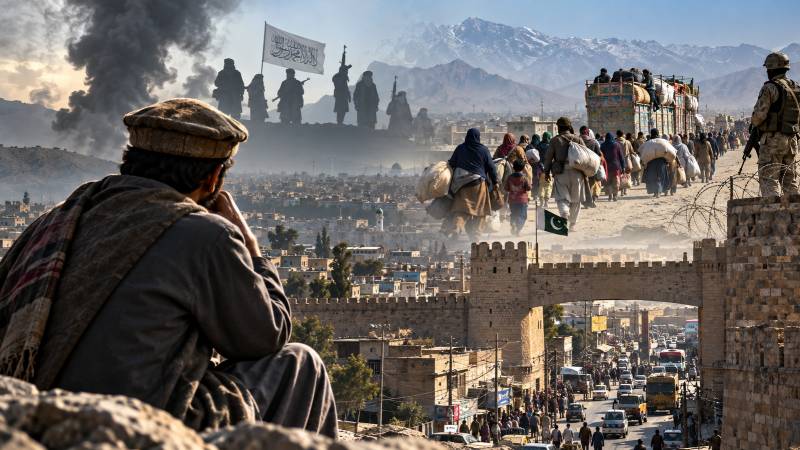
Forty-five years of one Afghan policy, seventy-nine years of emergencies, operations and declared traitors. It is time the decisions came home to those who answer for them. In December 1979 Soviet forces crossed into Afghanistan. We hosted more than three million refugees and became the conduit of a war whose weapons and narcotics stayed with us. In the 1990s we were one of three states to recognise the Taliban. After 2001 we joined a war against the movement we had recognised while hoping to keep it in reserve. In August 2021 much of our public life hailed the fall of Kabul as a triumph. Within two years violence in Khyber Pakhtunkhwa was at a decade’s high, and we had begun expelling Afghans born and schooled here.
Through all of this governments rose and fell. One thing did not change: where the Afghan file was held and where it was decided. Prime ministers inherited the policy; they did not make it. Parliament was briefed, when it was briefed, after the event. I make no accusation of bad faith; many who carried this policy paid for it with their lives. But a policy held in the same hands for forty-five years must be judged by its results, not its intentions. A mistake repeated for forty-five years is no longer a mistake. It is a doctrine.
Either the control of that policy changes, or at the very least it is debated openly, its lapses are examined and corrected, and its decisions are taken where the Constitution places them. Under Article 90 the executive authority of the Federation vests in the Federal Government; under Article 91(6) the Cabinet is collectively answerable to the Parliament. Can any institution that has held the pen on this policy for four decades escape accountability when the outcome is the same, or worse? I do not think the Constitution allows it. Nor is the Afghan file an aberration. It belongs to an older habit of deciding for the provinces and their people, and calling it national security.
On 11 October that habit returned to Peshawar. Accusing the elected provincial government of deliberately disengaging from the fight against terrorism, the federal cabinet secured an emergency under Article 232 and Governor’s Rule under Article 234. It is the province’s fourth Governor’s Rule, after 1975, 1994 and 1999. In 1975 the Frontier’s leading party was dissolved for acting against the sovereignty and integrity of Pakistan (PLD 1976 SC 57), in years when Kabul was pressing its Pakhtunistan claim. Half a century later the province’s most popular party stands accused of softness on militancy and of seeking its own channel to Kabul. The diagnosis has not changed in fifty years. Neither has the remedy.
Yet the Afghan policy that produced today’s violence was not made in Peshawar. The return of TTP fighters in 2021 and 2022 was negotiated while the same party governed in Islamabad, and it must answer for its part; but that proves my point, for governments changed and the file stayed where it was. A province that votes against another military operation, as its assembly did in December 2024, is not voting for the Taliban. It is voting against another exodus. Treating that memory as disloyalty will not defeat the militants. It will only widen the distance between Peshawar and the state.
For seventy-nine years we have treated the provinces as the problem: suspend them, clear them, label them, and call it national security. The province was never the problem.
The habit is as old as the state. Seven days after independence the elected government of the North-West Frontier Province was dismissed, and in August 1948 unarmed Khudai Khidmatgars were fired upon at Babra. East Bengal’s elected government went in May 1954, two months after the United Front swept the election; seventeen years later East Bengal was Bangladesh. A people told repeatedly that their vote could be cancelled by notification drew their own conclusions. Balochistan’s government went in 1973, and four years of insurgency followed. Sindh, Punjab and Balochistan again have each had their turn since. Which of these proclamations left a province, or Pakistan, better off? I have looked for one. I have not found it.
The Frontier has paid for our choices in the only currency the poor possess: their homes. In 2008 Bajaur sent hundreds of thousands to Jalozai; in 2009 well over two million left Swat within weeks, taken in by the families of Mardan and Swabi; in 2014 close to a million left North Waziristan for Bannu. The promises of the 2018 merger remain largely promises. These operations were not fought against phantoms. The men who murdered 132 children at the Army Public School in December 2014 were real, as were the soldiers and policemen who died fighting them. That debt is owed. But Swat in 2009 was the second operation in Swat, and Bajaur has been cleared more than once. That is not a tactical failure. It is a failure of policy.
The same habit explains our appetite for declaring citizens enemies of the state. The Khudai Khidmatgars, Fatima Jinnah, Sheikh Mujibur Rahman, G.M. Syed, Wali Khan, Baloch leaders, the MQM, elected prime ministers: each had its turn. I hold no brief for anyone who takes up arms. Those who bomb markets and hijack trains, are criminals and must be treated as such. But a man who leads a sit-in is not a man with a rifle, and a state that cannot tell them apart will soon have fewer of the first and more of the second. Yesterday’s traitor has regularly become tomorrow’s coalition partner.
Other countries have faced this question and found that the answer lay less in who was wiser than in who was answerable. Indonesia fought in Aceh for thirty years; peace came in 2005 when an elected government took the file to its cabinet table, and let the former rebels contest elections. It simply placed the final word where the ballot box could reach it.
There is a further lesson in how the world’s premier intelligence services are led. In the United States, Britain and most established democracies they are generally headed by civilians of extraordinary skill and deep understanding of the world they assess. For most of its history, and at most of its defining moments, the CIA has been led by such men: John McCone in the Cuban missile crisis, William Casey through America’s own Afghan war of the 1980s, and William Burns, a career diplomat, when Russia invaded Ukraine. Britain’s foreign intelligence service has for decades been led by career intelligence officers and diplomats. Where officers of the armed forces, serving or retired, have occasionally held these posts, they held them under civilian authority and answered to it. Their agencies have erred, but their errors are examined in public. Afghanistan is diplomacy, trade, refugees, water, tribe and faith at once. A policy of that breadth cannot be the work of one professional formation alone.
We already have such a forum, chaired by the Prime Minister. What it lacks is not authority but the habit of deciding. An open reckoning would begin with a parliamentary commission on Afghan and counter-terrorism policy since 1979, with power to summon any office holder, past or present, without exception. It would require a statutory standard before any political movement is proscribed, and full compensation for the displaced of the Frontier, funded first. None of this is an attack on anyone. It is the ordinary hygiene of a republic. An institution that has served well should welcome an audit; only failure fears one. For seventy-nine years we have treated the provinces as the problem: suspend them, clear them, label them, and call it national security. The province was never the problem.