

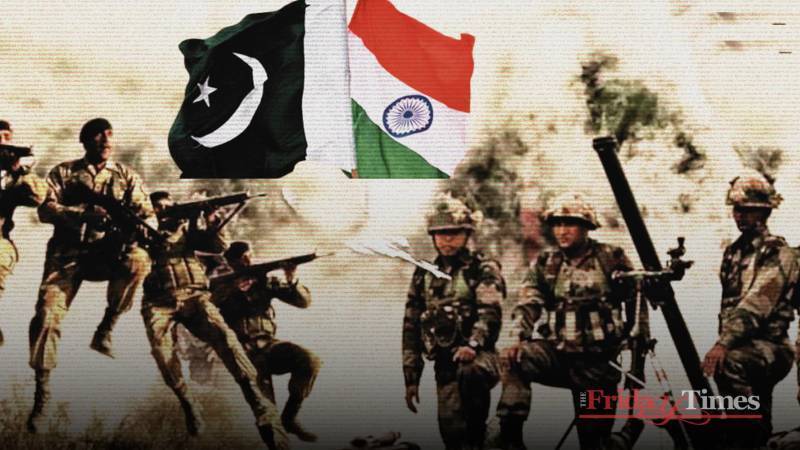
Indian Prime Minister Narendra Modi thinks that Pakistanis are afraid of him. He has said this in so many words many times in his public appearances. Serious political analysis always makes clear that individuals don’t matter in political developments, most of the time. When we seriously analyse the political situation in South Asia, we come to the conclusion that the individuals who seem to be calling the shots in Islamabad and India are mere front faces of the larger social and political forces that are shaping the political and security situation in the region. Prime Minister Modi and his belligerence and jingoism are reflective of three broader political and military trends in Indian society. The portrayal of Modi as someone extremely angry with Pakistan as a response to terrorism emanating from across the border is a misrepresentation of the true situation on the ground. Modi happens to be at the helm of affairs in New Delhi at a time when three broader political and military trends converged to put in place India’s new belligerence towards Pakistan.
The first of these trends is the new confidence Indian military leaders acquired by way of a decade-long military acquisition spree, which brought state-of-the-art weapons systems into Indian military inventories in the recent past. Secondly, this Indian belligerence comes at the culmination of anti-Pakistani public opinion mobilisation in Indian society as a result of Pakistani missteps like the Kargil intrusions and failures on the part of Pakistan to play a role in preventing terror attacks like the Mumbai attacks. Thirdly, the mobilisation and resulting complete control of Hindu extremist ideology over Indian society. In my opinion, Pakistanis should fear neither Prime Minister Modi’s anger nor any of the above-mentioned political and military developments in Indian society. They should fear the fact that these developments have shrunk and eroded the political space for those lobbies in Indian society which once wanted and advocated normal relations with Pakistan. There is hardly any social or political force left in the Indian political landscape with which Pakistan can engage in normal diplomatic activity.
Is war with India in Pakistan’s interest? Can Pakistan afford another war with India? The answer to both these questions is in the negative. Rationality demands that Pakistan should strive to avoid military action with India at all costs. One way is to formulate our India policy in the light of this rational analysis of our situation. The other way is to go with the flow—in response to India’s jingoism and irrational behaviour, we should be equally belligerent in our foreign policy and military attitudes. In that case, we would be fully embracing a reactive policy. The initiative would not be in our hands. Our ultimate objective is to secure Pakistan from external threats. Avoiding conflict and making efforts to avoid conflict is the best way to secure Pakistan from external threats. Jingoism in reaction to the jingoism of the other side will amount to having no policy. Through foreign policy, we engage with other countries. Jingoism is like expressing anger—it’s not a policy.
Pakistan’s political and military leaders have on several occasions reached a consensus on the point that avoiding a conflict with India is Pakistan’s prime interest
Avoiding war by adopting particular foreign policy options will surely mean treading the path of rationality through the use of the collective wisdom of society and foreign policy institutions. Jingoism stemming from social attitudes or the proclivities of state institutions will amount to thinking irrationally and surrendering the collective wisdom of society to emotionalism stemming from particular segments of society. This emotionalism patently goes against the security interests of the Pakistani state and society—interests like avoidance of conflict, about which we can reach a consensus through rational debate. In the post-Kargil period, Pakistan’s political and military leaders have on several occasions reached a consensus on the point that avoiding a conflict with India is Pakistan’s prime interest. We only reached this conclusion; we never made an attempt to convert this principle into the central plank of our diplomacy. Perhaps Indian intransigence never allowed enough space for such an activity.
Hindutva is not simply a political ideology it is also an obscurantist view of Indian history. Colonial historiography portrays Hindus as a docile race (Hindus are not a race, by the way) in Indian history. In contrast, Muslims are portrayed as warriors and barbarians and Hindus as effeminate. Since the 1999 Kargil conflict, Indian Hindu extremist groups have had the golden opportunity to mobilise Hindu public opinion against Muslims and Pakistan. One after the other, opportunities were hurled at them. In 2002, there was an attack on the Indian Parliament, which was traced back to militant groups based in Pakistan. Pakistan officials portrayed the Kargil intrusions as the handiwork of Muslim militant groups based in Pakistan. In India, Kargil was portrayed as a challenge to Indian society, which Hindu extremist groups were already portraying as suffering from an effeminate syndrome, as it had been painted in colonial histories of India.
The Mumbai attack was another event in this sequence of terrorism, where, in the perception of Hindu extremist groups, the manliness of Hindu society was challenged. This was a classic case of the recycling of colonial historiography: Islamic militancy was associated with the warrior nature of Muslims, and Hindu society as a victim of terrorism and therefore effeminate. There are Indian strategic experts who, during this time, were writing entire books on the role of military thought and tradition in ancient Hindu society. These authors started to dispel the colonial impression that Indian society was devoid of military traditions and thought. At the same time, Bollywood developed a special interest in producing films about Hindu warriors from the Maratha military class of the early modern period, which played a crucial role in the collapse of Mughal imperial structures in India. The rise of Hindu militancy and its impact on Indian society didn’t go unnoticed in the wider world. American authors like the late Stephen Cohen described the BJP, India’s incumbent ruling party, as a natural house of India’s military assertiveness. The import of the latest military technology, military tensions, terror attacks on Indian territory, and Hindu extremist groups peddling a particular view of history all collectively came together to produce war hysteria in Indian society. Indians started to see in their powerful military a reflection of their newfound manliness.
We should consider Prime Minister Modi a hostage to war hysteria in Indian society and not someone who is simply angry
The question for Pakistani society is whether to copy the Indian model of popular public opinion mobilisation. This would be like reproducing more of the same from our past decades. We have been victims of our own manliness—masculinity, militancy, and martyrdom have given us one nightmare after another. From 2007 till 2018, we faced the paragon of manliness and masculinity: the suicide bomber. He bombed our cities, killed our children, and attempted to destroy our civic life. For Indians, war may be something glamorous. For us, war is a nightmare from which we have still not fully recovered. From 2007 till 2018, we have seen war in our cities and towns. It is not at all glamorous. What the Indian state did after the Kargil conflict to mobilise its public opinion and to create war hysteria was something our state had already done with its society in the 1980s and ’90s, during and immediately after the Afghan War, when the Kashmir uprising was heating up. We are still repeating what our state did with our society in terms of building structures of militancy in support of the Afghan and Kashmir freedom struggle.
What to do with the Modi phenomenon and war hysteria in Indian society? First, we need to be clear that creating counter war hysteria in Pakistan would be very destructive. First, it will prove too costly for our plans to revive the country's economy. Second, war hysteria will generate compulsions for Pakistani decision-makers. It means that Pakistan’s decision-makers’ space to make rational decisions would be severely restricted by public opinion. At one time during the four-day Pakistan–India war, it appeared that the Indian Prime Minister was a hostage to his hysterical populace. In fact, he faced scathing criticism back home when he agreed to a ceasefire on the coaxing of the American President. Nobody was interested in the strategic compulsions which forced him to agree to a ceasefire with Pakistan. War hysteria in Pakistani society will restrict the strategic space for Pakistani decision-makers to deal with the military and strategic threat emanating from India. We have to keep in mind that the options to which Pakistani public opinion—or Indian public opinion, for that matter—will agree, will not allow strategic flexibility to Pakistani decision-makers, which is the need of the hour to manage our relations with India.
We should consider Prime Minister Modi a hostage to war hysteria in Indian society and not someone who is simply angry. We should try to create options for the Indian government to come out of the situation which it has created itself. This will not be appeasement but a rational way to deal with a potentially very dangerous situation. The attack in Pahalgam is unlikely to be the last mass-casualty event on Indian soil. Next time, the Indian Prime Minister will again be faced with the same compulsions from a hysterical public opinion, pressure from its military to test their newly acquired weapons on the battlefield, and from Hindutva ideologues to prove that Hindus are not effeminate. The Pakistani government should attempt to convey a solid proposal proving Pakistan’s non-involvement in attacks in India. We should also offer India a joint mechanism to deal with the terror threat. An innovative diplomatic initiative might work to break the ice.Let me know if you'd like a visual slide version or a pull quote summary.