

Art is not simply a reflection of reality. As Marx and Lukács note, it is a means by which reality can become self-aware. Every true poet embodies historical tensions: self and world, beauty and necessity, desire and ideology. The lyric, though personal, can convey a connection to history, even as it distances itself from politics. Thus, a central modern question emerges: What is the purpose of art when the world demands change? The shift from romantic subjectivity to revolutionary realism is more than literary; it marks a transition from the aesthetics of being to the ethics of becoming.
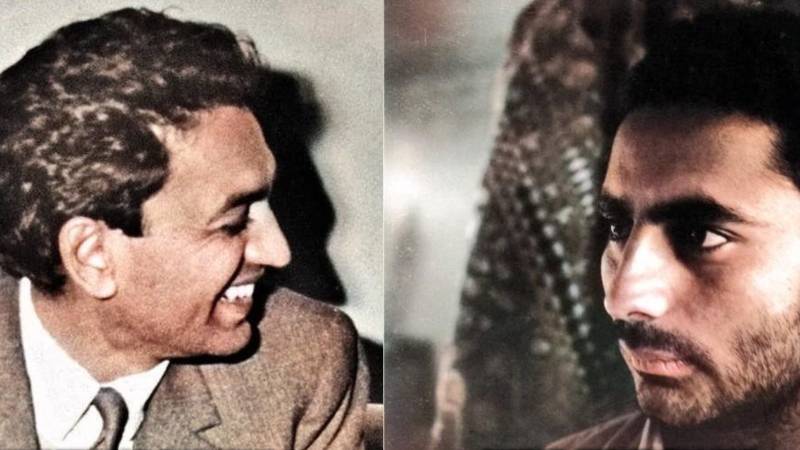
In this movement, twentieth-century Punjabi poetry found its two emblematic voices: Shiv Kumar Batalvi (1936–1973) and Avtar Singh “Pash” (1950–1988). One emerged from Punjab's folk consciousness, speaking in myth and lament, turning personal anguish into a metaphor for universal loss. The other arose from agrarian and ideological struggle, making poetry a weapon of historical awakening. Together, they capture the full spectrum of human response: tenderness and rebellion, solitude and solidarity, the whisper of the heart and the shout of the street.
The Ontology of the Lyrical: Shiv Kumar Batalvi and the Aesthetic of Pain
Shiv Kumar Batalvi’s work lies at the intersection of folk imagination and modern alienation. His poetry seeks not social change but remembrance. Feeling is humanity’s final refuge. Philosophically, his view is existential, not materialist; being is experienced through suffering, which is the mark of authenticity. His anguish is not protest but a testament to existence’s fragility.
Batalvi’s lyricism reflects what Lukács termed “the tragedy of inwardness.” His poetry inhabits a space where love, death, and memory merge, and emotion takes on a metaphysical quality. When he writes,
Ēh merā gīt kisē nā gāṇā,
Ēh merā gīt main āpē gā ke,
Bhalke hī mar jāṇā.
(This is my song; no one else will sing it.
This is my song; I myself will sing it,
and, having sung it, will die, perhaps as soon as tomorrow.)
He affirms the self as the only true witness to its existence. These lines are existential, not narcissistic: the expression itself becomes proof of being. For Batalvi, to sing is to exist; silence is a double death.
While Batalvi’s perspective centres on existential being-toward-death, Pash’s is based on Marxist humanism’s being-for-others
Rooted in Punjabi oral traditions, Batalvi’s aesthetic turns communal sorrow into the personal anguish of modern life. He revisits myths like Heer-Ranjha and Puran Bhagat, rendering them as internal struggles rather than social parables. In Loona, the condemned queen seeks justification before a moral universe that has already judged her. The political silence in his poetry is not indifference, but an acknowledgement that tragedy begins in the human heart.
Through existential phenomenology, Batalvi’s work shows individual isolation in an absurd world. His anguish echoes Camus’s despair at the world’s silence. Unlike Camus’s rebel, Batalvi accepts the silence and turns it into song. His rebellion is aesthetic, insisting that feeling remains sacred in a world that has become increasingly commodified.
The softness of Batalvi’s language, with its musical repetition, folk rhythms, and tenderness, masks a deeper metaphysical resistance. It rejects modern rational rigidity. His poetry strives to preserve beauty from utilitarian decay, reflecting Adorno’s view that lyrical form itself protests instrumental reason.
This inward focus also limits Batalvi’s vision. The self repeats its pain, and love becomes ritual suffering, with death as resolution. The world is aestheticised but unchanged. The dialectic ends at the personal level, not in history.
The Ethics of Fire: Avtar Singh “Pash” and the Revolutionary Turn
While Batalvi’s voice marks the end of tradition, Pash’s rises with political modernity. His poetry emerged during the turbulent 1970s and 1980s, when Punjab faced state repression and radical change. Batalvi sings of exile; Pash writes within the struggles of history. For Pash, the poet is a combatant, and the poem a tool for awareness.
Pash’s humanism redefines the purpose of poetry. He insists that art should not only describe suffering but also intervene in it. His well-known declaration —
“Sab ton khatarnaak hunda hai
saade supneyan da mar jaana”
(The most dangerous thing
is the death of our dreams)
Transforms lyric emotion into political ethics. The true catastrophe is not violence. It is apathy, not oppression, but indifference. In this way, poetry becomes an act of vigilance, defending imagination against the numbing effects of power.
While Batalvi’s perspective centres on existential being-toward-death, Pash’s is based on Marxist humanism’s being-for-others. The self exists only through collective struggle. In the Main Communist Na Hovan, he writes:
Main communist nā hovān,
jē mērē vich nā hovē insān dī khushbū.
(Let me not be a communist
if within me there is no fragrance of humanity.)
These lines place politics within ethics: revolution without compassion becomes tyranny. Pash’s communism is deeply existential, reclaiming individuality by placing it within history. The poet’s role is to preserve human tenderness amid struggle.
Formally, Pash breaks from the smooth rhythms of folk lyricism. His syntax is angular, his imagery industrial. His verse’s rhythm resists, disrupts, and challenges. The reader cannot remain passive. He writes for cognitive dissonance, not harmony, urging readers to move beyond complacency. His metaphors, iron, fields, and prisons derive from labour’s material world. The result is what Gramsci called “organic literature,” inseparable from the people’s lives.
Pash’s poetry shifts from ontology, the study of existence, to praxis, or purposeful action. While Batalvi asks, “What does it mean to exist?”, Pash asks, “What must we do to make existence just?” This shift echoes Marx’s Eleventh Thesis on Feuerbach: the goal is not to interpret the world but to change it. For Pash, the answer to existential despair is collective action, not aesthetic withdrawal.
The story of these two poets is the story of art: transforming pain into meaning, and meaning into action
Between Beauty and Praxis: Aesthetics, Politics, and the Human
Reading Batalvi and Pash together reveals not opposition but dialectical continuity. They show two phases of the same cultural consciousness: lyricism and revolution, beauty and action. Batalvi’s introspection lays the groundwork for feeling. Pash’s activism transforms it into action. Both defend humanity against dehumanisation. One emphasises emotion, the other resistance.
Theoretically, Batalvi’s art aligns with the Frankfurt School’s idea that art’s truth is found in its separation from direct involvement with everyday life, a concept also referred to as autonomy. In this view, the independence of art serves as a form of protest against a world that has become impersonal or object-like, a phenomenon philosophers refer to as reification. In contrast, Pash represents the Marxist belief that art and labour should be united: the poem as action, the artist as worker. His verse favours active participation over independence from the world.
Both positions risk extremes. Pure lyricism can become escapism. Pure activism may become propaganda. What unites them is ethical seriousness and a refusal to reduce humanity to an object. Batalvi’s lament for lost love and Pash’s anger at lost justice both express the same grief: the world’s betrayal of its own beauty.
Batalvi’s work can be considered in light of Heidegger’s concept of poiesis, which refers to the act of bringing something into being. His poems reveal existence by making what is hard to express visible in language. Pash, by contrast, fits with Marx’s idea of praxis, which is the joining of thought and action. For Pash, language is a tool for creating and changing reality. Batalvi gives us the experience of pain; Pash gives us the aim of struggle.
Their views on death underscore the divide between them. Batalvi, anticipating early death, sees mortality as destiny: the poet dies so the song endures. Pash, killed by reactionary violence, turns death into continuity: “Where I fall, there itself the crop grows.” Batalvi accepts tragedy; Pash makes it progress.
The Relevance of Pash: From the Individual to the Collective
In today’s world of ecological crisis, digital isolation, and commodified desire, Pash’s voice is newly urgent. His warning about “dead peace” addresses societies numbed by consumption. Calling “the death of dreams” dangerous, he captures the quiet loss of hope beneath progress’s surface.
Pash’s poetry sees the need for a politics of imagination. He knows the fight for justice is also a search for meaning. He combines the existential concept of self-made essence with the idea that collective labour shapes us. He offers a union of freedom and solidarity that philosophy still seeks.
By contrast, Batalvi’s inwardness, though beautiful, belongs to a past era. His pain reflects a time when emotion was sacred. Now, in a world of systemic crises, such tenderness risks becoming mere elegy. Action outweighs the luxury of melancholy. Yet, as history favours Pash, Batalvi reminds us: action must be rooted in feeling.
Pash remains relevant not for militancy, but for combining it with compassion. He saw that revolution must be ethical to last. His poetry rejects cynicism and despair, reclaiming hope for labour and imagination.
The Human Horizon
The meeting of Batalvi and Pash outlines the moral landscape of modern Punjab and, by extension, modern consciousness. Batalvi represents the inward truth of emotion; Pash, the outward truth of justice. Together, poetry moves from elegy to manifesto, from solitary song to collective voice.
Batalvi shows that feeling is the basis of ethics; Pash shows that feeling without action is powerless. The gentle and the passionate poet complete each other: without Batalvi, revolution lacks tenderness; without Pash, beauty lacks purpose. Together, they represent art’s dialectic: the need to dream and act, to sing and struggle.
Their relevance endures because both reject nihilism. Each, in his own way, affirms the indestructibility of the human spirit, whether through love or resistance. Batalvi’s whisper, “Main āpē gā ke mar jāṇā, (I myself will sing it and die), and Pash’s pledge, “Jithē main digdā hā̃, uthē hī phasal ugdī hai.” (Where I fall, there itself the crop grows), are not opposites but continuities: the song becomes the seed, and the seed becomes the song.
Ultimately, the story of these two poets is the story of art: transforming pain into meaning, and meaning into action. From the fragrance of being to the fire of becoming, their legacy poses a timeless question: How can we live truthfully in a wounded world that also asks us to heal it?