

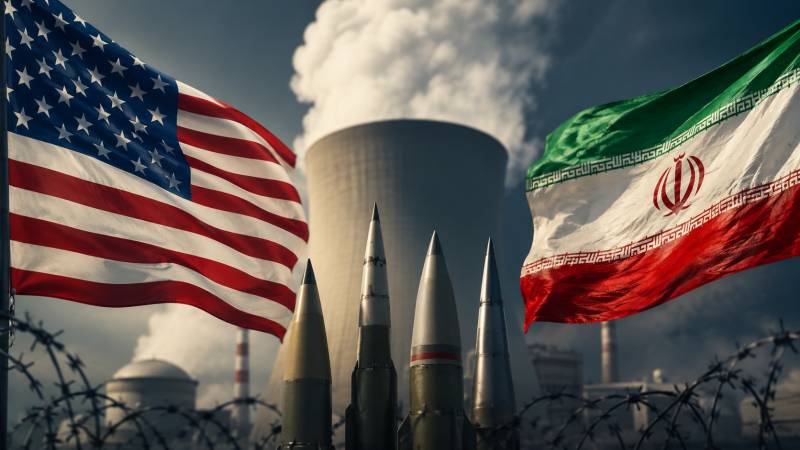
The uneasy standoff between Iran and the United States also has a nuclear dimension. Under a proposed deal, America wants Iran to hand over its around 450 kilograms of uranium to an international body. Iran is unwilling to accept the U.S. condition but has expressed its readiness to freeze its uranium enrichment for five years.
America wants Iran to freeze its uranium enrichment for 25 years before other issues like the reopening of the Strait of Hormuz, lifting of sanctions on Iran, unfreezing of its assets by Washington, curbing Iran’s missile programme, and restricting Tehran from supporting its proxies like Hezbollah of Lebanon and the Houthis of Yemen are resolved.
Following the standoff on Iran-U.S. talks after the holding of direct negotiations in Islamabad, it has been more than a month since a fragile ceasefire has been in place. The bottom line for the U.S. and Israel in their conflict with Iran is the nuclear issue.
When, two decades ago, the world, particularly the International Atomic Energy Agency (IAEA), noticed the progression of Iran’s uranium enrichment, the then supreme leader Ayatollah Khamenei, in a fatwa, termed nuclear weapons as haram (illegal) and vowed that his country would never go for manufacturing a nuclear device. As a signatory to the Nuclear Non-Proliferation Treaty (NPT), Iran is committed not to go nuclear.
But after the death of Ali Khamenei as a result of the American-Israeli attack, is his successor Ali Mojtaba Khamenei committed to that fatwa? After facing relentless U.S.-Israeli attacks from February 28 till the ceasefire in the first week of April, is Iran not rethinking its fatwa and considering the option of going nuclear?
In an article, “Cornered and wounded, will Iran now go for a nuclear bomb?” by Mostafa Salem and Leila Gharagozlou in CNN on March 29, 2026, the authors argue that: “The calls to pursue a nuclear bomb grew louder with Israel’s unprecedented military operation against Iran last year which killed several of the country’s military and nuclear leaders.
The U.S. and Israel, despite all their efforts, are unable to decapitate Iran’s uranium stockpile of 450 kilograms capable of detonating a nuclear device
The calls increased again with Trump’s order to strike three of Iran’s most important nuclear sites. Even before those strikes, Iran’s Islamic Revolutionary Guard Corps (IRGC) had warned that Tehran was prepared to shift its nuclear posture.
‘A reversal of Iran’s nuclear doctrine and policies, including a shift away from previous considerations, is likely and conceivable,’ said Ahmad Haqtalab, the IRGC commander responsible for protecting Iran’s nuclear facilities, in 2024.”
Furthermore, according to the authors, “Iran hasn’t yet publicly reversed its doctrine. However, it possesses more than 400 kilograms of highly enriched uranium. That would be enough to produce several nuclear weapons if Khamenei’s son and Iran’s new supreme leader, Mojtaba, reverses his father’s fatwa.
Uranium is a key fuel for nuclear power plants that can be used to create a bomb if enriched to high levels.”
The 2015 Joint Comprehensive Plan of Action (JCPA), reached between Iran, permanent members of the U.N. Security Council, and Germany and signed under the Obama administration, provided guarantees that Iran would cap uranium enrichment at 3.67%, but the U.S. withdrew from the JCPA during the first term of the Trump administration in 2018, which enabled Iran to enhance its uranium enrichment to 60% in 2025.
It is argued that uranium enrichment beyond 60% by Iran will, within a span of a couple of years, pave the way for a nuclear test by Tehran. Despite the June 2024 and 2025 bombardment of Iranian nuclear sites, it is suspected that not enough damage has been caused to Iranian uranium enrichment facilities because these are hidden in tunnels that are difficult to target.
The U.S. and Israel, despite all their efforts, are unable to decapitate Iran’s uranium stockpile of 450 kilograms capable of detonating a nuclear device. Furthermore, the U.S. ceasefire since April 2026 has enabled Iran to augment its nuclear enrichment so that it can, within a short span of time, conduct a nuclear test.
“If Iran goes nuclear” is a fundamental question being raised by analysts in the aftermath of the U.S.-Israeli attack on Iran. For America, Israel, and pro-U.S. Gulf states, it will be their nightmare to see Iran going nuclear.
The ball is in the court of Tehran, as nuclear deterrence is the only way to prevent any future outbreak of hostilities in the Persian Gulf
One can examine the question of Iran going nuclear from three angles. First, Iran now believes that the only way it can prevent an American-Israeli attack is by going nuclear because of nuclear deterrence.
It has the example of North Korea, which first left the NPT and then conducted nuclear tests. That saved North Korea from threats of attack and other punitive actions from the U.S.
However, in order to go nuclear, Iran needs to reach the threshold of uranium enrichment of 90%, which will pave the way for conducting nuclear tests. If Iran has reached that threshold, then it needs to make two decisions: revoke the fatwa of Ali Khamenei and withdraw from the NPT.
If Iranian leaders, heavily influenced by the IRGC, take those two decisions, there will be no obstacle for Tehran to go nuclear. As a result of weeks of U.S.-Israeli attacks, Iran may have learned the lesson that had it been equipped with nuclear weapons, it would not have faced external aggression.
Second, if Iran goes nuclear, the responsibility shall rest with the United States and Israel because these two powers, as a result of their aggression, augmented the hardline stance of the Iranian leadership. Like India, which forced Pakistan to conduct its nuclear tests on May 28, 1998, after New Delhi conducted nuclear tests on May 11, it will be Israel and the U.S. forcing Iran to follow the nuclear path.
It is widely believed in proliferation circles that once Iran is in possession of nuclear weapons, it will be confident in dealing with any future external aggression. Iran, as the ninth nuclear state, will thus create an example for other nuclear-ambitious countries to follow the nuclear path.
Yet it is another matter how Israel will react to Iran’s nuclear tests, as its vulnerability will deepen. After not winning its war with Iran, despite its military superiority, both Israel and the United States will make a last effort to capitulate to Tehran by launching a final assault.
But, like the past adventure, there is no guarantee that by ending the ceasefire and launching another round of attacks on Iran, America and Israel will be able to achieve their main objective: to destroy Iran’s nuclear enrichment and its ambitions to test a nuclear device.
Finally, at stake is peace and stability in the Persian Gulf and the Middle East. If Iran goes nuclear, it will open a Pandora’s box and push other nuclear-ambitious countries of the region, namely Saudi Arabia and Egypt, to follow the nuclear path.
Had the U.S. not withdrawn from the JCPA treaty of 2015 and lifted sanctions on Iran, the possibility of Tehran going nuclear would not have existed. Now, if Iran succeeds in going nuclear, it will not only protect its sovereignty but also provide an incentive to all those countries which face external security threats.
Iran has proved its resilience, commitment, and determination despite facing weeks of U.S.-Israeli onslaught. Now it will be a hard task for the nuclear scientists of Iran to take their uranium enrichment to its logical conclusion.
Taking political decisions like revoking the fatwa against acquiring nuclear weapons and leaving the NPT will also matter.
Iran is certainly at the crossroads and will have to decide to go nuclear soon before it is attacked again by the United States and Israel. The ball is in the court of Tehran, as nuclear deterrence is the only way to prevent any future outbreak of hostilities in the Persian Gulf.