

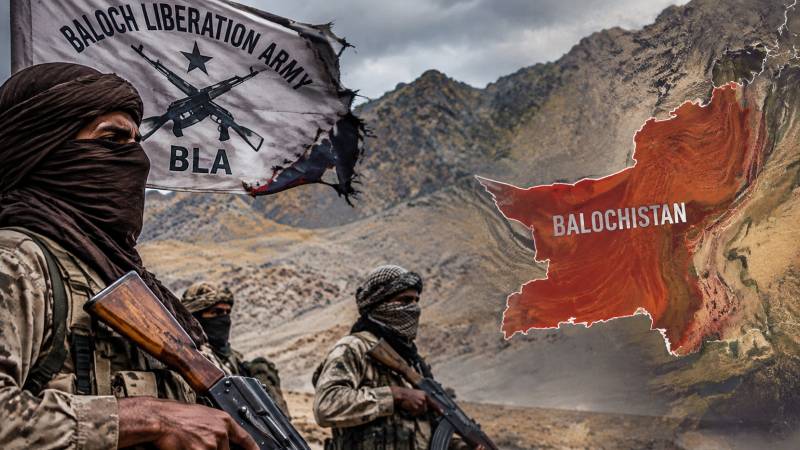
Its chief has gone quiet, its commanders are arguing over the money, and its press office says all is well. Inside the BLA's unravelling.
Every insurgency has a press office. Few welcome an audit. Now the BLA's own dissidents are demanding one, while the man at the top has stopped talking.
The BLA is no minor player. Banned by Pakistan in 2006 and designated a terrorist organisation by the United States, it has for years targeted security forces and Chinese interests in Balochistan, Pakistan's largest and most resource-rich province. Its suicide wing, the Majeed Brigade, is listed by Washington alongside it. A change at the top therefore matters well beyond one insurgent faction: to Islamabad, to Beijing and to anyone watching regional security.
The announcement, issued through spokesperson Jeeyand Baloch, said a joint meeting on 16 October had backed the move, with power passing to a Senior Command Council until a successor is chosen. Zeb, a former student leader from Nushki, had succeeded Aslam Baloch after Aslam was killed in a suicide attack in December 2018. Aslam, PICSS says, founded the Majeed Brigade and sent his own son on its first suicide mission. Yet the statement never explained why removal was needed or what role, if any, he would keep. As PICSS notes, the claim of a fully democratic process cannot be tested without knowing the group's constitution.
Pakistani analysts offer a rougher account. PICSS, citing its own sources, says Zeb was effectively sidelined as early as February, with Captain Rahman Gul, who heads the Majeed Brigade, taking charge of key decisions. The trigger, it reports, was Operation Herof 2, launched on 31 January and 1 February as a sequel to the original Herof attacks of August 2024. In the following week, Pakistani forces killed at least 215 BLA fighters, while the group admitted to 96 deaths. Balochistan's chief minister had earlier put the toll at 145 in the first days, so figures vary by source and stage. Rahman Gul is said to have argued that the operation exposed too many fighters at once, letting Pakistan's superior aerial surveillance map their positions before Operation Radd-ul-Fitna 2 and later operations took a further toll. None of this can be independently confirmed.
The money story has a twist: there are two crises, not one. The explosive 82-page dossier, titled "Our Experiences, Objections, and Joint Demands", belongs to the rival BLA-Azad faction linked to Hyrbyair Marri, not to Zeb's BLA-Jeeyand. According to Eurasia Review, it reached the leadership in April and alleged that PKR 3 billion had gone missing over five years while fighters and martyrs' families went without support, pointing at Marri's network and denouncing what it calls "Sardari slavery", a system where tribal loyalty beats merit. Marri, who lives in London, denies leading the BLA, although Islamabad alleges otherwise. The dissent grew into a Reform Command Council, which appointed its own commanders and, per PICSS, announced the removal of the faction's spokesperson. Its proposed charter calls for independent audits, an elected strategic council, limits on the chief's powers and protection for whistleblowers. In late October, several senior figures of the Free Balochistan Movement, which Marri also heads, resigned. The irony is hard to miss: Eurasia Review reports that reformers in BLA-Azad say the old guard drafted a charter for lifelong rule, while Zeb's camp cites a rule against exactly that.
The BLA's leadership crisis is real, but the mystery surrounding Bashir Zeb's whereabouts, the allegations of financial corruption and growing factional divisions have exposed deeper fractures within the insurgency.
Corruption allegations against Zeb's own circle surface separately, and with weaker sourcing. One Pakistani outlet describes meetings on 7 and 14 May at which commanders allegedly presented evidence of embezzlement worth millions of rupees, with Rahman Gul among those demanding his removal. Other Pakistani reports say associates moved money to Stockholm and Paris. These claims rest on anonymous or partisan sources, no supporting documents have been published, and the group has not publicly addressed them, as far as available reporting shows. They are allegations, not findings.
History offers a clue. The 2010 to 2012 split that created the United Baloch Army also began with accusations of stolen funds, which the accused denied. Analysts have long noted that local commanders accuse Europe-based tribal leaders of running groups like fiefdoms, a class divide that may explain these revolts better than any single scandal. PICSS adds that reunification talks between the two BLA factions began in 2025 without producing a merger, and that today's upheavals could either remove obstacles to one or deepen the fragmentation.
The external dimension is where the claims collide. Pakistan's official position, restated by the DG ISPR on 2 November, is that India finances and uses the BLA and the Tehreek-e-Taliban Pakistan as proxies, a charge built into the state's label for the BLA, "Fitna al-Hindustan". Pakistan's UN envoy says such groups operate from sanctuaries in Afghanistan. India rejects the accusation and calls the label disinformation, and independent reporting notes that Pakistani officials have not made the supporting evidence public. What the record shows is narrower: PICSS says Aslam Baloch travelled to India in 2016 without his leadership's approval, and the BLA's own 2017 statement accused him of unauthorised travel there. Meanwhile, the United States, United Kingdom and France placed a hold on a Pakistan and China bid to list the BLA and Majeed Brigade at the UN, citing insufficient evidence of Al-Qaeda or ISIL links, even as Washington keeps its own listing.
The most dramatic claim is that Zeb was poisoned in Kandahar and moved to India for treatment and refuge. Pakistani outlets attribute this to intelligence reports. PICSS says similar claims could not be independently verified, and the BLA says only that he has stepped down. Days earlier, the DG ISPR had named him among militants Pakistan believes are in Afghanistan, and the two accounts have not been reconciled. Until credible evidence is made public, his whereabouts and any foreign facilitation remain open questions, not established facts.
What is clear is that the BLA's leadership crisis is real, and that it unfolds while Pakistan's security forces keep up pressure: the ISPR reported an operation on 1 November that killed 17 militants. Division may sap cohesion in the short term, but PICSS cautions that such disputes can also produce new leadership, new tactics and unexpected alliances. For Islamabad, and for Beijing and Washington, the question is not only who replaces Bashir Zeb, but whether a more decentralised BLA proves harder to track than the one it replaces. In a movement that sells itself as a revolt against unaccountable power, the loudest demand inside it is now for an audit.