

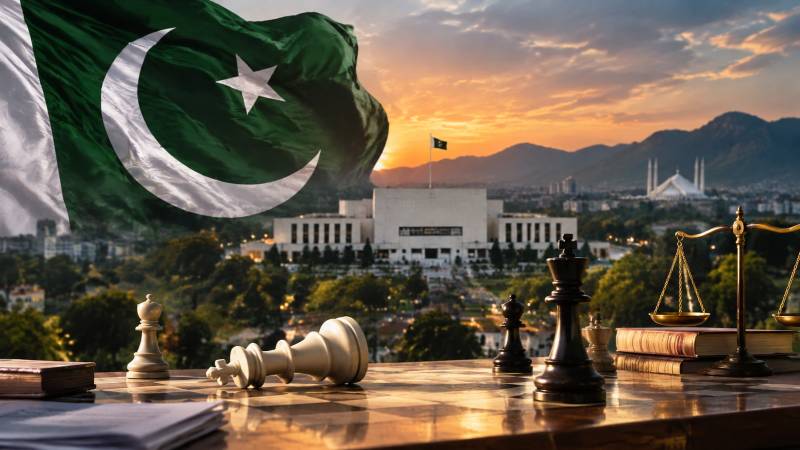
The old order will yield when defending privilege becomes more costly than sharing power. What could bring that moment closer?
The most painful thing about Pakistan is not that we do not understand what has gone wrong. It is that we understand it so well and still struggle to imagine how it might end. Elite capture has been diagnosed repeatedly. The more difficult question is what could compel those who benefit from the arrangement to accept limits and enable those who bear its costs to change it. Pakistan needs a new social contract built on equal application of the law, lasting stability within and across its borders, and sustained, broad based wealth creation. But a destination is not a route. Who would take us there, against whose resistance, and when?
An honest answer begins with an uncomfortable possibility: the present order could survive for years. Countries can disappoint their citizens for generations without their governing systems collapsing. Yet an apparently immovable order can also change abruptly. What looks like permanence may depend on a few relationships, expectations and decisions that are less secure than they appear. Pakistan’s future turns partly on whether the forces sustaining its governing bargain remain aligned and whether an alternative is ready when they cease to be.
Game theory helps explain this predicament. It studies how people and institutions make decisions when the consequences depend on what others do. Its central insight here is that an arrangement can harm the country collectively while remaining rational for influential participants individually. The military fears losing control and exposing institutional interests. Politicians fear accepting constraints while rivals retain access to the establishment. Protected businesses fear competition. Citizens fear becoming visible targets while others remain at home. Each has reasons to dislike the system, yet reasons to hesitate before challenging it.
This resembles what game theorists call a Nash equilibrium. Given everyone else’s choices, no participant expects to improve its position by changing course alone. It need not involve a conspiracy. Rival elites can fight bitterly over office while preserving the discretion that makes office valuable. Politicians may sincerely oppose interference when excluded and welcome it when it helps them return. The equilibrium survives because the immediate rewards of cooperation are uncertain, while the risks of moving first are personal and concrete. Changing it requires altered incentives and credible commitments, not simply another appeal to patriotism.
The armed forces remain pivotal because their influence extends beyond any particular government. Constitutional changes approved in November 2025 expanded the army chief’s powers and curtailed the Supreme Court’s remit, reinforcing institutional consolidation. There is little basis for expecting a retreat simply because civilian supremacy would serve the constitutional order. Yet political predominance carries liabilities. Military capability requires a productive economy, reliable revenue, technological capacity and social cohesion. The more an institution determines national outcomes, the harder it becomes to disown national failures. A system that protects institutional authority today may gradually undermine the resources and legitimacy on which that authority depends.
That contradiction could eventually change the military leadership’s calculations. It could also produce tighter control. Economic distress does not automatically democratize a country. Leaders may interpret it as evidence that civilian politics needs further restraint. External threats can reinforce this response. The decisive question is whether influential commanders come to see constitutional limits as a more dependable source of institutional security than permanent political management. A credible civilian alternative would matter enormously. Those being asked to relinquish discretion will be harder to persuade if they expect paralysis, retaliation or renewed appeals for intervention from tomorrow’s political losers.
It is equally important to reconsider the claim that Pakistanis have not demanded change. Citizens have expressed resistance through elections, demonstrations, professional movements and local campaigns. In 2024, PTI aligned independents won the largest number of directly elected National Assembly seats despite substantial restrictions on their party. Whatever one thinks of its leadership, this was hardly evidence of public indifference. The difficulty lies in converting dispersed resistance into sustained cooperation across party, class and provincial boundaries. A worker risking wages, a student risking arrest and a family dependent on a government salary confront different costs. Their caution should not be mistaken for consent.
Here, too, expectations matter. People may remain at home because they believe others will remain at home. A widely understood event can change that belief quickly, turning private anger into collective action. But mobilization does not guarantee a democratic outcome. Bangladesh’s 2024 uprising involved both mass participation and a consequential military decision. Reuters reported that army leaders would not enforce the curfew by firing on civilians immediately before Sheikh Hasina fled. Pakistan’s military occupies a different institutional position, with deeper stakes in the governing order. The comparison offers insight into how power shifts, rather than a timetable Pakistan must follow.
A system that protects institutional authority today may gradually undermine the resources and legitimacy on which that authority depends. The more an institution determines national outcomes, the harder it becomes to disown national failures.
International relationships further complicate the picture. Foreign governments have reasons to value Pakistan’s security cooperation, nuclear stability, regional position and protection of investments. Those interests can favour continuity even when continuity sustains domestic inequality. Strategic importance can therefore help finance political postponement. Yet partners also require results. China’s demands for better protection of its nationals and projects illustrate that even close relationships carry performance expectations. Creditors need repayment, investors need enforceable contracts and trading partners need dependable suppliers. External relationships may simultaneously support the existing order and expose the economic limitations of its methods.
The IMF’s governance diagnostic identified discretionary regulation, politically connected advantages and weak accountability as obstacles to economic performance. This creates potential common ground between domestic demands for fairness and external demands for sustainability. But financial pressure alone cannot deliver a new social contract. Governments can meet revenue targets by extracting more from accessible taxpayers while preserving powerful exemptions. They can improve selected economic indicators without widening political participation. External influence becomes useful when domestic constituencies can turn demands for reform into rules that apply to the influential as well as the ordinary.
Against this background, three futures deserve consideration. They can unfold faster than expected, overlap or give way to one another. Their timing depends less on a calendar than on whether political cohesion, external financing, public compliance and the security establishment’s calculations hold together. A single shock can expose several weaknesses at once. Equally, fresh financing or a temporary recovery can repair an apparently terminal crisis. Forecasting Pakistan requires watching these relationships rather than declaring either inevitable collapse or inevitable continuity.
The first scenario is a harder or more efficient status quo. Over the next twelve to twenty four months, selective reforms and external support could preserve the existing distribution of power. If civilian arrangements become unmanageable, direct military rule is also conceivable. It would change who formally governs without necessarily changing the underlying bargain. Its attraction to the establishment would depend on whether additional control outweighed the costs of openly owning economic and political failure. This scenario could produce temporary order and some economic improvement, but its defining feature would remain discretion. Accountability applied selectively, political competition restricted and privileges available for negotiation.
The second scenario is a negotiated opening. It need not wait until the 2030s. An opening could emerge within one to three years if economic pressure, political deadlock, organized public demands and changing institutional calculations converge. Exporters and productive businesses could become stronger advocates of predictable rules. Parties could recognize that invitations to intervention ultimately endanger them all. Military leaders could seek a sustainable division of responsibility. Initial agreements might cover electoral credibility, lawful political activity, fairer taxation, transparent procurement and effective local government. Establishing such arrangements could happen quickly. Making them survive successive governments would take considerably longer.
The obstacle would be trust. Why should any participant surrender an advantage today in exchange for a promise tomorrow? The answer must be reciprocal, observable steps rather than a grand declaration. Parties would accept electoral defeat and cease seeking establishment assisted shortcuts. Institutional discretion would narrow through published rules and independent scrutiny. Predictable legal treatment would protect those losing influence without granting permanent impunity. The strongest evidence of change would be powerful actors accepting an adverse ruling, electoral outcome or financial investigation without disabling the institution responsible. A bargain becomes credible when breaking it carries a cost even for its strongest participant.
The third scenario is abrupt rupture, which could occur within months. A disputed political decision, economic shock, security failure or episode of state violence could become the point around which previously separate grievances converge. Large demonstrations could alter expectations rapidly. Divisions within the governing coalition or changes in the security response could accelerate events further. But a rupture could lead to negotiation, direct military takeover, intensified repression or a replacement civilian elite. These are competing possibilities, not successive stages of liberation. The democratic prospects would depend heavily on whether credible civilian organizations already possessed a shared transition programme and the authority to uphold it.
Preparation therefore matters before the opening arrives. The three foundations of a new contract must become commitments that organized constituencies can defend. Rule of law means constitutional limits binding every institution and public decisions governed by published rules. Stability means legitimate political competition, protection from arbitrary coercion and sustained efforts to reduce regional confrontation. Broad based wealth creation requires productive investment, exports, reliable energy, education and women’s economic participation. Eight to ten per cent growth can remain an ambition, but the contract must earn public trust through better opportunities and services rather than depend on an uncertain headline number.
There are grounds for hope, but they lie in building these constituencies. Businesses that gain from competition, workers who benefit from investment, local governments that deliver, and parties that expect to return to office under rules they also respect in opposition. Change could begin sooner than we think whereas consolidation could also last longer than we can bear. What hurts is watching Pakistanis seek abroad the dignity and dependable rules they should find at home. The old contract will begin to end when enough citizens can organize around an alternative and enough powerful actors conclude that their own future is safer within it.