

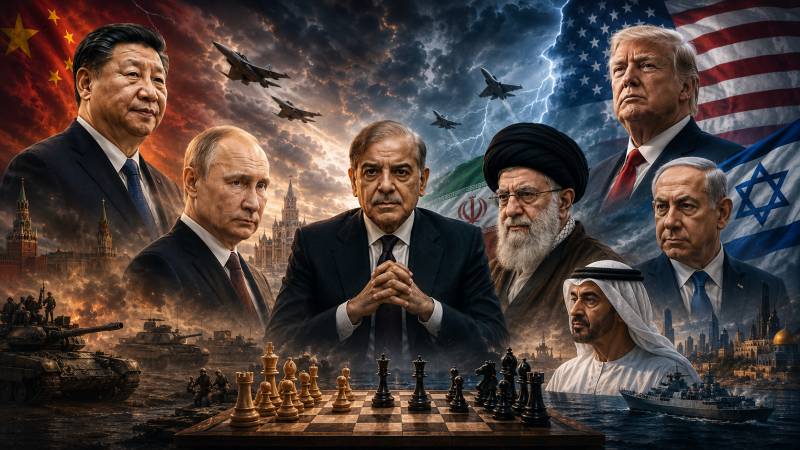
Three developments over the past few days carry significant geostrategic and diplomatic implications for Pakistan. These developments must be understood in the context of the trajectory Pakistan has followed since the May 2025 conflict with India, as well as its mediation efforts between Iran and the United States in April 2026.
First, the South China Morning Post reported on 8 May 2026, while Pakistan was marking the first anniversary of its perceived victory in the conflict with India, that Chinese engineers were present in Pakistan during the India–Pakistan aerial engagement on the night of 6–7 May 2025. The report suggested that Chinese technical teams provided on-site support to the Pakistan Air Force during the conflict.
Second, a CBS News report alleged that Pakistan allowed Iran to station fighter aircraft at Pakistani airbases while the United States was conducting air strikes on Iranian facilities. If accurate, these claims could call into question Pakistan’s stated neutrality during its mediation efforts between Tehran and Washington.
Third, Israeli Prime Minister Benjamin Netanyahu claimed in a televised interview that Pakistan was using fake social media accounts, posing as Americans, to undermine US–Israel relations and influence public opinion online. These allegations were subsequently reported by several media outlets, including ABP News and The Current.
Collectively, these developments force a diplomatic and strategic reset for Pakistan, which it has been avoiding by pursuing a policy of “maintaining a balancing act” between powers.
Although the statement regarding the sending of technical personnel to Pakistan during the India–Pakistan conflict does not come from any official Chinese source, one can be almost certain that the South China Morning Post report could not have been published without the consent of the Chinese government.
Pakistan may like to admit it openly or not, but the information now sits in the open. The question here does not pertain to the debate around whether the Chinese were present in PAF control rooms. The point is the timing of the report — 8 May 2026 — when Pakistan was celebrating its victory over India.
Speaking of India, one is immediately reminded of Israel
Did it come as a reminder to Pakistan that, before you go too far in your romance with the Americans, remember we were there when nobody else was? Is it a message to India to exercise caution with regard to its military ambitions and designs against Pakistan? Or a direct message to the Americans to think carefully before taking Pakistan on a long ride in the Middle East conflict?
The simultaneous emergence of the CBS News report claiming Pakistan was sheltering Iranian Air Force assets rings alarm bells. Although Pakistan quickly denied these reports as mere false claims, Senator Lindsey Graham posted on X about his doubts regarding Pakistan’s neutrality in the Iran–US talks in Islamabad.
ABC News reported on 13 May that Senator Graham stated, “I don't trust Pakistan as far as I can throw them,” during a subcommittee hearing with Defence Secretary Pete Hegseth and Joint Chiefs Chairman General Dan Caine. President Trump responded by reiterating his confidence in Pakistan, stating, “The Pakistanis have been great, the field marshal and the prime minister of Pakistan have been great.”
So, this is not merely a media matter, as dismissed and downplayed by Pakistan’s Foreign Office. It has been discussed in US Senate committees, and both Senator Graham and President Trump have taken positions on it. Moreover, it would be absurd to imagine that any movement of large Iranian military or civilian aircraft would have gone unnoticed by US intelligence and satellites.
And what about the US silence on the opening of six land routes between Iran and Pakistan, despite US sanctions?
So, both China and the United States have shown up at the same time. Meaning that both Iran and Pakistan, increasingly drawing closer, have demonstrated their military resolve against much bigger rivals India and the US/Israel in their respective confrontations.
Therefore, allowing them to drift decisively closer to China would mean the United States has no space left in the Middle East and Eurasian regions. In this context, that three-way message from China via the South China Morning Post makes sense.
In other words, it is a forced reset for Pakistan. No more comfort zone of balancing acts. No more diplomatic ambiguity. No more hide-and-seek. Take clear sides. If you are still hesitating, looking away from the CBS News report, open your eyes to the US Senate proceedings. Illusions of “brotherly” Muslim nations are being shattered. The UAE has removed the mask; others may follow suit in due course. If some in Islamabad still want to keep their heads buried in the sand, then wait for the Indian move in the next few months.
And if you have the heart and mind to pre-empt that scenario realistically, ask yourself: who will be standing on your side? Who will ensure uninterrupted oil supplies without imposing conditions? Who will supply weapons and ammunition without hesitation?
Speaking of India, one is immediately reminded of Israel.
Netanyahu’s remarks about Pakistan’s ability to damage his country’s relationship with the United States might have left many stunned. Is Pakistan really so strong that it can dent the unwavering resolve of the United States to defend Israel? Are the Americans, the CIA, and those in the White House so naïve, gullible, and incompetent that they never had any idea that a few computer operators from a basement in Pakistan were pretending to be rednecks and running an entire campaign against their relationship with Israel?
Nay, nothing is accidental in this world. Nobody is so naïve or gullible in Washington or Beijing. I only wish I could speak with the same certainty about those in Islamabad’s think tanks, or, for that matter, in the Foreign Office, if they still harbour the belief that a balancing act remains possible in a world that has drastically and dramatically changed since the onset of this year.