

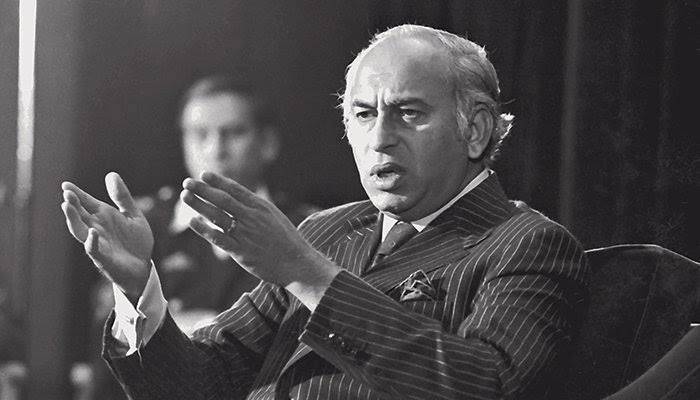
Zulfikar Ali Bhutto’s execution on April 4, 1979, remains one of Pakistan’s most contentious chapters, a blend of political vendetta, judicial controversy, and international intrigue. The question of whether Bhutto genuinely believed he could escape the noose cuts to the heart of his character, a blend of defiance, fatalism, and strategic foresight. Drawing from his personal writings, family recollections, associate accounts, declassified United States documents, trial records, and additional sources, including Urdu narratives of his final days, such as M.A.K. Chaudhry’s Martial Law Ka Siyasi Andaz, the evidence overwhelmingly suggests a leader who anticipated his demise.
Bhutto did not harbour delusions of survival; he viewed his fate as inevitable under Zia-ul-Haq’s regime, driven by fears of his political resurgence and broader geopolitical pressures. This anticipation transformed his ordeal into a calculated embrace of martyrdom, ensuring his legacy would endure beyond the grave.
Bhutto’s own writings, smuggled from his death cell and published as If I Am Assassinated, lay bare a man attuned to the endgame. He framed his trial as a sham designed to eliminate him, writing of the military’s terror that he might reclaim power if spared. He rejected exile as a betrayal and foresaw unrest, a “conflagration” following his execution. His words drip with resignation: “More than my life is at stake. Make no mistake about it, the future of Pakistan is at stake.” Death was portrayed as a “sweet” sacrifice for equality, amid condemnations of in-camera trials and propaganda.
In diary notes from the death cell, he vividly described his torment: “Since 18th March 1978, I have spent twenty-two to twenty-three hours out of the twenty-four in a congested and suffocating death cell.” He confronted the gallows head-on: “I was not born to wither away in a death cell and to mount the gallows to fulfil the vindictive lust of an ungrateful and treacherous man,” and “If I am assassinated through the gallows, these questions will nevertheless be put very loudly.” Such reflections reveal not surprise but preparation — he even burned pages of his writings, resigned to the possibility that they might never see the light of day.
Earlier warnings amplified this foreboding. In Parliament in April 1977, he declared, “the bloodhounds are after my blood,” and noted August 1976 threats from a superpower to make a “horrible example” of him over nuclear policy. A May 7 1978, letter from Kot Lakhpat Jail to Chief Justice Anwarul Haq requested recusal, citing the “dark shadow of the Martial Law” over his appeal, implying lethal peril arising from judicial bias and resentment over constitutional changes.
Family insights deepen this portrait of stoicism and foreknowledge. Begum Nusrat Bhutto recalled early premonitions, even during their 1951 engagement, a fortune-teller predicted his end at the age of 48 at the hands of enemies. In jail, he told her starkly: “They are going to hang me. Because Zia knows if he does not hang me, I shall come back to power.” He banned mercy petitions, vowing suicide if freed humiliatingly, emphasising dignity. Their final meeting evoked composure; he shaved and bathed routinely, remarking upon seeing her and Benazir: “Achha… Both of you have come.” He enquired about the 5 a.m. execution time and welcomed death with a smile.
Islam recalled Bhutto rejecting proposals for armed struggle and instead emphasising dignity and historical destiny. His account provides some of the clearest evidence that Bhutto consciously rejected last-ditch escape options and had reconciled himself to death
Benazir Bhutto’s Daughter of Destiny depicts a father focused on legacy amid impending doom. She was oath-bound in his cell to perpetuate his mission, detailing visits overshadowed by death where he schooled her in politics. “I told him on my oath in his death cell, I would carry on his work,” she wrote, without illusions of salvation. In interviews, Benazir admitted treating each visit as potentially final, once feigning illness to avoid one but attending nonetheless. She awoke at 2 a.m. on the morning of the execution, screaming, “No! No! Papa! Papa!” Their last encounter, 14 hours prior, saw pleas for the cell door to be opened denied; Bhutto grasped the finality: “This means it’s the last meeting,” requesting Shalimar perfume so he could “smell nice” when returning to the earth.
Urdu sources such as Nawaiwaqt and Dawn Urdu add emotional layers. Informed at midnight by the superintendent, Bhutto briefly disbelieved before composing himself, resting, then showering, shaving, and dressing anew, declaring: “If I am to meet my Lord today, I want to do so while I am paak.” On the gallows, unmoved, he murmured faintly, “This to me?” and “God help me, for I am innocent!”
These accounts align with other narratives showing surrender after dashed hopes of uprising. He lamented to a jailer, “Where are all the bastards who were willing to lay down their lives for me?”
Tariq Islam, Bhutto’s nephew, who visited him in his death cell on March 27 and March 30, 1979, recalled his uncle’s mindset in a letter published in Dawn on April 22, 2010. Islam recalled Bhutto rejecting proposals for armed struggle and instead emphasising dignity and historical destiny. His account provides some of the clearest evidence that Bhutto consciously rejected last-ditch escape options and had reconciled himself to death. Acting at the request of Mir Murtaza Bhutto, Islam flew from London, where he was then a student, to Islamabad on March 24, 1979, carrying two urgent messages.
One sought Bhutto’s permission for Murtaza to relocate to Afghanistan and wage a guerrilla war against the regime, an option reportedly encouraged by the Afghan government under Hafizullah Amin. The other message came from Palestine Liberation Organisation leader Yasser Arafat, who regarded Bhutto as a “soldier of Islam” and was prepared to deploy his organisation’s resources to free him from Rawalpindi Central Jail.
Islam met Bhutto on March 27, allowed just thirty minutes to whisper across the bars of the tiny, heavily bugged cell while police and military officers stood listening nearby. Bhutto flatly rejected both proposals. At the suggestion of Mir Murtaza’s move to Kabul, he flew into a rage, snapping words Islam recalled vividly decades later: “Did I send Mir to Harvard and to Oxford to learn about all this stuff? Already they are calling me a murderer and a smuggler,” a reference to the regime’s claims that If I Am Assassinated had been illegally smuggled abroad. The vehemence of his refusal even in the face of armed rescue and foreign backing underscores not hope of survival but a deliberate choice to confront his fate and preserve the historical meaning of his death.
Aziz Ahmad, Bhutto’s former foreign minister, provides poignant context through accounts of Bhutto’s final foreign trip in June 1977 to Muslim countries such as Libya and Saudi Arabia. Amid negotiations with the opposition Pakistan National Alliance, Bhutto abruptly departed, leaving the accord unsigned. When Ahmad questioned the purpose of the trip, Bhutto replied enigmatically: “I went to say goodbye.”
On July 5, Bhutto calmly phoned Zia: “What’s happening? I hear the army is on the move. Is that correct?” Zia confirmed the takeover, apologising: “I’m sorry there was no other way out”
This suggests early foreboding of downfall, perhaps sensing the military’s brewing coup. Ahmad later contributed to appeals against the death sentence, drafting a secret plea with others arguing insufficient evidence and national risks, warning Zia of divisions akin to Turkey’s after Adnan Menderes’s execution, severe reactions in Sindh and external vulnerabilities. Bhutto, however, refused personal clemency, telling allies: “A Muslim’s fate is in the hands of God Almighty. I can face Him with a clear conscience and tell Him that I rebuilt His Islamic state of Pakistan from ashes into a respectable nation.”
M.A.K. Chaudhry, who was federal interior secretary when martial law was imposed in July 1977, in his Urdu book Martial Law Ka Siyasi Andaz, offers detailed insights into the night of July 4 1977, the eve of the coup, capturing Bhutto’s mindset amid escalating crisis. After a defiant July 3 press conference rejecting a “super government” and declaring readiness to retire to Larkana regardless of successors, Bhutto decided to finalise the opposition accord. In a cabinet meeting around 7 p.m., discussions with advisers such as Hafeez Pirzada, Ghulam Mustafa Jatoi, and Mumtaz Bhutto revealed tensions. Pirzada opposed signing, calling the Pakistan National Alliance unreliable and suggesting the agitation had waned, allowing time to “level the score”. Jatoi countered, warning of renewed protests and martial law within weeks. Bhutto overruled them, insisting: “Enough is enough. I want to finish it,” and announced in a late-night press conference (11:30 p.m. to 1:30 a.m.) his intent to sign the accord the next day.
Notably, Chaudhry mentions that on the same evening, General Zia hosted a reception and dinner for the outgoing United States Ambassador Henry Byroade and his wife at the Army House in Rawalpindi, attended by senior military officers, Foreign Minister Aziz Ahmad, and other civilians. This event, occurring amid political turmoil, was later viewed by Bhutto’s advisers as a potential signal of impending betrayal, bypassing standard protocols and hinting at Zia’s preparations for the coup. A brief post-cabinet meeting with General Zia saw him emerge hurriedly, foreshadowing betrayal. As army movements began around 2:30 a.m. on July 5, Bhutto calmly phoned Zia: “What’s happening? I hear the army is on the move. Is that correct?” Zia confirmed the takeover, apologising: “I’m sorry there was no other way out.” Bhutto requested relocation to Murree and family safety, showing no panic but acceptance of an uncontrollable shift. This composure hints at underlying anticipation.
Trial records and associate recollections further evidence this foresight. On December 17, 1977, uttering “I have had enough!” of humiliation, Bhutto was deemed mentally disturbed and excused from proceedings under section 540-A of the Code of Criminal Procedure. He boycotted the trial from January 24, 1978, refusing defence beyond claims of bias and fabrication, adopting obduracy under section 342. In the Supreme Court addresses (December 18–21, 1978), he denied conspiracy, asserting fabrication to “eliminate him politically and physically”.
Declassified United States documents highlight international foreknowledge and futile interventions Bhutto likely intuited. On May 21, 1978, in Beijing, Deng Xiaoping queried Zbigniew Brzezinski on Zia’s non-execution pledge to China versus rumours of United States support for the death sentence. Brzezinski denied this, stating, “It is not true… We feel that public pressure would not be helpful,” amid concerns about nuclear complications complicating aid. The United States anticipated hanging; a February 15, 1979, telegram from New Delhi shared the ambassador’s view with Indian Prime Minister Morarji Desai, who concurred. A March 19, 1978, Islamabad telegram detailed a demarche urging clemency, warning of diplomatic damage and global backlash. Allies such as Saudi Arabia, Iran, Libya, the Soviet Union, China, and even Pope John Paul II all intervened to rebuff.
Given that Bhutto’s fate roiled major capitals from Washington to Beijing, from Riyadh to Tripoli, it strains credulity to assume that Begum Nusrat and Benazir remained unaware. As appeal orchestrators, relaying messages during visits, they surely conveyed this reality to Bhutto. Yet global clamour only solidified his anticipation; he spurned compromise, prioritising legacy over survival.
Collectively, these accounts depict Bhutto as prescient, not optimistic. His “goodbye” tour, refusal of clemency, composure during the coup, and defiance in the death cell reveal a man who foresaw the end and chose dignified confrontation. Not delusion, but strategy. Death became the final political act, transforming the gallows into a legacy and execution into immortality.