

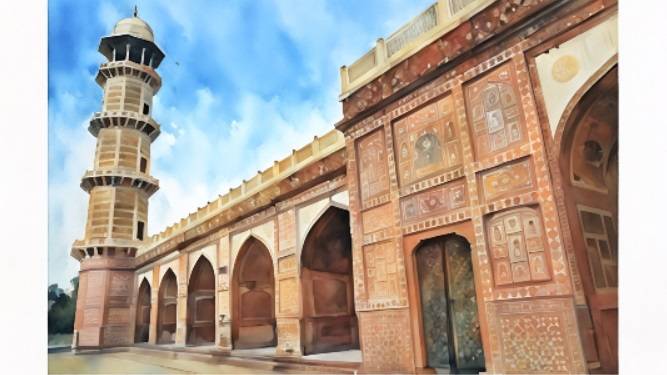
Click here for the previous entry in this series
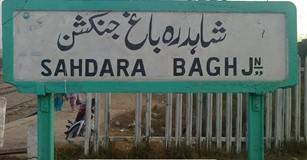
Shahdara, literally ‘the royal entrance’, is a now a large town on the right bank of the River Ravi opposite Lahore. It is so named because it was the royal entrance to Lahore for the Mughal emperors, princes and the elite coming from Kabul and Kashmir. The town started its life as the site of many gardens built during the Mughal era. The name of its railway station, as given by the British in the 1870s (picture below), was Shahdara Bagh; a name that depicts its reason for fame.
Till the Sikh era, Shahdara was connected with Lahore by a ferry located about two kilometres upstream of the railway bridge. Well-worn unpaved tracks connected the ferry with Badami Bagh and Shahdara. A small village, also by the name of Shahdara, came to exist a little north of Jahangir’s Tomb complex. Gradually, the town has now extended to both sides of the GT Road.
The first recorded structure in Shahdara region is the Mughal Serai. The Serai is a large single-storey rectangular building of 470-meter length and 365-meter width. It has 180 guest rooms with a chaharbagh in the centre. It was either built or refurnished by Emperor Akbar, as it is reported to have been originally built by Sher Shah Suri; one of the many that he built along his Jarnaili Sarak. The tombs of Jahangir and Asaf Khan were built outside its eastern and western walls. The Serai is provided with a small mosque along the path connecting the two tombs. One of Serai’s impressive features is the massive gateway to Jahangir’s tomb enclosure, built as a part of the tomb complex. During the early British era, the rooms adjacent to the gateway served as dak bungalow because the cool environment of the large gardens provided relief from the Lahore summer heat. Later, when railway line was being constructed in 1870s, these rooms were occupied by the British technical staff as living quarters.
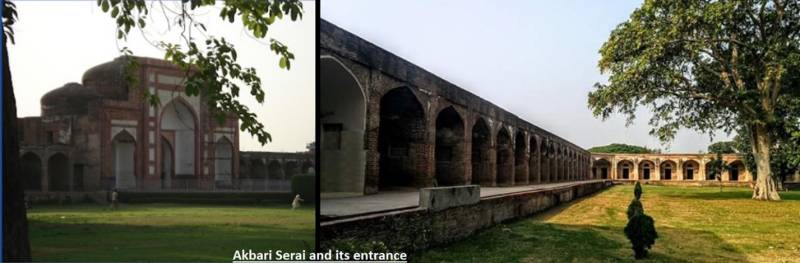
Standing in the centre of the Chaharbagh, the Serai looks wide and regal and one can visualise it thronging with visitors of various nations and regions in that long-lost time 500 years ago when travel was difficult and there were no hotels. The Serai is in a good state of repair, though not much has been done for its preservation.
The genesis of this garden as the grand Mughal burial site began with the death of Jahangir. He, like his father before him, was enamoured by the Vale of Kashmir and often spent his summers in the cool environs of Srinagar
The next structure, perhaps the first Mughal monument, to be built in Shahdara was the marble Baradari and its accompanying garden. Prince Kamran was a younger step brother of Emperor Humayun and, like all Mughal princes, hostile to his elder brother. While Humayun was crowned the Emperor in 1530, Kamran was entrusted with the governorship of the vast area extending from Kabul to Kandahar and Lahore. However, he refused to help his elder brother in the latter’s losing contest with Sher Shah Suri. Eventually, Humayun blinded Kamran to stop him from conspiring against him. In 1530, Kamran created a garden on the right bank of the River. He added the Baradari in 1540; the year when Humayun fled India after being defeated by Sher Shah Suri. Over time, the garden was gobbled up by the changing course of the Ravi, turning the Baradari into an island. Now the restored structure once again lies on the right bank of the river and a garden has been added to it. Kamran’s name lives on only because of this elegant baradari.
Here is one of those places where one feels the grandeur of Mughal Empire, as also the weight of history. It has become a favourite place for family visits and picnics
Built as a pleasure garden, the place took a sinister turn in 1605 when Jahangir defeated his rebellious son Prince Khusrau near Lahore. The prince, along with his 300 imprisoned companion soldiers, was brought in chains to Jahangir in this same Baradari, who ordered the companions to be impaled on stakes placed from the Baradari to the Fort, three kilometres away. Later, the prince was dragged along the entire length of these stakes, as he watched his wretched soldiers dying in utter agony.
During the Mughal era, when needed, a temporary bridge of boats would be built over the Ravi near the Baradari using about 50 boats. Subsequently, when the British took over Lahore, a permanent bridge of boats was constructed near the Baradari, where the current Lahore-Shahdara multi-lane road bridge stands. The boat bridge was so efficient that its design was used to build boat bridges over other Punjab rivers. The Baradari then became the residence of the European superintendent of the bridge. The building was also used as the office for collection of tolls from bridge users. When the boat bridge was dismantled in about 1915, the Baradari served as the Public Works Department (PWD) rest house. Subsequently, it fell into neglect but in 1989, it was renovated and brought to its past glory. However, regretfully, its walls are full of graffiti, as many visitors have used them for writing their names, cell phone numbers, or messages for their beloveds. Our nation in general holds no value for our heritage.
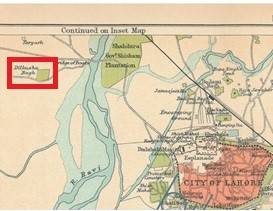
A 1907 map based on data collected in the late 1800s shows a Dilkusha Garden south of Taragarh in Shahdara, a little distance from the bridge of boats. It is now difficult to pinpoint the location of this park because the river has partially dried up, robbing it of its many smaller channels. The road alignments too have changed over the previous a hundred and fifty years and the population has exploded, turning green areas into concrete jungles. A correlation of the old and the new maps indicates the park to have been south of the eastern end of the Baradari Road that emanates from Begum Kot road-crossing. However, it is also known that Empress Nur Jahan had built a vast garden named Dilkusha around the existing Akbar’s Serai. The location of the new Dilkusha garden near the Baradari, a kilometre and a half from Nur Jahan’s tomb, is intriguing and needs investigation. The extant of the original Dilkusha is not known, however, it must have been massive. Since then, it has been encroached upon during the period of Mughal disintegration (1707-1770), the Sikh rule (1770-1845), and then, during the early British era, because the railway line separated Nur Jahan’s tomb from the rest of the complex. Col Goulding (Old Lahore) wrote that in 1854, the Punjab Chief commissioner allocated 6,000 rupees to protect the monuments from floods by building a protective embankment. The tomb complex is still spread over a large area of 82 acres with a perimeter – as measured on Google maps – of about 3.4 kilometres.

The genesis of this garden as the grand Mughal burial site began with the death of Jahangir. He, like his father before him, was enamoured by the Vale of Kashmir and often spent his summers in the cool environs of Srinagar. In the summer of 1627, the severely alcoholic ailing 58-year old monarch proceeded to Kashmir. The usual Mughal route was from Lahore to Bhimbher, Nowshehra, Rajouri, the Pir Panjal Pass, or, as it is also called, ‘Pir ki Gali’, to Shopian, Pulwama and Sri Nagar. The winding road through the Pir Ki Galli is still known as the Mughal road. The visit was of no help to the ailing emperor. His return was delayed and by the end of October, when snows had already started falling, he could only manage to reach Rajouri. He didn’t survive the cold and died there. His body was transported to Lahore and buried by Nur Jahan in her Dilkusha garden. When Shahjahan became the emperor, he ordered a magnificent red-stone mausoleum to be built for his father. This was first of the three mausoleums to be built in Shahdara.
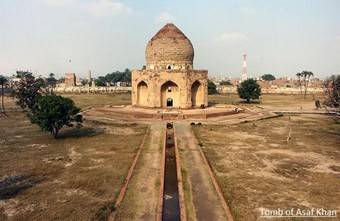
The next Mughal dignitary to be buried here was Asaf Khan. He was brother of Empress Nur Jahan, father in law of Shahjahan and father of Mumtaz Mahal, the chief occupant of Taj Mahal at Agra. He had been the prime minister to Shahjahan before becoming the Vakil, or the next in rank to the Emperor but without any responsibilities. In 1641, while leading an army against a rebel Rajput raja in Rajasthan, he died near Ajmer Sharif. Shahjahan had his body brought back to Lahore and buried in Shahdara in a grand tomb, surrounded by a 300 feet-sided chaharbagh, which was set with water reservoirs, fountains and pathways. The tomb is opposite to and connected with the burial place of Jahangir. Its architecture is octagonal with each side of 38 feet. Its bulbous dome is an innovation of Shahjahan’s era and was later superbly employed in the Taj Mahal. It is of double height with a gallery inside the tomb at the first-floor level. The cenotaph is made of white marble inscribed with ninety-nine names of Allah. The tomb took four years to complete at a cost of three hundred thousand rupees.
The third tomb built here is of Jahangir’s favourite queen, Empress Nur Jahan. Jahangir’s death was followed by a brief upheaval and contest for inheritance. Prince Shaharyar was the youngest son of the late emperor and the younger, probably uterine, brother of Prince Khurram, who would later rule as Emperor Shahjahan. Shaharyar was son-in-law of Nur Jahan, who had him proclaimed as the Mughal Emperor immediately after Jahangir’s death. Prince Khurram was in Deccan at the time of his father’s death but had entrusted Asaf Khan with taking care of his interests. Asaf Khan too favoured Shahjahan who was his own son-in-law. Thus, the forces of brother and sister were arrayed against each other, both wanting their daughters to become the queen of the empire. In a battle near Lahore, Asaf Khan prevailed and had Prince Shaharyar first blinded and then, on the orders of Shahjahan, killed. Shahjahan became the emperor and later built Taj Mahal in honour of Mumtaz Mahal. Nur Jahan and her daughter, Mihr-un-Niassa Begum, also known as Ladli Begum, lived in regal imprisonment till their death in 1645. Both are buried side by side in Nur Jahan’s tomb. This author, as indeed every other visitor who knows a bit of this history, once visited the dark chamber under the grand canopy over the twin sarcophagus, and looking at the lonely and the dilapidated dusty graves in the dimly lit basement, came back with a melancholy heart. Royalty is indeed a game of thrones, and a brutal game at that. Jahangir was right when in a pensive mood he said that the kings had no relatives, not even their sons.
The Shahdara tomb complex is a piece of our national heritage. It is on the tentative list of UNESCO World Heritage Sites.
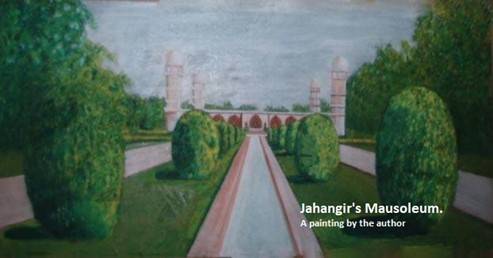
Here is one of those places where one feels the grandeur of Mughal Empire, as also the weight of history. It has become a favourite place for family visits and picnics. This author has visited the place a number of times and even turned a picture he took into an oil painting. During the last visit, he was accompanied by his daughters, sons-in-law and grandchildren, who were enchanted by the stories related to the buildings spread around this elegant Mughal site.