

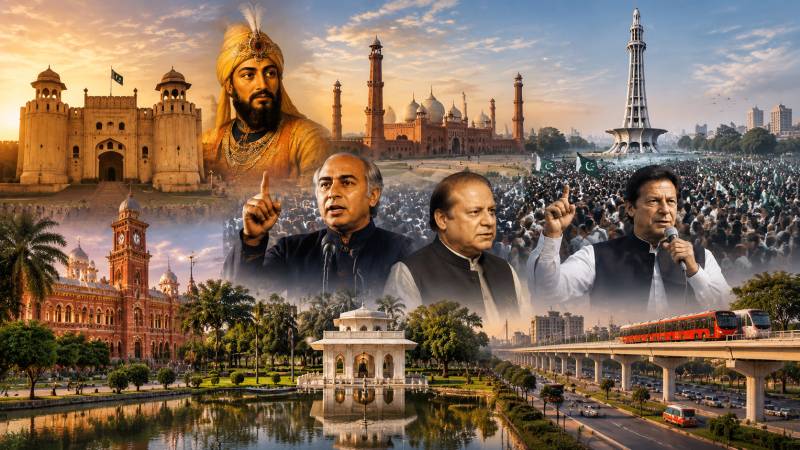
Lahore is not merely a city. It is a historical argument about power. Mughals made it an imperial capital. Maharaja Ranjit Singh made it the centre of a Sikh kingdom. The British transformed it into a colonial administrative and cultural hub. Pakistan turned it into a centre of politics, commerce, education and culture. Governments changed, rulers rose and fell, political movements were born and defeated, yet Lahore endured absorbing every age without belonging entirely to any of them. Perhaps that is why Lahore is best understood not through its rulers, but through the relationship between the city and power.
When Maharaja Ranjit Singh entered Lahore in 1799, he did more than conquer a city. He understood its political and symbolic importance. In 1801, he was crowned in Lahore, and for nearly four decades the city remained the capital of his expanding Sikh Empire. Lahore Fort became the seat of his court and government. The gardens, gateways, courtyards and ceremonial spaces of the city were incorporated into a new political order.
Ranjit Singh’s Lahore was a city in which power was deliberately made visible. Yet history is rarely as simple as the triumph of one ruler over another. Ranjit Singh inherited a city layered with Mughal architecture, Islamic institutions and centuries of cultural memory. Some monuments were preserved and restored; others were altered or repurposed. His legacy, like Lahore itself, was therefore neither wholly destructive nor wholly preservative. It was another layer added to an already extraordinary historical palimpsest. The ruler eventually disappeared. The city remained.
Almost a century later, Lahore acquired another kind of political significance. In 1940, the historic Lahore Resolution gave the city a defining place in the political story that culminated in the creation of Pakistan. The Minar-e-Pakistan, built later to commemorate that moment, became more than a monument. It became a stage upon which successive generations would redefine Pakistan’s political aspirations.
One of the most consequential transformations came in 1967, when Zulfikar Ali Bhutto founded the Pakistan Peoples Party in Lahore. Bhutto’s politics represented a fundamental departure from the established political order. He sought to take politics beyond traditional elites and give the language of power a distinctly populist vocabulary. “Roti, Kapra aur Makan”—bread, clothing and shelter was not merely an election slogan. It represented an attempt to give political expression to economic deprivation and social exclusion.
Governments change. Political parties rise and decline. Leaders are celebrated, condemned, exiled, imprisoned and sometimes returned to power. But cities possess a longer memory than governments.
If Ranjit Singh’s Lahore represented power, Bhutto’s Lahore represented the mobilisation of people. The city had begun to perform another function: it was no longer merely where rulers governed. It was where political movements were born. Then came Nawaz Sharif. Few modern Pakistani politicians have been as closely associated with Lahore as Nawaz Sharif. Under his political leadership, Lahore increasingly became the showcase of a different conception of politics: development.
Roads, bridges, mass transit, urban infrastructure and large public projects became instruments through which government sought to make itself visible in everyday life. The underlying proposition was simple: citizens should be able to see the state working, not merely in government offices, but on the streets of their city.
The Lahore Metrobus and later the Orange Line became symbols of this development-oriented politics. Its critics questioned whether mega-projects received too much attention at the expense of basic public services, education, healthcare and institutional reform. Its supporters argued that a rapidly expanding metropolis required modern infrastructure and that visible development was itself an important form of governance.
The debate remains unresolved. But Nawaz Sharif undoubtedly helped make development a political identity in Pakistan. Then came the paradox. The politician who had made construction and development central to his political vocabulary also experienced the fragility of political power. After his government was overthrown in 1999, Nawaz Sharif was imprisoned and subsequently went into exile in Saudi Arabia. His attempted return in 2007 was initially thwarted, but his eventual return to Pakistan and particularly to Lahore, became another chapter in the city’s long history of political homecomings.
Lahore had once again become more than a geographical location. It had become a symbol of political return. Then, in 2011, the city witnessed another defining political moment. At the Minar-e-Pakistan, Imran Khan’s Pakistan Tehreek-e-Insaf held a rally that marked the emergence of a powerful new political force. The gathering transformed the political landscape and demonstrated that a movement built around anti-status-quo politics, accountability and change could mobilise a mass constituency.
The symbolism was impossible to miss. The same monument associated with the political aspirations that preceded Pakistan’s creation had become the stage for a new generation demanding to redefine the country’s political future. If Bhutto had mobilised the language of class and economic deprivation, Imran Khan mobilised the language of change, accountability and resistance to the political status quo.
Once again, Lahore had reinvented itself as a political stage. Four men, therefore, offer four very different interpretations of Lahore: For Ranjit Singh, Lahore was power, the capital of an empire; For Bhutto, Lahore was the people, the birthplace of a mass political movement; For Nawaz Sharif, Lahore was development, a city through which the state could demonstrate its capacity to build; For Imran Khan, Lahore became resistance, a place from which the political establishment could be challenged.
These interpretations are different, but they share one remarkable characteristic: each sought to use Lahore not merely as a place from which to exercise power, but as a source of political legitimacy. And that may be Lahore’s greatest political gift. The city gives movements a historical vocabulary. Its streets carry memories of empires. Its monuments recall independence. Its political gatherings invoke generations that came before. Its architecture makes every contemporary political claim part of a much longer story. But Lahore also imposes a discipline upon its rulers. It reminds them that power is temporary. Ranjit Singh’s empire disappeared. The British departed. Bhutto’s government ended in tragedy. Nawaz Sharif experienced both extraordinary political authority and prolonged exile. Imran Khan moved from electoral victory to political confrontation, imprisonment and continuing resistance.
Yet Lahore remains. This is perhaps the central lesson of the city’s history. Governments change. Political parties rise and decline. Leaders are celebrated, condemned, exiled, imprisoned and sometimes returned to power. But cities possess a longer memory than governments.
The real question, therefore, is not which of these men was the greatest. It is what each conception of power left behind: Ranjit Singh left Lahore a chapter of imperial history; Bhutto left it a vocabulary of mass politics; Nawaz Sharif left an imprint of development-oriented urban politics; Imran Khan left a powerful language of political disruption and resistance. But none of them owns Lahore. No ruler ever has. The city belongs to its people, and to the generations yet to come. That is why the future of Lahore cannot be measured only by the height of its buildings, the length of its roads, the number of metro stations or the size of its political rallies.
A great city must preserve its history while creating opportunity. It must build infrastructure without destroying heritage. It must grow economically without sacrificing dignity, environment and public space. Above all, it must make its citizens feel that the city exists for them, not merely as a monument to those who govern it. Ranjit Singh conquered Lahore, Bhutto politicised it, Nawaz Sharif sought to build it, Imran Khan challenged the political order from it. But Lahore outlived them all, and perhaps that is the final wisdom of this remarkable city:
Rulers come and go. Power changes hands. History moves on. Cities remain. The true measure of leadership, therefore, is not how long a ruler occupies Lahore, but what he leaves behind when Lahore no longer needs him.