

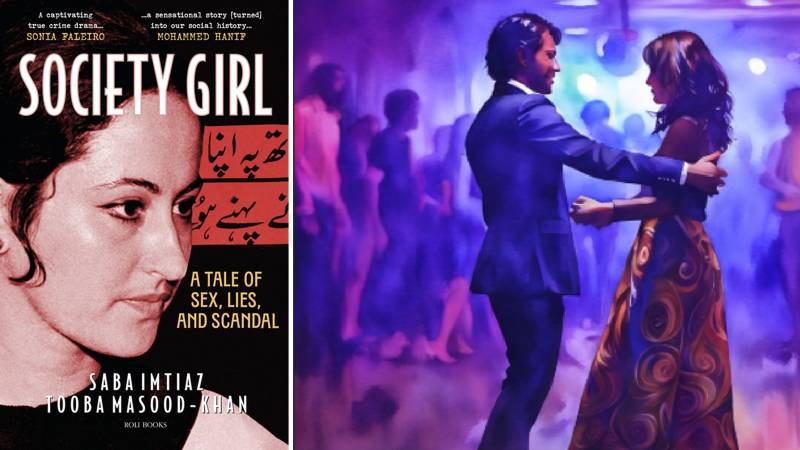
The decade of the 1970s began in Pakistan with suicides – both individual and national. It was 12 October 1970 that the renowned Urdu poet and civil servant Syed Mustafa Hasnain Zaidi committed suicide in his house in Karachi, just a year before the idea of Pakistan committed suicide on 16 December 1971. Interestingly, in both these cases, suicide was made to look like a homicide – in case of Zaidi, a woman Shahnaz Gul, who was found unconscious in his house was accused of killing the poet, and for later, it was India’s war that was painted as the reason for the death of united Pakistan. Both these intriguing tragedies have been well documented and presented in a recently published book Society Girl by journalists Saba Imtiaz and Tooba Masood. The book is more than ‘A Tale of Sex, Lies and Scandal’ as it not only helps in understanding the socio-political environment ridden with exploitation and contradictions where such suicides become inevitable, but also a great example of how socio-political histories can be turned into an engrossing read.
Based on thorough research of archival material and interviews with many of the people who were witness to Mustafa Zaidi’s life and death, the book provides an objective clue to the inevitability of both Zaidi’s and united Pakistan’s deaths. The story and the larger narrative are laid out serpentine style – it doesn’t get you bogged down in either a personal story or country’s history – facts keep pouring in which keeps a reader firmly glued to the seat until the last page.
The facts of the case, especially details of mishandling of it by the police, raise expectation, as it may have happened in 1970, that the death was not suicide. There was confusion regarding the first autopsy, so another was conducted for which the body was exhumed which added spice to the entire case. Problem was that as Mustafa Zaidi left no suicide note few were willing to believe that a poet of his stature could indulge in self-harm. Mentored by another renowned poet, Josh Malihabadi and friends with icons like Faiz Ahmed Faiz, Zaidi was a well-known name. His death got many excited and so everyone from the higher Sindh judiciary, politicians like Zulfikar Ali Bhutto to the West Pakistani media, went after Shahnaz Gul, the socialite found unconscious in the adjoining room, to prove that the death was a murder. But months of legal proceedings could not prove the woman’s culpability in his death leading to the conclusion in the court room that Mustafa Zaidi had indeed committed suicide.
However, the more interesting angle of the book is the exposé of the crudeness and hypocrisy of the urban upper-middle class of the then still young country. The media and other segments of the elite were too eager to skin a wrongly accused woman without questioning credibility of the renowned poet including his mental health. Thus, the authors draw an obvious conclusion that Zaidi probably suffered from mental issues, which was not thought about too seriously then, or even now. It was his image of a famous poet, senior civil servant and someone who moved around in elite circles that concealed his personal flaws from public. For example, going through the material in the book, we are exposed to his viciousness in trying to physically and emotionally control a woman he was so obsessed with. Police investigation discovered the flyers he got printed using personal contacts that carried a secretly taken naked photograph of Gul with the title “Christine Keeler of Karachi.” Had he distributed those flyers, it would have tarnished her image by equating her with the notorious English model Christine Keeler, who was accused in the British press during the early 1960s for links with the famous Profumo affair, which was a spy scandal. Keeler’s name was also popular in Pakistan due to another story that got splashed around in British media about General Ayub Khan flirting with her at the swimming pool at a private mansion in Cliveden, UK, to which the dictator was taken by Pakistan’s high commissioner. She had claimed in her interview to the press about Ayub Khan that: “he was more English than the English” and that she kept “as close to him in the water (swimming pool) as I could during the fun and games. Small wonder that in the heat of a game he grabbed me by the legs – and down I went.” Other witnesses present in the party saw that: “the man who saw Christine Keeler topless was President Ayub Khan of Pakistan.” The mini-diplomatic row between Karachi and London that erupted on the story due to the noise created by Justice AR Cornelius and inapt handling of British press by Pakistan’s High Commission, was finally sorted by “sensible” handling by the Foreign Minister Zulfikar Ali Bhutto.
Though a woman of flexible morality, the real problem was not just Shahnaz Gul’s character but the rampant perversion of the elite circles in Karachi and rest of Pakistan. The media and public that went after her forgot that she was one of the many cases of upper-middle class households where husbands aspiring for greater power and riches used their spouses to open doors for greater upward mobility. Indeed, the end of the case didn’t put an end to this behaviour. There are many stories waiting to be investigated and told of wives and even daughters used to climb up. I am reminded of a man, who many years later, who used his wife to open many doors – even shutting his eyes to the establishment to use her to service some Afghan mujahideen leaders in return for influence for the state and personal gains for her husband. Thus, Gul’s husband, Saleem Khan was typical. Notwithstanding commitment to his wife whom he supported through his presence during the length of the court case, the fact is that he knew quite well that she was absent from home the entire night and would be found at Zaidi’s house where she was later found unconscious. The affair was public, as Zaidi had written several love poems for Gul.
A more interesting angle of the book is the exposé of the crudeness and hypocrisy of the urban upper-middle class of the then still young country
The Sindh Club- and Gymkhana-going elite of those times and even now are the ones as perverse as the poet, who had numerous affairs including the notorious one with Shahnaz Gul despite being married to a German woman Vera with whom he had two children. His sexual deviance was ignored because it was an acceptable norm amongst the particular upper class where everyone else knows about the rot but remains silent as long as one is not caught. It’s just like many in Pakistan consume alcohol within their circles or laced in coke so to hide it from the crowd.
Zaidi’s behaviour was probably seen as a necessity for intellectual inspiration for men of literature for creating enchanting verses. From Mustafa Zaidi, Faiz Ahmed Faiz, Muneer Niazi and many other known names, sexual and cultural deviance was forgiven as liberalism. Around the time Zaidi was preoccupied with Shahnaz Gul, another big poet of leftist leaning, who was also taken to see the dead body and scene of death, was hobnobbing with a woman from a big publishing house family in Karachi. This behaviour justified or ignored as secular liberalism was part of the contradiction that existed amongst the literary elite then and even now. On the one hand, most poets had and still have an elite lifestyle – consuming alcohol, indulging in extra-marital affairs, being entertained by affluent female hosts and socialising with societal elite to whom this kind of living was acceptable. On the other, they lamented the tragic life of the working class that was mired in religious conservatism and for whom the liberal lifestyle was foreign.
Pakistan’s liberalism has always suffered from being more inherently cultural than political with the intellectual elite, which included all the names I have mentioned above, being popular publicly for raising voice for the politically dispossessed of the land while spending their evenings with the brutally powerful. Khushwant Singh caught this contradiction so well in Faiz Ahmed Faiz’s obituary, describing the leftist poet as “a Communist but more at ease amongst Capitalists, a man who denied God and yet was most god-fearing.” Singh further writes about how Faiz’s poetry changed after being made President of the National Council of Arts and getting a big bungalow after which it was “more Scotch than sonnets of love.” Probably because Pakistan’s leftists or Communists inherited sympathy for the state from the pre-partition days, especially many that migrated from India were more supportive of the state than organic movements or local nationalism, the habit continued. I am reminded of a conversation many years later in 2009 with the poetess (late) Fahmida Riaz for whom General Musharraf was more acceptable for his cultural liberalism and as a symbol of progressive middle class with no attention paid by her to the fact that he had shattered the constitution of the state.
The intellectual liberal and leftist elite of Pakistan has always suffered from three problems: hiding their promiscuity behind liberalism, wrongly arguing that it is mullah alone that misinterpret secularism as ladiniyat (lack of religion) when they themselves are guilty of doing the same as they don’t focus on political values being the source of secularism but as a concept that allows their perversion, and inadvertently having little ownership of the general public or understanding of the source of their cultural ethos.
Such contradiction was also obvious in the way women were treated or the attitude women had towards themselves. I am referring to the broad margin that spouses of many great literary figures gave to their husbands that engaged in sexual deviance including many of the foreign wives. Zaidi’s German wife Vera, for example, knew about her husband’s affairs but stuck to him because, as claimed in the book, she believed that despite his deviance he loved her and their two children. An incident quoted in the book is about a poet Naseer Turabi visiting Zaidi’s house in Lahore where he found the poet locked up in his bedroom with an actress in knowledge of his wife. Perhaps, coming from lower-middle class or middle-class backgrounds, these foreign wives either had nowhere to go or were charmed into silence by the luxuries and societal attention offered in Pakistan courtesy their husbands. Zaidi, while being posted as deputy commissioner, Sialkot, named the stadium in his wife’s name that continues to be used. Back in Germany, where she had to shift after Zaidi lost his civil service job, Vera had to struggle for her economic survival and that of her children.
The masses of course remain sensitive to the power differential between themselves and the elite, thus tolerating the deviant behaviour of the rich and famous but are less forgiving when it happens amongst their own kind. This is probably the reason why many men and women, from Mustafa Zaidi to Imran Khan have lived and enjoyed their pervert life styles in the middle of religiously and socially conservative public. This is not tolerance but fear of both power and the powerful.
Only if perversion would be limited to socio-cultural norms. This elite and the power circles of the country are cold blooded, and it is worth admitting, equally responsible along with the military regimes of Ayub Khan and Yahya Khan in mistreating the masses, particularly those of the then East Pakistan. It was not just the Punjab dominated military but also the West Pakistani elite that mistreated and betrayed the masses in the eastern wing. There was hardly any press coverage of the devastating cyclone Bhola that took 300,000-500,000 lives. The press and the elite in the western wing were too busy following Shahnaz Gul’s trial. It was certainly a strategy, used even now, to keep attention diverted from regime’s petty treatment of the Bengalis. In the aftermath of the cyclone insufficient support was provided by the western wing dominated civil servants or the military, which in any case, had nothing more than two helicopters for rescue operations. This negligence was justified as a strategic necessity. Since, the eastern wing could not be defended from India, the defence of the east lay in the west. The reality is that when the war started with India, the strategy was never fully activated which was even protested by some army officers who then tried to attempt a failed coup.
I remember growing up in Lahore taught at a school a history that presented Bengali agitation as a result of brainwashing by Hindu teachers in East Pakistani schools. The loss of East Pakistan is still remembered as ‘dismemberment’, a stab in the back by India, rather than a partition necessitated by brutality of the state. This narrative was so much part of Faiz’s famous poem on Bengalis parting away from Pakistan:
“hum ke tehrey ajnabi itni madaraton key baad
Phir banege ashnaa kitni mulaqaton key baad”
(we stand estranged after so many hospitalities…
How many meetings will it take for us to get acquainted again…”
One wonders as to what “hospitalities” Faiz was talking about! Later, he issued a statement published in the Nawa-e-Waqt condemning the Bengalis and their movement as an India-inspired struggle.
The Ayub Khan era that is so eulogised and remembered today as decade of development sowed the seeds of dissent in the eastern wing. The popular narrative today that condemns Zulfikar Ali Bhutto’s policy of nationalisation ignores the fact that, notwithstanding many flaws of the policy and mechanism of implementation, it had its justification, at least at that time. The private sector of the 1960s owed its growth to the military regime and depended on state patronage to exploit national resources for their personal benefit without any visible aim of trickle down to the impoverished masses. They were a racket that milked resources of the eastern wing without investing the capital from where the resources were extracted. One of Pakistan’s biggest exports at that time was jute that grew in the eastern wing. It was processed using west Pakistani capital to feed the American war effort in Korea and Vietnam the financial benefits of which came to West Pakistan. The political protest and popular demand for autonomy was then brutally crushed. The Yahya Khan government and Bhutto were not inclined to transfer power to Sheikh Mujeeb-ur-Rehman, despite that he had gained majority in elections and virtue of higher population numbers qualified to become Pakistan’s prime minister.
The power and social elite in west Pakistan had its eyes shut to both the pillage and war in the eastern wing. There was no coverage of the ‘pogroms’ carried out by the regime in the east. As the book describes, there were parties in Karachi and as the evening newspaper, Star, a subsidiary of Dawn reported:
“71 has been a wonderful year…While midi dresses were popular, the report pointed out, there were common complaints – it doesn’t suit me or its too dowdy and ageing.”
A Pakistani journalist Anthony Mascarenhas, who was embedded with the army in the east, had to flee the country after his report was published in the London Times, titled “Genocide,” about conditions in East Pakistan. However, the Pakistani press was silent and, as mentioned earlier, obsessed with the Shahnaz Gul case. One of the most haunting images described in the book is of the post-1971 surrender new year’s party of a woman dancing away “seemingly lost to the world” just like rest of the elite that until the end was fed on the media campaigns that presented the “West Pakistani regime as victors.” Even the regime decided to reward its soldiers by setting up the Army Welfare Trust in 1971.
Since 1971, the propaganda campaigns that ignore the civil war in the eastern wing have continued, one of the latest being the 2022 documentary by Javed Jabbar arguing that fissures between the two wings were created due to years of Indian involvement. The Indian intelligence’s involvement in former East Pakistan is a fact but can’t help denying that in the gathering at Dhaka in March 1971, as witnessed by senior Pakistani police officers present at the occasion, Sheikh Mujeeb had raised the slogan of “joy Pakistan” (long live Pakistan) as he still hoped to become its elected leader but was denied the opportunity. Before losing the war with India, Pakistan’s government had lost hearts of the Bengalis. It is a possibility that had India not waged a war, Pakistan might have controlled the eastern wing for a bit longer. Nevertheless, a sustained relationship between the two wings had become impossible because of ill-treatment of the ruled by the rulers.
Pakistan’s problem is that it never experienced a regime change just change of faces which is why the powerful remain deaf to the voices that say it to its face:
Aaj tum mujh se meri jins-e-giran mangte ho
Halaf-e-zehn-o-wafadari-e-jaan mangte ho
Jao yeh cheez kisi madah sara se mango]
Taifay walon se dholak ki sada se mango
Apne darbanon se badtar fuqara se mango
Apne darbaar ke goonge shora se mango
Mujh se poochho to khanjar se adu bolega
Gardanein kaat bhi do ge to lahu bolega
(And today, you demand my most precious possession
You seek the loyalty of my mind and soul
Go, ask these things from those who praise you,
From the beaters of your drums,
From your gatekeepers or the poor beneath them,
From the mute poets of your courts
If you ask me, the dagger will speak against you
Even if you sever heads, the blood will speak)
(from Mustafa Zaidi’s Bename Watan)
If anything, Society Girl is a loud cry to break the deafening silence of the powerful by telling a history how it should be told.