

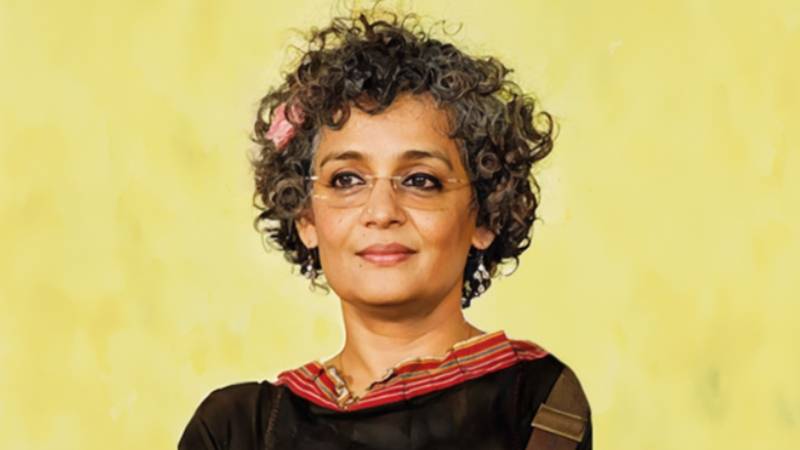
“Pakistan and India are not at war, stay assured— it’s their governments that is their upper stratum comprise, the business classes, film industries, top level bureaucrats, politicians and top brass generals. The poor public/people are not fighting each other. This war is a drama created by the ruling elites on both sides, who exploit fear and hatred for their own benefit.”
(Arundhati Roy, 2025)
My countrymen are angry at Arundhati Roy. They are angry at the pacifist, booker prize winning Indian author for saying what they feel is downright dumb. They disagree with her idea that elites manufacture war that harms others, not them. This will not be the first time that a woman has been called simplistic or deductive. It happens all the time.
Her political position on the disputed region of Kashmir comes from an elementary idea: you only see what you are designed to see. That those with microphones build pathways for the armies in this region. No army can go to war when the public is lukewarm. War requires a potent form of anger that is reserved for men with means. The weak know better than to be angry.
Warring armies in India and Pakistan fatten their defence contracts with fear, then trim it by hurting women and children on the other side, citing fair game. The military spending of Pakistan ranks 29 and India’s is sixth. Independence was supposed to be a boon. Yet as soon as the British left the subcontinent, both India and Pakistan have tried their best to outdo each other in the role of colonizer: India in Kashmir and Pakistan within its own border to its own minority communities.
But, for the world and for each other, they were free. They were democratic republics.
Democracy is supposed to keep military might in check. Information is supposed to keep democracy representative of citizenry. But if the media algorithm is in the hands of political elites, then truth is also in their hands.
I’m with Arundhati when she asks inconvenient questions at a time everyone would rather lace their spears with poison. When everyone is quick to choose a side, I want to bask in her kinder communication.
I used to be a big fan of the blade.
I used to like the idea of the neck of a tyrant under my blade.
Made for a better story.
It started with the state Pakistan Television broadcast on Kashmir. On the backdrop of 9/11 and President George Bush’s “us against them” binary, my language on war was about asking no pertinent questions.
The iron-handed rule over our own minorities is not a reason enough to lose the right to defend ourselves against Indian aggression, but Pakistan’s war-crazed elite men end up looking dumb, deductive and hypocritical
Conversely, when I would watch Indian state TV broadcaster, Doordarshan, where hate speech against Pakistanis was synonymous with terrorism. As I listened, I also let the poison seep into my bones. I let my opinions become facts; I let my feelings become reasons.
I had visions of pressing buttons in a Black Hawk to take down some non-friendlies (if you know what I mean) in India-occupied Kashmir. Kashmir, as every Pakistan Army Chief has so memorably said, was our jugular. In fact, my first piece of serious political writing on Kashmir was in 1999 on a South Asian internet blog called Chowk. I was in it. “You might not be interested in war, but war is interested in you,” Perhaps Leon Trotsky said this about the intoxicating power that war planes, war ships and surveillance drones offer for us in the 21st century. But for me, the motives were different. Moved by incessant reports of oppressive Indian brutality, especially the crimes against women and the disappearances of young men, I wanted war. I called for it back then.
Justice, I felt, would only be served by war.
I was interested in war. War was interested in me.
But eventually, as all keyboard warriors do, I ran out of steam. I landed that imaginary Black Hawk I was flying. I wanted to soothe the thirst that revenge had left in my throat. But there was no water – none from the Indus River, certainly – to drink. Waging war has its limitations.
The United Nations has, over the years, called for a referendum for Kashmiris to decide their own fate. But how do you decide your fate when you live under martial law? How do you decide your fate when you are caught in the crosshairs of a bilateral conflict that has nothing to do with you, but everything to do with the land you live in?
The tragedy in Pahalgam was a good example of that. Kashmiris came out in droves to help the injured and the dying, to protest the violence that had been carried out in their name. It was followed, days later, by war – by killings of civilians, including children, and by violating Pakistani sovereignty.
I found that going to war requires feelings becoming facts by way of opinion-makers, influencers, high pitched TV hosts. The stronger the defence spending, the angrier the feelings and vice versa.
The iron-handed rule over our own minorities is not a reason enough to lose the right to defend ourselves against Indian aggression, but Pakistan’s war-crazed elite men end up looking dumb, deductive and hypocritical. Our state controls us by adding arbitrary constitutional exceptions in the name of “Glory of Islam” and “national security”. To disagree is to get disappeared or publicly shamed or be fed to the blasphemy law clergy. Pakistan commits harrowing atrocities against its own citizens and does not even consider a woman to be worthy of testimony. It makes me wonder why the men who control Pakistan get to be angry at someone pointing out that we fail at courting power, persuasion, fear, and respect. They get angry when someone points out that war takes money we don’t have.
I know the realities of male anger, but I refuse to join the merrymaking of the war caravan.
We will all end up dried up like a raisin if it was up to them, and as much as “we will eat grass” sounds valorous, it is bovine. We need water, even if it is to humbly wash down the grass we will have to eat, God forbid there be a full-fledged war.
Women are left picking up the pieces of every aggression.
The poor take thrice as long to bounce back.
Men forget and move on to the next war path.
Children cannot.
People on the margins of Pakistan, despite being a majority, are muzzled.
They are strangers in their own lands.
Ignoring poverty, cruelty and social injustice in your own country’s people extends into casual cruelty for others.
The Pakistan army makes my cereal.
I want to protest because this is insular inward-looking insanity, or both.
I get to protest because my taxes have funded these lofty plans of world dominance.
I get to say sometimes sovereignty is less important than curry.
I get to say, I think you should stock take, not in stockpile but in your persuasion power.
Often Pakistan is in a state of international isolation.
There is no shame in being a victim.
Pakistan is victimized because of India is a bully, because islamophobia, for its proximity to China, and for being poor after eons of failed IMF economic policies.
I get to protest because I had to wait to be a resident of America to be able to say how crappy Fauji Cereal is. To say I’d rather eat the box.
Walking back from war requires growing up, putting the weapons down, and walking back to right your homegrown wrongs. The most macho thing right now is what Arundhati Roy is calling for.
Mostly because wars hardly solve what they said they would solve.
The truth is that this region could use a de-escalation.
After US-Soviet war in Afghanistan, the US declared war on the Taliban. Trillions of dollars, millions of deaths and three decades is what was invested to “eliminate” the Taliban. Yet, they lord over Afghanistan today, over its women and children.
Men forget. No matter the anger. They forget.
Moral disorders cannot be bombed away.
A fascist Hindutva government is bred with the intent to hurt Pakistan in extreme ways.
That is real and terrifying.
It deserves real terror.
Narendra Modi is not looking to right some wrongs for his people. India is an apex predator when it comes to the extractive policies against its poor. Its farmers. India’s justice system, lauded once for its impartiality decreed martial law in Kashmir. India is rooted in the caste system where the untouchables can never systemically be integrated into society. India struggles with its Sikh population’s access to power. Its stifling free speech against militant Hindus that lynch Muslims for eating beef.
So instead, Modi would rather fix what he thinks is an error in history after the creation of Pakistan. He is selling the dream of a Hindu South Asia, making sure that his people do not know Pakistanis, never care for them.
He has been voted in by millions in fear, to teach his neighbour a lesson with a clear imperialist agenda. If there is temptation to unite behind a brute-force leader during fearful times, it is because all war is rooted in misogyny. Modi is the man whose cronies in the fascist BJP raped Muslim women in Gujarat in 2002. He is among those who hold to dishonour men by dishonouring the women under their protection. He may have laid the widest net of fibre-optic cables to move India towards becoming an even larger economic powerhouse, but he does not permit humanity. Not his style.
Men like Modi go quiet after a storm.
No apology for Gujarat.
Gloating over what is essentially a martial law in Indian Occupied Kashmir.
His government will not wait for independent evidence that Pahalgam was Pakistan-led.
He will knee jerk.
Men like him also find joy in hovering their thumbs over red nuclear buttons and calling it honour.
Meanwhile, Pakistani politicians are looking for a mongoose-snake fight. They think that their army chief is a bit like the mad king in Game of Thrones. Maybe he’s so psychotic that the Indians will cry for a halt. But you see, every flailing government benefits from an unjust war.
Hope comes from off-the-page memes.
Not from state press releases.
It gladdens me that Indian-Pakistani young people are artfully sharing memes mocking the war.
They are voting with their street humour.
They are voting no to war.
They are reminding us of our own frailties, instead.
They too are India.
They too are Pakistan.
They may not be getting to have a direct say on the war, but their memes are in levity, and they are a protest, as I see it, against the banality of evil. The term was coined by Hannah Arendt.
Easy to let evil happen when you aren’t directly a target, but impossible when the guns turn to you. War by elites is therefore very self-referential and ill-informed. The people who suffer are not the people who sign up to suffer.
In his epic novel, Dracula, Bram Stoker wrote,
“But a stranger in a strange land;
He is no one,
men know him not,
And to know not, is to care not for.”
I refuse to not know Indians.
I refuse to make them a Bollywood parody.
To me, they will not be a monolith of frothing angry men.
I don’t care if they don’t extend the same grace to me.
Intellectual elites want war – across both sides of the border. These are the men who own the media, the algorithm and living-room chatter.
Peace is not a reciprocity contest.
It is a truth-telling.
If narratives wage wars, then let us try to at least have an honest one.