

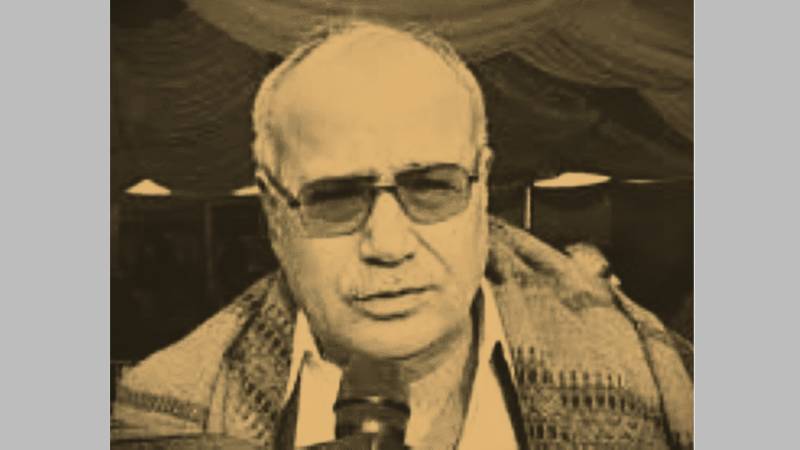
Last week, at an unusual hour, I heard my cell phone ring. When I saw it was Nasir Panhwar calling, I rushed to pick it up, but before I could answer, a text message arrived. I hurriedly read it. The words struck me like a bolt of lightning: “Lakho Sahib is no more.” I called Nasir back, my heart racing, and opened the conversation with a trembling question: “Is it true?” He confirmed the heartbreaking news. I was utterly shocked, and for a moment, I found myself speechless. As I slowly emerged from that state of disbelief, I shared the tragic news with Mr Sani Hussain Panhwar and Dr Zulfiqar Ali Kalhoro through text messages. Instantly, both scholars responded, expressing that his passing was not only a loss for Sindh but, more specifically, a loss to the subject of history.
The next day, I resolved to write about Lakho Sahib, though I wasn’t sure what form that writing would take. I opened my laptop, but for a considerable time, I sat staring at the blank white screen, my fingers frozen above the keyboard. Frustrated, I closed it and lazily flipped through the pages of my notebooks, hopeful that I had some notes about Professor Lakho Sahib. As I turned through the old, faded diaries, I stumbled upon a touching poem by Maya Angelou titled “When Great Trees Fall.” I was drawn to the last line of the third stanza. I re-write it here, it reads: “Our memory, suddenly sharpened, examines, gnaws on kind words unsaid, promised walks never taken.”
In that moment, I felt a deep resonance with Angelou’s words; she had truly captured the essence of grief. The death of a friend compels us to remember all the kind things we wished we had said and the plans we made but never fulfilled. These words helped me revisit old diaries and mend my fragmented memories of meetings, discussions, and friendly debates with Lakho Sahib. I reviewed my numerous entries regarding my meetings with Lakho Sahib, and I found it necessary to classify the content into distinct categories.
These conversations often encompassed a range of topics, including discussions about books, thoughtful comments and appreciations of various scholars” works, new research projects, and, inevitably, some light-hearted gossip. However, I have chosen to restrict my focus to those entries specifically related to history as a subject and, more importantly, to the history of Sindh. These selectively presented events span over the years.
Research themes
I vividly recall meeting Professor Lakho Sahib for the first time at MH Panhwar’s residence in Latifabad, Hyderabad. In that meeting, the discussion focused on the themes of Sindh’s history. If I remember correctly, MH Panhwar suggested and Lakho Sahib agreed that myths and mere chronicles should be avoided. Instead, Sindhi scholars should strive for better history research projects, following academically accepted standards and a multidisciplinary approach. This means incorporating geography, climate, and archaeology into our understanding.
Another topic, according to my notes, was the importance of the Indus River and its changing courses, which have deeply affected agriculture, society, and migration patterns throughout history. The influence of various empires, such as the Achaemenian, Greek, and Islamic empires, was another key point. However, the lead question while writing about the conditioning of these empires should focus on how they have contributed to cultural and religious transformations in Sindh. But, according to them, the dynamics of Hinduism, Buddhism, and Islam in the context of Sindh’s physical geography and natural history should be explored. However, it was emphasised by MH Panhwar that an unexplored area of research is the British era’s irrigation history and its role in changing the agricultural landscape.
Another topic was the railway, marine history, and marine trade, highlighting the interplay of trade, migration, and cultural exchange, and exploring how Sindh has served as a crossroads of civilisations (Latifabad, 2000).
Thar desert
Saeen MH Panhwar called me for a cup of tea and mentioned that Professor Lakho Sahib was also coming from Jamshoro. I agreed and confirmed my presence. We discussed our usual topics, but this time the conversation focused on books about the Indian desert. MH Panhwar mentioned that someone had recently sent him a copy of Rajasthan: A Cultural History by J.C. Sharma. He showed us the book but said he had not read it yet. We then talked about various books on Thar and other parts of Sindh, including Asharf Samoo’s Thar - An Annotated Bibliography. Let me say a few words about it.
The book provides a valuable account of literature related to Thar. It includes basic and historical sources, summaries of various books, and material published in magazines about Thar. MH Panhwar has written the introduction, and Dr Ghulam Muhammad Lakho has contributed a detailed preface. Dr Ghulam Muhammad Lakho suggested that similar bibliographic books should be written about different parts of Sindh. Panhwar Sahib added that there is also a need for such books on Sindh’s political history. He emphasised that comprehensive books (in volumes) should be prepared, and they must focus on main themes and significant events (Latifabad, 2001).
History of Sindh’s disasters
We met at his residence in the Mehran Housing Society, Jamshoro. I showed him the book Everybody Loves a Good Drought by P Sainath. He glanced at it and asked me in Sindhi, “Ada! Kitan Chhtho Chae?” (What is it about?). I explained that the author explores rural poverty in India through 84 articles written for the Times of India between 1990 and 1992. I added that the book highlights the gap between government initiatives and the realities faced by rural communities.
Organised into thematic sections, it challenges economic concepts like “trickle-up” and “trickle-down,” showing their ineffectiveness in practice. He placed the book on the table, took a deep sigh, and began to speak. He suggested that Sindh’s scholars could write similar books. He envisioned documenting the droughts in Tharparkar, Kohistan, and Kachho. He also mentioned the need for research monographs on Sindh’s coastal belt and emphasised the urgent task of writing a history of floods in Sindh.
We fell silent for a moment. Then, as the tea arrived, its aroma filled the air and reignited our conversation. He took the lead again, posing a crucial question: “Who will work on such fresh ideas?” (Sindh University’s Employees” Housing Society, Jamshoro. 2002).
Dr Hamida Khuhro and Dr Mubarak Ali
It was peak mango season when I called M.H. Panhwar about our weekly meeting. He told me that the meeting was scheduled but with a slight change: it would take place at the Tandojam farm, and Lakho would also join. I informed Panhwar Sahib that I was fine with this, but I would like to inform that my wife, Rozina, would also be there, and afterward, we would travel to Mirpurkhas to attend a meeting of the Participatory Village Development Programme. Panhwar Sahib agreed.
Rozina and I drove to Tandojam Farm, where we were welcomed by Ms. Farzana Panhwar and MH Panhwar. We had a cup of tea, and then some sliced mangoes were served. Rozina and Farzana strolled into the garden while we discussed what might be listed about Sindh. Meanwhile, we talked about the works of Dr Hamida Khuhro and Dr Mubarak Ali, focusing on their ideas about history.
In the middle of our discussion, Panhwar Sahib asked Lakho Sahib how he viewed them as a historian. Professor Lakho Sahib paused and explained that both scholars couldn’t be compared because they had different socio-cultural backgrounds and educational experiences. However, he concluded that both were trained historians with an in-depth understanding of archival studies. He noted that Dr Hamida was comfortable writing in English and was much more methodical, valuing standard archival sources. In contrast, Dr Mubarak confidently expressed himself in Urdu and focused on common issues. He popularised history among the youth of the 1980s, and writing in Urdu played an instrumental role in reaching remote areas of Pakistan. Lakho Sahib added that if Dr Hamida Khuhro had regularly contributed, it would have greatly benefited the understanding of Sindh’s history, particularly of the colonial period. The meeting ended with a cup of tea, and we headed to Mirpurkhas. (Panhwar Farm, Tandojam. 2003).
On book editing
We discussed the importance of edited works, particularly in social sciences. In fact, I placed an idea of publishing a series of edited books on the English period. MH Panhwar and Lakho Sahib agreed and elaborated that bringing together diverse scholars” articles to address the same historical period and exploring common issues would be a great intellectual service.
However, the editor has to address coherence. Although it is generally accepted that edited volumes remain popular due to their ability to promote interdisciplinary dialogue. (Latifabad, 2004).
Research and requirements
In today’s meeting, Muhammad Ibrahim Joyo also participated. I vividly recall picking him up from his journalist colony. During the meeting, I requested permission to take notes; previously, I had relied on my memory and wrote only for personal reference. I was allowed. Most of our discussion focused on research in the social sciences, led by Joyo, who emphasised that a hastily written newspaper column is not equivalent to a solid research article and that research is far from an ordinary or easy task. He humorously remarked that often our friends come up with ideas without sufficient thought or exploration of their historical context, only to announce they are researching a particular topic. Within a year, they often change their topic or their supervisor.
MH Panhwar added that if researchers rush and skip necessary processes, they might find themselves going back and forth, realising they have spent too much time on one approach or overlooked important sources. Lakho Sahib contributed that sometimes fortunate moments occur, such as discovering unexpected records or meeting someone who can provide valuable insights. He highlighted that the most crucial phase is the beginning, where researchers struggle to define a topic that is original, useful, and feasible. He stressed that new questions can lead to fresh insights and connections.
Joyo Sahib reiterated that researchers, particularly our university professors, should ask themselves how their work contributes to their field and to the people of Sindh. Panhwar remarked that the analysis sections of many of our teachers” and professors” work are often weak, perhaps due to insufficient logical reasoning or methodological rigor. The meeting ended with a meal of chicken and boiled rice, albeit without oil and chilies. (Latifabad, 2005).
History of floods
Today’s meeting took place at the Jamshoro office of the Thardeep Rural Development Programme. He revisited his old idea of writing the history of floods in the Indus River and noted that Panhwar Sahib is no longer here to guide us. He elaborated on how floods have influenced both ancient and modern civilisations. The unique geography of Sindh and the Indus, combined with seasonal monsoon rains, contributes to frequent flooding. These floods have devastating effects on local communities, agriculture, and infrastructure, often resulting in displacement and significant economic losses. He seemed to be in a hurry and even declined a cup of tea. I accompanied him to see him off at the main gate of the office. However, before leaving, he reminded me that the proposed research needs to be based on various sources, including historical documents, eyewitness accounts, and scholarly articles. This approach should integrate perspectives from history, geography, and environmental science to create a comprehensive understanding of floods in the Indus River. (Sindh University Employees Housing Society, Jamshoro. 2010).
Atomic bomb literature
Today, Lakho Sahib and I met with Professor Murtaza Dharejo at his home in the Sindh University Employees Cooperative Housing Society. After exchanging pleasantries and enjoying a cup of tea, Dr Dharejo posed a question about the term “Atomic Bomb Literature.” I was silent, but Lakho Sahib commented that it might relate to atomic bombs.
Dr Dharejo partially agreed and explained that the term refers to a body of work exploring the impacts of nuclear warfare, particularly the atomic bombs dropped on Hiroshima and Nagasaki during World War II. He mentioned that this genre includes various forms of writing, such as novels, essays, diaries, and poetry, reflecting the psychological, social, and moral consequences of nuclear weapons. He noted that there are a considerable number of such works, one of them being Hiroshima, a novel by John Hersey. He also mentioned The Naked and the Dead by Norman Mailer, which touches on the implications of nuclear warfare. Additionally, he highlighted Hiroshima Diary by Dr Masakazu Fujii, which offers a poignant personal reflection on the events following the bombing.
Dr Dharejo further discussed Black Rain, an autobiographical novel by Masuji Ibuse, published in 1965. The story is told through a series of diary entries, letters, and reflections, capturing the immediate and long-term effects of the bombing on survivors. He emphasised that Black Rain vividly portrays the horrors of war and the profound impact of nuclear weapons on human lives. He concluded by sharing that he has translated a major portion of the novel and added that its publication would be a valuable addition to Sindhi literature. (Sindh University Employees Housing Society, Jamshoro. 2011).
Writing of a historical novel
Lakho Sahib congratulated me on the publication of my novel, Ujhame’n Bharan. He invited me for a cup of tea. When I arrived, he asked, “Ada, novel Chhato Chawee?” (What does the novel tell?). I narrated the plot, introduced the characters, and explained the story’s strengths and balances. He listened patiently and said, ‘so, it is a political novel embedded in the phenomena of Sindh in the 1980s.” I agreed. Then he suggested that I should write a historical novel. I told him I have planned to write about Sindh’s historical cities. He asked if I had conducted thorough research, particularly about the prerequisites for writing a historical novel. I opened my notebook and shared my initial notes. I explained that a historical novel shouldn’t miss major events, movements, and milestones of the era. It should present customs, traditions, and daily life accurately. The political landscape and important figures must be correctly depicted.
Additionally, the locations of the story should be well understood, including landscapes and city layouts. I noted that the characters” attitudes, beliefs, and social norms should reflect their time. The language and expressions must also be appropriate for the period, and the novel should show historical conflicts. He then told me that if I start with Thatta, he would help me gather relevant materials and check the facts. I agreed. (Mehran University Employees” Housing Society, Jamshoro. 2015).
History of Hunting
I came from Malaysia to collect data for my PhD research and had the opportunity to meet Lakho Sahib. He asked about any new books or monographs my professor had published. I mentioned that my professor’s recent research focuses on the history of animal adaptation in Malaya, which piqued his interest. Lakho Sahib noted that similar research is needed in Sindh, as there aren’t many good books with a historical perspective on hunting.
He mentioned two books. The first was Falconry in the Valley of the Indus by Sir Richard Francis Burton, which details his experiences with falconry in Sindh and describes various types of falcons and their habits. The second was Sindh: Ways and Days: A Medley of Memories, Hunting, and Sporting by Pir Ali Muhammad Rashidi. This book portrays the pastime of the upper classes in Sindh known as Shikar, introducing renowned marksmen, hunting methods, and the weapons used, along with adventures and its socio-political significance.
I also brought along Shooting a Tiger: Big-Game Hunting and Conservation in Colonial India. I explained that this book argues that hunting during the colonial period was not just recreational but a crucial aspect of imperial governance. It highlights how hunting helped the British consolidate power and examines its significance across various social groups and regions, including the exclusive privileges of the ruling classes and the role of Indian princes. After our discussion, we quickly noted the common hunting games in Sindh, such as falconry, game bird hunting, deer hunting, wild boar hunting, hunting small mammals like rabbits and hares, and fishing. We also recognised that animal fighting has been part of local culture, including cock fighting, bull racing, dog fighting, and bear and dog fighting. This conversation underscored the rich traditions surrounding hunting and animal-related activities in both Sindh and Malaya or even other parts of South and Southeast Asia. (Mehran University Employees” Housing Society, Jamshoro. 2018).
Sindh Quarterly
I earned my PhD in 2020 and joined Gadap Public School in Karachi shortly thereafter. During my occasional trips back to Hyderabad, I used to meet Lakho Sahib. One day, I shared with him that Professor Aijaz Qureshi and some friends intend to revive the Sindh Quarterly, originally initiated by Sayed Ghulam Mustafa Shah, the former Vice-Chancellor of the University of Sindh, Jamshoro. Lakho Sahib informed me that for the last two or three years, Professor Aijaz Ahmed Qureshi had made earnest attempts to revive the journal but had not yet succeeded.
Perhaps, a primary concern was the issue of ownership; it was claimed that Shah Sahib’s son asserts ownership of the journal. If the legal and financial aspects are resolved positively, the next question would be about regular contributors. He paused for a moment, reflected on the past, and recalled a few names of those who had written regularly for the journal: Sayed Ghulam Mustafa Shah, Siraj-ul-Haq Memon, Muhammad Ibrahim Joyo, MH Panhwar, Dr Mubarak Ali, and Dr GM Mehkri. He then expressed concern that while we have scholars with language skills and presentational abilities today, the critical issue remained the content. He emphasised that to retain the same standards of the Sindh Quarterly, with a focus on Sindh-related content, was a prerequisite. He added that the professor is resourceful and capable, but the first step in this regard would be to obtain permission from Shah Sahib’s family or son. I agreed. (Mehran University Employees” Housing Society, Jamshoro. 2021).
Department of History
One day, Lakho Sahib shared the story of how he secured his desired position in the History Department, thanks to two influential individuals: MH Panhwar and Dr Mubarak Ali. He explained that he became acquainted with Panhwar Sahib through his articles published in the quarterly Mehran Magazine. When an advertisement for some positions appeared, he applied but felt anxious because he had no connections or references.
To seek guidance, Lakho Sahib visited Panhwar, expressing his desire to join the department. Panhwar encouraged him, affirming that he was a young scholar and definitely competent for the role. He then called Mr Mazhar-ul-Haq Siddiqui during their conversation, assuring Lakho that Siddiqui knew him well. However, he cautioned that he would not bypass the recommendation of the chairperson, who at the time was Dr Mubarak Ali. The next day, Lakho met with Dr Mubarak, who surprisingly welcomed him. However, Dr Mubarak warned him not to see him again until the interview day and advised him to prepare for tough questions, as there would be no leniency during the interview.
On the interview day, Lakho faced the board, where several pertinent questions were asked. Interestingly, an expert from Karachi was also familiar with his work. Mazhar-ul-Haq Siddiqui questioned him about the Persian language and source materials in that language, while Dr Mubarak Ali posed more technical questions. Lakho concluded that his journey—from Mitha Khan Jokhio in District Nawabshah, to Govt. High School in Dolatpur Safan, then Govt. College Nawabshah, followed by Mehran College of Moro, and finally the University of Sindh—had come full circle with this opportunity. (Mehran University Employees” Housing Society, Jamshoro. 2022).
His own favoured books
One day, I asked him which of his original books he liked most and why. He said that if allowed, he would choose two books: Samma Sultanat, published in 1987, and Kalhora Dore Hukumat, published in 2004. He explained that Samma Sultanat is about the Samma dynasty, which ruled Sindh from 1335 to 1520.
He believes that this period is crucial in Sindh’s history because the Samma rulers played an important role in shaping the region. His second favourite book was Kalhora Dore Hukumat, which is based on his PhD research. It explores the pre-Talpur era of Sindh, focusing on its irrigation, trade, and economy. (Mehran University Employees” Housing Society, Jamshoro, 2023).
Anthology of NM Billimoria
In mid-August, I received a call from Lakho Sahib that he had some urgent task to share with me. The next day, I went to his place, Mehran University Colony. We discussed some projects in hand. Afterward, having a cup of tea, he handed me a sealed envelope, which was quite heavy. Jokingly, I asked, “Saeen, it contains what?” He said, “Nothing, just there are photocopies of NM Billimoria that were published in the Journal of Sindh Historical Society.” In a friendly manner, he told me that I had to edit and compile them into an anthology. Furthermore, he told me that he had requested Mr Sani Panhwar to take care of the publication of that anthology. I obliged and took the package. It was our last meeting. (Mehran University Employees” Housing Society, Jamshoro, 2024).
Even now, as news of the professor’s passing reverberates through social media, every time I read those words, I am thrust back to that haunting moment last week. I can still hear the chilling ring of my cell phone slicing through the stillness of the night, forcing me to confront the heavy weight of those words: “Lakho Sahib is no more.” Each notification, status update, and reminder feels like a poignant echo of the void he has left behind. This realisation compels us to reflect on the legacy he created and the enduring echoes of his wisdom that continue to resonate in our hearts.