

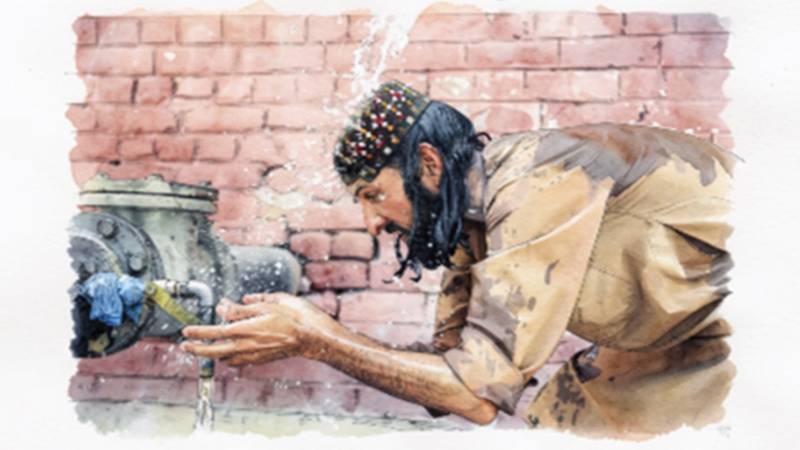
Men and animals dozing side by side on the sidewalks, green stretches, and pavements right in the heart of our cities is not a rare or startling sight. Normalised by prevalence and familiarity, the sorry spectacle dots our cityscapes, as the privileged drive by callously, completely shut to the vagrant suffering, while sheltered within the cosy confines of their four-wheelers.
With the brunt of extreme climate-change-driven weather patterns pushing unprecedented temperatures upon the country, sheltering needs have become more pronounced. Hot spells encompass metropolitans, flash floods subdue the north, while droughts drain the deserts, with the poorest predictably falling most ready victims to these climate shocks.
Pakistan joined the world in observing World Environment Day on the 5th of June, a marking that doesn’t go much beyond rhetoric, reiteration, and symbolic gestures, as our glaciers and farmlands continue to be stressed, posing innumerable challenges to the most impoverished and resourceless.
Already in May, temperatures in parts of Sindh and Balochistan hit 50°C, triggering heatwave alerts and diffusing advisories for people to stay indoors, an option that the homeless cannot exercise or enjoy. They live rough, seeking shelter on the streets under the open sky, while substantially exposed to climate severities, in addition to the imminent perils of outdoor survival.
A warning was issued by the UN this week that the world must prepare for the imminent El Niño and the supercharged weather extremes it hails, further exasperating challenges for those camped out in the open. The powerful natural weather pattern, which raises global temperatures and worsens rainfall and droughts, has an 80% chance of forming before September and a 90% chance before November, and will be “at least moderate” in strength, and possibly strong, the World Meteorological Organization sounded the alarm.
Advisories urge people to stay indoors to escape the 50°C heat—an option the homeless, exposed to the open sky and climate severities, simply cannot exercise
The World Meteorological Organization has also alerted that from 2026 to 2030, some years are likely to rank among the hottest ever observed, increasing the possibility of some record-breaking twelve-month cycles before the end of this decade.
Though official data on homelessness is scarce in Pakistan and varies significantly, one only needs to take a late-night jaunt around their city to witness at least tens of people, if not hundreds, sleeping on roadside pavements or under flyovers in any given area at a given time. Taking refuge under the open sky, near key hubs across the city, the tens multiply into hundreds and thousands, rendering homelessness a serious national emergency, more so in the face of looming climate upsets.
According to the 2023 population census conducted by the Pakistan Bureau of Statistics, there are around 200,000 homeless individuals nationwide, almost equally divided between the urban and rural settings. Hence, making homelessness not only an urban challenge.
NGO counts and Gallup surveys, though, quote figures that are much higher as some also take into account masses who lack permanent housing and live in temporary shelters or slums. Consequently, many aid organisations estimate the number of housing-insecure or homeless to be in the millions.
According to Muslim Aid, a UK-based charity, there are around 20 million homeless people in Pakistan, against the 2 million quoted by authorities, with most of them living in temporary accommodation and refuges, and around 300,000 of them sleeping on the streets.
And with the world witnessing two major wars since the last official count in 2023, the resultant inflation and economic hardships have significantly added to the numbers of those rendered homeless and holding on below the poverty line. Driven largely by economic migration, destitution, rapid urbanisation, and a severe lack of affordable housing in the cities, challenges facing these unshielded populations have snowballed due to climatic abnormalities.
Studies in major urban centres like Lahore indicate that a large portion of the homeless population consists of economic migrants, lacking valid identification documents, unemployed, with drug addiction rampant across communities. Karachi is heavily burdened by homeless communities, with roughly 40% of the population living in informal settlements or slums.
And our social and economic woes may not be getting any better with the World Bank now projecting Pakistan’s poverty rate to remain persistently high between 40% and 42.4%, and an additional 1.9 million people pushed below the poverty line.
All of these combined adversities put a toll on the physical and mental health of homeless people, already bogged down by food insecurity and a lack of nutrition. Thus, it forms a vicious cycle, where health issues act both as a cause and a consequence of homelessness, while the physical and mental traumas keep on exacerbating.
The susceptibility of the homeless to natural disasters is well demonstrated by the fact that 3 million people were made homeless in 2005 due to a devastating earthquake in the north; in 2010, over 10 million were displaced by floods, while the floods of 2022 were among the most catastrophic in Pakistan’s history, as climate change exacerbates the trials of those already homeless.
Last year’s massive floods across Punjab, Khyber Pakhtunkhwa, and Gilgit-Baltistan left millions more homeless, as they destroyed vital crops and pushed fragile communities to the brink. Around 2.5 million people were displaced, many temporarily sheltering in government-run camps or with host families already stretched to their limit.
With a Pakistan GLOF forecast already reported for this year and floods almost an annual disaster that hits Pakistan, there are no official statistics at the government level on how many of those displaced and rendered homeless every year manage to rebuild homes or later acquire a permanent roof over their heads. With droughts, cyclones, floods, and rising temperatures becoming more prevalent, millions more may face threats of losing their homes this year.
For those living on the streets, extreme climate conditions can also be life-threatening, with chances of survival in intense summer heat or sweeping autumn flooding and cyclones being low. Climate change is, hence, not an abstract future peril but an active, current accelerant that is adding to the challenges of the poorest, especially the unsheltered.
As is true in most scenarios, women and children, the most marginalised and jeopardised, are disproportionately affected by the broader crisis of homelessness, where a lack of access to proper nutrition, healthcare, sanitation, and education limits the socio-economic advancement or mobility of the next generations.
Living on the streets also means the homeless have no protection against violence. In 2005, 14 homeless people were violently killed by a serial killer targeting the homeless population. They also often experience being victims of physical assault and petty crimes, with women constantly exposed to the dangers of sexual assault and abuse.
The Punjab Panah Gah Authority Act 2021 aimed to establish a structured and sustainable system for protecting and supporting the homeless and shelterless in Punjab, while providing food and shelter. But the Act’s success and reach have diminished over the last few years. Most night shelters erected under the act have been shut or dismantled over the past years due to changing governments and their policy shifts and priorities, forcing thousands of homeless people back onto sidewalks to be again at the mercy of harsh climatic conditions.
Even when the Act was legislated during the previous government’s tenure, implications of gaps between policy and practice were starkly visible. Other public sector support programmes across the country have also not been very successful in implementing measures that can house or help the homeless.
The corporate sector introduced some initiatives like the concept of "billbeds," instead of billboards, that aimed at utilising public spaces along roadsides where advertisement billboards could be converted into billbeds at night. Much of such plans also didn’t see the light of the day.
The inhabitants of our streets and their non-existent presence are as much the responsibility of the state as those residing in opulent abodes; the former are as much the citizens of this country as the latter. And in the heat of these moments of climate chaos, instability, and unpredictability, we must not continue to ignore the silent calling of the homeless.