


This article began with a digital ultimatum – the notification almost every email user eventually dreads. Storage is full – soon, you will be unable to send or receive a single word. To fix this, I began a thorough purge of my inbox. I read each email briefly before hitting the ‘delete’ key, clearing out heavy files to save space. In the middle of this exercise, I stumbled upon a relic from the past. The subject line read: “From Where Do Research Ideas Come?”
The title immediately transported me back to the University of Sindh, Jamshoro. Years ago, I had delivered a lecture on that very topic. Curiosity took hold. I opened the attached presentation and stopped at one specific slide. It read: “Research ideas also emerge from thematic research books.”
That sentence acted as a catalyst. It brought the scholarly works of Dr Allah Rakhio Butt, Dr Dur Muhammad Pathan, and Dr Aziz-ul-Rahman Bughio back to mind. I also thought of the contributions of Pir Ali Mohammad Shah Rashidi and Professor Mangharam Malkani. Their deep research reignited my interest in a long-neglected topic: “the periodicals of Colonial Sindh.” Building on this inspiration, I returned to my research with a fresh perspective. I focused on the crucial era between 1899 to 1947, a time when the printed word was the heartbeat of social change.
To understand this period, I have categorised these publications into three distinct themes. The first is the “Institutional Multilingual Periodicals.” These unique periodicals were a melting pot of ideas, featuring several languages within the pages of a single volume. The second theme covers “Dual-Language Periodicals.” Unlike the others, these were published as separate linguistic editions in distinct physical bindings. Finally, I explore “News-oriented Periodicals,” which focused on the rapid flow of information. Together, these categories reveal how the colonial press acted as a bridge, sharing the many diverse voices of Sindh.
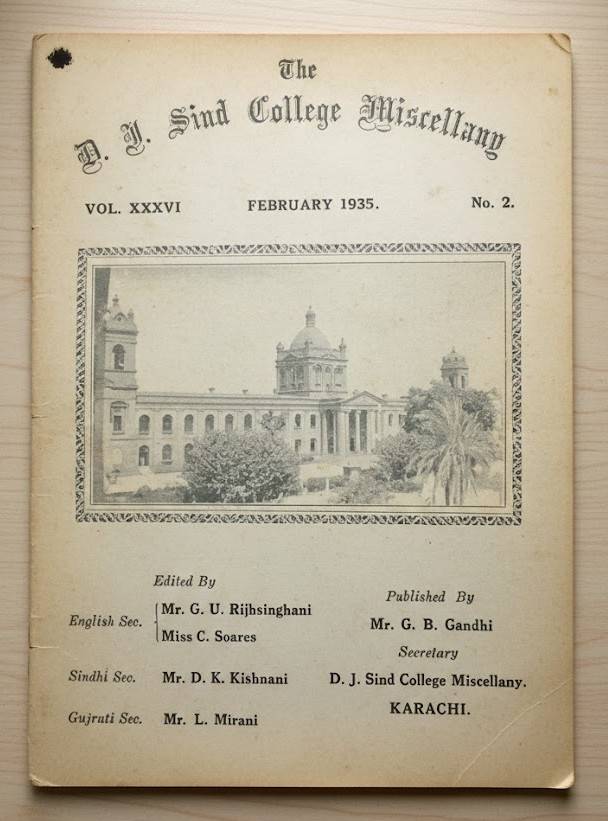
The “Institutional Multilingual Periodicals” theme highlights the diverse landscape of colonial Sindh. These periodicals often served as a linguistic bridge, reflecting a multicultural identity where several languages existed side by side within a single cover. Lead in this tradition was DJ College Miscellany (1899), issued by the DJ Sindh College, Karachi. Initially, it was a trilingual effort featuring Sindhi, Gujarati, and English sections. The editors of the DJ College Miscellany 1935 (Volume XXXVI/ No 2) were GU Rijhsinghani and Ms C Soares (English section), DK Kishnani (Sindhi section) and Mr L Mirani (Gujrati section). However, GB Gandhi published it being the Secretary of the DJ Sind College Miscellany. Later, around 1940s, Urdu section was added, and it became a rare quadrilingual publication.
The tradition of institutional journalism continued with the (Sindh) Madressah Chronicle (1903). Initially published as a monthly magazine and printed at the Al-Haque Press in Hyderabad, it consisted of 10 pages in English and 30 pages in Sindhi. The magazine typically published ten issues per year under its first editor, Abdul Haque Shaikh. In August 1907, the publication transitioned into a quarterly journal while retaining the name Madressah Chronicle. It remained in regular circulation until 1909, when financial constraints forced a hiatus until July 1912. Similar administrative and financial challenges led to another suspension of publication until 1925. Throughout its run, the published content spanned several categories: religion, ethics, education, literature, and history. Some notable special editions, including the “Special Double Founder Number” in 1925 and the “Golden Jubilee Number” in 1935 were also issued. While the former contained 24 pages of Sindhi content, the Golden Jubilee edition expanded to include 44 pages. The magazine’s linguistic scope continued to grow with the addition of an Urdu section in 1930 and a Gujarati section in 1934. Printed at renowned establishments like the Al-Wahid Press, the Chronicle stood as a testament to the institution's scholarly ambition.
A similarly influential publication was the Miscellany/ The Young Scholars (1918) that was issued by NJV High School, Karachi. Featuring both English and Sindhi sections, later Urdu section was also added. It is widely noted that the quality of the Sindhi content—crafted by talented teachers and students—was exceptionally high, and it is credited with significantly enriching the region’s vernacular literature. Likewise, its English section was also of a high standard; Maneck B Pithawala was one of the regular contributors. The October 1949 issue of Young Scholars lists the editors for each section: SK Ghosh and Akram A Ansari for the English section, Maula Bakhsh Sangi for the Sindhi section, and Mirza Daud Beg for the Urdu section.
Collectively, these dual-language periodicals acted as the cultural glue of colonial Sindh, binding together a society on the cusp of a new era
In the 1920s, the Sindh Muhammadan Association launched the triweekly newspaper Sindh Zamindar from Sukkur. The front page of the newspaper featured some columns in English. These were addressed to government representatives and officials. Some of its famous editors were Master Abdul Wahab, Ali Muhammad Alig, Pir Ali Muhammad Shah Rashidi, Pir Hisamuddin Rashidi, Aga Nazar Ali, Molvi Abdul Ghafoor Sitai, Dur Muhammad Avasi, and Hafiz Khair Muhammad Ohdi. Dr Ali Muhammad Shah Rashidi noted that Sindh Zamindar was established to counter Al-Wahid. He summarised that its supporters were toadies of the British. Due to various editorial and managerial issues, the newspaper’s decline began in 1936, and it soon disappeared.
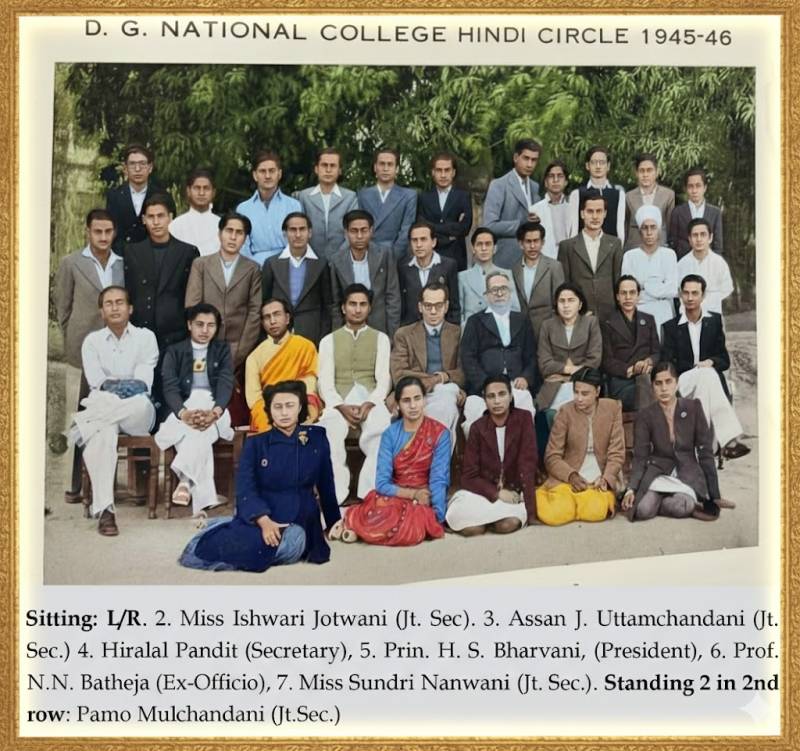
The intellectual spirit was equally vibrant in Hyderabad, where the Phuleli (1924), issued by the DG National College, became a vital outlet for creative expression. Teachers and students contributed poems and essays on general knowledge, while the magazine also served as a record for both curricular and administrative activities. The magazine had two sections, Sindhi and English. Prior to the Partition, the Miscellany Committee’s team consisted of these members: GC Sippy (Secretary), Ms GM Mukhi (Joint Editor—English), Principal BR Kumar (President), Prof KH Notani (Ex-Officio), Mr DJ Sippy (Editor—English), Mr RG Punjabi (Editor—Sindhi). However, in 1947, Utam became the editor ofthe Sindhi section. His two essays “Preet Nagar” and “Soviet Bhomi” got popularity in left-inclined literary circles. The magazine was published at the National Printing Press and Bhaiband Press in Hyderabad. During 1945–46, the Hindi Circle at DG National College was particularly active, engaging in various literary and cultural activities. Its prominent members included Ms Ishwari Jotwani, Assan J Uttamchandani, Hiralal Pandit, Principal HS Bharvani, Ms Sundri Nanwani and Pamo Mulchandani.
Education and spirituality often intertwined in these periodicals, as seen in Mira (1935), edited by Gangaram Samandas. Mira High School owned and managed the magazine. It had Sindhi and English sections. The magazine offered a sophisticated blend of fine arts, literature, and the life lessons of various Saints.
In Rohri, Mira High School issued Roshni Wadhek Roshni (1936). Bhagwandas edited it. This magazine was dedicated to propagating the philosophical ideals of Sadhu TL Vaswani. Its English section, aptly titled “Light More Light,” provided a spiritual beacon for students and female contributors alike. This magazine was published at the Sukkur Printing Press, Frere Road, Sukkur.
In the realm of student advocacy, The Muslim Student (1938) emerged as a powerful representative voice. Published by the Muslim Student Federation and headquartered at the Muslim Hostel in Karachi, it featured Sindhi, Urdu, and English sections. The magazine was distinguished by its high intellectual calibre, regularly featuring the lectures of Allama II Kazi and the evocative poetry of Elsa Kazi.
As the decade progressed, the tradition of school annuals was epitomised by Salyano Roshni (1940). Originally known as the Navalrai Hiranand Miscellany, it was renamed Roshni in 1944, it had Sindhi and English sections. It was a bilingual archive of the student body’s literary and extra-curricular triumphs. Kishinchand T Shahani was the secretary of the Miscellany. The magazine was printed at the National Printing Press in Hyderabad.
Finally, the younger generation was catered to by Bal Mitar (1941). Launched by Vishu Bal Singh and edited by Manohardas Khilnani. This monthly magazine focused on character-building stories. Although primarily a Sindhi publication, it notably reserved four pages for English content, ensuring that the youth grew up comfortable navigating multiple linguistic worlds. Collectively, these institutional periodicals formed a rich, multilingual record that captured the intellectual spirit of both students and scholars. This shared effort created a vibrant tapestry of discourse, reflecting the diverse perspectives and academic rigor of the era.
Moving into the second phase of this exploration, we encounter the unique category of “Dual Periodicals”—publications that often-employed distinct linguistic identities to serve their diverse readerships. This era was defined by a sophisticated blend of ethics, activism, and the arts, beginning with the January 1910 debut of Aena. Under the editorship of Nirmaldas Fatehchand Sujansinghani this monthly magazine was published in Sindhi and English. However, it appeared on the 15th of each month.
It offered a curated mix of history, health, and ethics, alongside beautifully rendered translations of international poetry.
Religious and social movements also found their voice through this dual-language approach. The Sanatan Dharam Parmarthak Patrika (1910), born from the tireless dedication of Kundanmal Deepchand Shivdasani, served as a spiritual guide for the Hindu community. Published in both Sindhi and Gurmukhi, it became a vital tool for propagating Hindu philosophy across Sindh. This magazine was published at the Vidyasagar Press in Hyderabad.
Perhaps the most linguistically ambitious project was Sitara Nao (1925). Issued by the “Sitara Mandal” and boasting a powerhouse editorial board including Jamshed Nusserwanji Rustomji Mehta, Jethmal Parsram, Kewalram Dayaram, P. M. Advani and Lilaram Premchand and Mirza Nadir Baig. However, its internation editorial board was based in Holland. This magazine was a staggering multilingual feat. It carried theosophical ideas across English, French, German, Spanish, Italian, Norwegian and various Indian languages, proving that Hyderabad’s intellectual reach was truly global. It was published at the Blavatsky Press, Hyderabad.
The welfare of the children remained a central theme of the Universal Children’s Guild, which launched the illustrated Bal Mitar (1931). Edited by Bhagwandas C Thadhani, it combined academic advice with ethical storytelling to shape the character the readers. Likewise, The Young Generation (1934) and the Sind Junior Red Cross (1934) initiated by the Red Cross Society, utilised a bilingual English-Sindhi format to promote hygiene and humanitarian values. They were often beautifully illustrated, using visual aids to ensure their messages of health and welfare resonated with the public.
In the same year, the Saliyano Indus (1934), an annual publication from Karachi, was launched by the Rabindranath Tagore Dramatic Society. Professor Mangharam Malkani served as its editor. The magazine was published in both Sindhi and English, and its contributors included many well-known scholars and writers of the period. One year later, Hyderabad saw the launch of the monthly Vidyaarthi (1935). Issued in English and Sindhi, it featured SA Munishi as editor of the English section and RJ Panjabi and Hero Panvani as editors of the Sindhi section. Its primary objective was to foster reading and writing abilities in young readers. The English edition carried the title “The Scholar.” The magazine was printed at the Bhaiband Press, Hyderabad.
In the same year, Vidya (1936) was launched in Hyderabad under the patronage of Nirmaldas Dharamdas Gurbuxani. Published in both Sindhi and English, the magazine featured educational articles, character-building stories, and moral tales curated for students. While Ms Ruki J Malkani served as its initial editor, the publication later transitioned to the management of Kamla Girls High School. Under this new ownership, Ms Sita Samtani took over as editor; however, the tradition of dual-language publishing remained unchanged.
Meanwhile, in Sukkur, the Kumar Bulletin (1937) was launched as a monthly magazine. It was published under the auspices of Kumar Talkies. The magazine featured interesting essays, songs, jokes, amusing anecdotes, and advice for students. It also included colour pictures of film stars, which were printed in Bombay (now Mumbai). The magazine was published in both Sindhi and English languages. It was printed at Parmatma Printing Press and Tilak Printing Press, Frere Road, Sukkur. One year later, again from Sukkur and other magazine, the Sind-Cine-Fan Bulletin (1938) brought the glamour of the silver screen to the masses. Premdas Chhapra was it editor. The magazine blended jokes and songs with news about film stars, providing a vibrant, bilingual window into the evolving pop culture of the late 1930s. It was published at the Tilak Electric Printing Press, Frere Road, Sukkur.
Finally, the academic community further refined its voice through Miscellany (1939). Managed by the Navalrai Hiranand Academy, this periodical served as a professional forum for both faculty and students to showcase their scholarly work in Sindhi and English.
Collectively, these dual-language periodicals acted as the cultural glue of Colonial Sindh, binding together a society on the cusp of a new era. There were some magazines that were published as dual language editions. In broader sense these may be treated as bilingual in scope but issued in separate monolingual volumes.
Lastly, the “news-oriented periodicals” of the period—effectively newspapers—emphasised the fast-paced delivery of news and provided a critical platform for addressing contemporary political debates.
Around 1924, students in Karachi launched The Student Herald. MM Kripalani served as its honorary editor, with students acting as its regular contributors. In addition, the newspaper carried essays on the Scout Movement, physical fitness, and healthy living. Mirza Qaleech Baig, Jethmal Parsram, Muhammad Siddique, along with others, were among the contributors to the first issue.
In 1925, Khemchand D Vasvani launched the weekly Desh Mitra from Karachi. This newspaper primarily carried essays on social issues and reforms Dewan Wadhumal Ganaga Ram served as its lead columnist. It also featured a column in English, to which Professor Lalsingh Ajwani was a regular contributor. In one notable piece, he argued that men, rather than women, were responsible for the community’s ills. This column sparked considerable debate, prompting the newspaper to receive articles both in favour of and against Professor Lalsingh Ajwani's argument.
In 1947, Comrade Hyder Baksh Jatoi launched Weekly Hari Haqdar, a Sindhi newspaper from Hyderabad. It was the first Sindhi newspaper to focus primarily on the problems faced by Haris and to promote the activities and objectives of the Sindh Hari Committee. Some articles were also published in English to highlight public issues, especially those affecting peasants. However, the authorities banned it for long periods on grounds of censorship and other political reasons. In addition, Comrade Hyder Baksh Jatoi's imprisonment and irregular/non-perennial financing prevented steady publication from the year of its inception.
I must admit that a single question from an old presentation—From where do research ideas come?—is what originally led me back to the colonial periodicals of Sindh. What began as curiosity soon became a focused study as I realised these archives were more than just old records; they functioned as active links between different languages and communities. The Institutional Multilingual Periodicals provided a space for scholarly debate, while Dual-Language Periodicals facilitated ethical and artistic dialogues, reflecting the varied voices of a society in transition. At the same time, News-oriented Periodicals brought a sense of urgency to discussions on reform, peasant rights, and political activism. Together, these publications helped maintain a sense of community under the pressures of the colonial era. While this exploration highlights the variety of the period, it also points to areas for further study. Significant work remains to be done regarding gender dynamics in multilingual spaces, the process of identity formation, and the theosophical and spiritual influences that shaped Sindhi thought.
Finally, I am grateful to the scholars who first mapped Sindh’s literary and journalistic landscape. Without their research and archival work, this piece would not have been possible. This article is a continuation of their efforts. I hope it contributes to the understanding of print culture in colonial Sindh and encourages others to explore this history.