

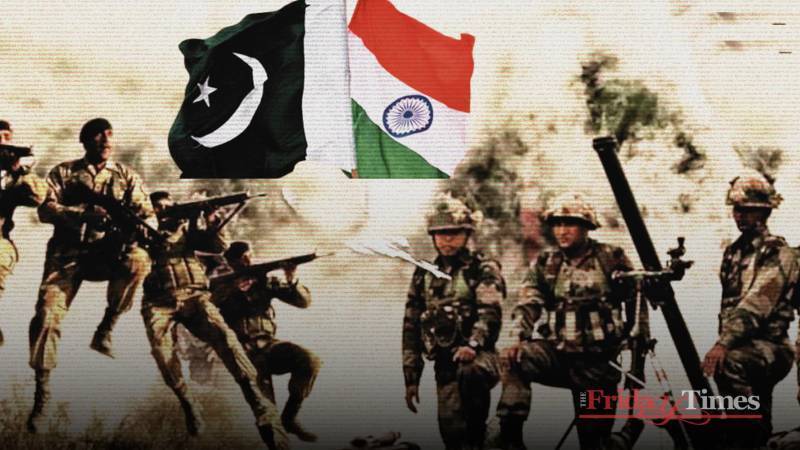
The ceasefire brokered by the United States between Pakistan and India may be interpreted in various ways, depending on one's perspective. However, two critical developments deserve attention. First, America’s role during the Pakistan-India conflict reveals a shift in its diplomatic posture. Historically, the U.S. has walked a fine line, balancing its relationships with both nations. But in this instance, Washington stepped in as a direct mediator, underscoring its growing involvement in the region’s security dynamics.
Second, India’s refusal to engage in dialogue with Pakistan, fueled by national hubris has been a defining feature of the conflict. For months, New Delhi’s leadership steadfastly rejected any form of third-party mediation or discussion, convinced that it could manage the situation unilaterally. However, after Pakistan launched its retaliatory operation, code-named Bunyaan ul Mursoos, India was forced to capitulate, agreeing to a ceasefire brokered by the U.S. This sudden shift in India’s stance raises a series of questions.
One pivotal moment in the unfolding conflict came when U.S. Vice President J.D. Vance declared, “We have nothing to do with the India-Pakistan conflict.” While this statement might appear neutral at first glance, it should be understood as a tacit endorsement of India. To fully grasp the context, it’s important to recognise that this remark was less about neutrality and more about signaling to Pakistan that the U.S. stood firmly with India. By saying this, the U.S. made it clear that it would not intervene to halt the conflict, particularly if Pakistan chose to retaliate against India’s missile strikes. The underlying message was unmistakable: the U.S. was confident that India’s superior air capabilities would enable it to manage Pakistan effectively, and Washington had no intention of getting involved in what it believed was a one-sided contest in India’s favour.
The United States appeared to believe, first, that India possessed superior military strength and airpower capable of inflicting irreparable damage on Pakistan, and second, that Pakistan would not retaliate
This U.S. stance was one of the key factors that emboldened India to escalate its aggression, continuing to target Pakistan with drones and missiles, despite Pakistan’s policy of restraint following Operation Sindoor. With Washington signaling tacit support for India’s military actions, New Delhi felt increasingly insulated from international repercussions, believing that its superior capabilities would deter any serious retaliation. This sense of unchecked confidence not only intensified the conflict but also placed a growing strain on the already fragile peace in the region.
However, once Pakistan crossed its threshold, it responded decisively with Operation Bunyan-al-Marsus, launching precision strikes that not only hit their intended targets but also successfully deceived India’s advanced S-400 defense system. The Pakistan Air Force engaged Indian targets successfully, creating panic within the Indian security and intelligence community. This prompted India to consult the United States. Although the U.S. had previously stated it had no involvement in the conflict, it suddenly began taking a keen interest and effectively became a party to it. This abrupt shift was no coincidence, it was primarily a move to support India’s collapsing air power and failing air defense system.
If one in the absence of clear information, seeks to assess the outcome of this conflict, a key indicator of victory lies in the noticeable shift in the positions of the United States and India.
The United States, whose response was so cold and which was so uninterested and, which initially claimed to have no involvement in the matter, rapidly altered its stance and became an active party to the conflict. India, which had previously assumed a position of military and diplomatic superiority and refused dialogue with Pakistan, suddenly rushed to the negotiating table and agreed to a ceasefire, without any retaliatory action or a tit-for-tat response to Pakistan’s Operation Bunyan un Mursoos.
It is equally important to recognise that New Delhi has consistently rebuffed any attempt by foreign leaders or international organisations to mediate in its long-standing dispute with Pakistan. From dismissing Switzerland’s quiet offer to mediate to firmly rejecting President Trump's public proposal to help de-escalate tensions, India’s stance has remained resolute. This position was reinforced by Vinay Mohan Kwatra, New Delhi’s envoy to Washington, who unequivocally turned down Trump’s offer during a particularly tense phase of India-Pakistan relations.
While this diplomatic posture may appear as hubris, it was not entirely without strategic reasoning. India's rejection of outside involvement likely stemmed from a tacit understanding with Washington, one that underestimated Pakistan’s ability to recalibrate the strategic equation. Both capitals seemed confident that Pakistan, diplomatically cornered and economically vulnerable, lacked the means to shift regional dynamics. But this assumption ignored one critical variable: Pakistan’s willingness to act outside the playbook, a risk that could yet throw off India’s calculated regional strategy. What both capitals seemed to misjudge, however, was Islamabad’s capacity to act unpredictably, a miscalculation that could yet reshape South Asia’s strategic contours.
What does this tell us, particularly those who specialise in diplomacy, security studies, and international relations?
The United States appeared to believe, first, that India possessed superior military strength and airpower capable of inflicting irreparable damage on Pakistan, and second, that Pakistan would not retaliate. Operation Bunyan un Mursoos proved the U.S. wrong on both counts.
This leads to several critical questions that demand serious consideration:
Why did the United States, initially cold and disengaged, suddenly take a keen interest and become a central broker in resolving the conflict?
Why did India, which seemed determined to eliminate Pakistan from the South Asian map, so quickly agree to a ceasefire?
What terms and conditions were agreed upon to finalise the ceasefire?
What prompted U.S. Vice President J.D. Vance, and later President Donald Trump, to publicly offer to mediate on the Kashmir issue? Their statements were not just casual remarks but a clear endorsement of Pakistan’s position that Kashmir is an international dispute.
The situation clearly shows how the war eventually ended in a ceasefire, and reveals who was left humiliated and whose credibility was damaged. The information has already started leaking, allowing us to draw more rational and critical conclusions. One thing is certain: India’s embarrassment at the hands of a much smaller country has raised serious questions, especially in the minds of the U.S. and the West. If a nation like India, which plays such a central role in their security strategy for the Asia-Pacific region, cannot stand up to a struggling country like Pakistan, how can it possibly confront a far more powerful adversary like China? This has created a dilemma for the West, prompting a reassessment of its policies in the Asia-Pacific. As a result, we are likely to see new security calculations in the region, with Pakistan playing a much more central role.