

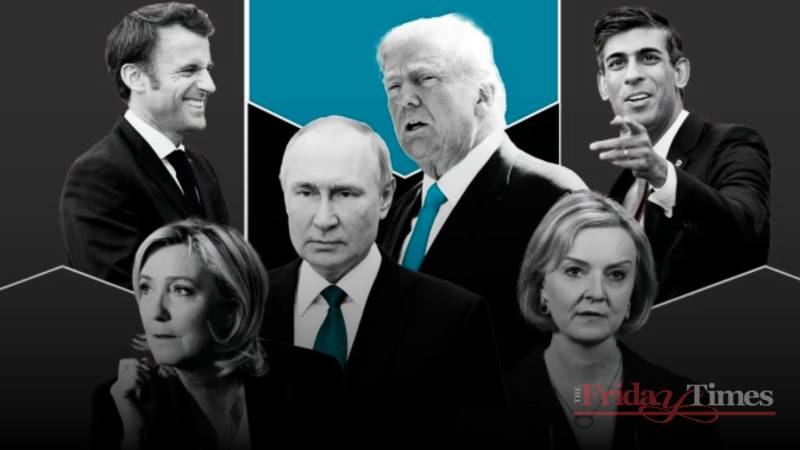
Donald Trump has never been a very good advertisement for liberal democracy. In fact, his rise is a reaction to the dominance of liberal elites over the foreign and domestic policy agenda in the United States. Unlike liberal internationalists, he is regarded as anti-war within America’s domestic politics. Former President George W. Bush was considered a liberal—he championed democratic causes in the Middle East and sought to spread American liberal values such as the rule of law, mass democracy, media freedoms, and human rights.
Every US President since 9/11—from Bush to Barack Obama to Joe Biden—has been considered a liberal by political commentators in the United States. These presidents have presided over two major wars in Iraq and Afghanistan and have engaged in several minor military interventions in Libya, Syria, and Yemen. So we must ask: are Bush, Obama, and Biden really good advertisements for liberal democracy?
You will find many voices in American society who speak out against war, particularly the wars in Iraq and Afghanistan. However, you will rarely hear disagreement with the idea that America, with its supposed exceptionalism, has lessons for the rest of the world—lessons that, if followed, are said to lead to a utopian future. That future is imagined as one full of prosperity, peace, and values that place humans at the centre of both the universe and political life.
This utopian worldview includes the oft-repeated claim that democracies are inherently more peaceful than authoritarian regimes. A corollary to this claim is the idea that democracies do not fight wars with one another—historically inaccurate, but nonetheless widely believed. But that’s not the focal point of this essay. My point is this: democracies can be ferociously violent and aggressive toward non-democracies, as evidenced by American behaviour since 9/11.
The American unipolar moment began with the collapse of the Soviet Union in 1991. It was not just a military triumph; it was considered an ideological one. With the fall of the USSR, the last military and ideological rival of the United States was cast aside. One of America’s foremost political thinkers, Francis Fukuyama, famously declared the “End of History”—a claim that liberal democracy had triumphed as the only viable ideological model for humanity.
A combination of Western capital and liberal democracy defeated fascism in the Second World War. That was followed by 46 years of Cold War with Soviet communism, a formidable ideological rival. With communism vanquished, Fukuyama asserted, the future of mankind would revolve around technical and administrative problems, not ideological conflicts.
A truly peace-seeking White House would not have dropped bombs on three Iranian nuclear facilities in the middle of a regional war
Even if we accept that liberal democracy remains the ideal governance model, the question persists: what have liberal democracies and their global power structures actually delivered in terms of international political stability?
Since 9/11, the United States has imposed two major wars on the world order. In the 9/11 attacks, around 4,000 to 6,000 people were killed. In retribution, American forces killed over 90,000 Afghans over the course of a 20-year occupation.
Let’s consider another self-proclaimed liberal democracy—Israel. In the Hamas attack on Israeli border towns on 7 October, around 1,300 people were killed. In retaliation, Israel has killed more than 50,000 people in Gaza. Over the past year, two liberal democracies—Israel and India—have launched military actions against Iran and Pakistan, respectively.
The decision-making processes surrounding war cannot be separated from the day-to-day workings of democratic systems. In these so-called liberal democracies, war and violence are systemically embedded. Peace at home must be maintained at all costs—even if it means immense suffering abroad. Using overwhelming military power against weaker states or non-military actors cannot be morally justified on the basis of imagined threats.
The international community, including relevant institutions, have stated repeatedly that Iran is not pursuing nuclear weapons. But some imagined threat, perceived by someone in the corridors of liberal democratic power, was enough to justify bombing Iranian nuclear sites. Such a war could have devastated the region—yet liberal democracies do not seem to care.
The world faces more than just administrative challenges. States that claim to be liberal democracies while embracing war-making as their primary international posture pose a profound ideological and political problem. After 9/11, the United States manipulated the global order to craft a justification for military interventions. Now, every Tom, Dick, and Harry seeks to invoke similar justifications to unilaterally strike opponents. This trend is rapidly eroding the credibility and viability of the international system.
All these adventurist states are self-proclaimed liberal democracies—closely allied, in most cases, with the original architect of post-9/11 militarism: the United States. Liberal democracy, in theory, was the culmination of centuries of Western thought—rooted in questioning religious and feudal authority, and based on the Christian idea that every human possesses inherent moral worth and rights bestowed by God. This vision reaches maturity only within a democratic framework that enables individuals to realise their full creative and civic potential.
But this noble philosophy doesn’t align with the post-Cold War belligerence of liberal democracies. Within the US, thinkers such as John Mearsheimer—founder of the “offensive realism” school—argue that America’s liberal internationalist foreign policy since Bill Clinton has only produced war and instability. Mearsheimer warns that this foreign policy orientation will ultimately undermine liberalism at home.
He has a point. Since 9/11, the US has failed to remake a single invaded society in its image. Meanwhile, liberal political resolve at home is fraying. The alternative emerging in American society seems deeply anti-war. In the past three months, President Trump—an archetypal anti-liberal—has helped broker two ceasefires: one between India and Pakistan, another between Iran and Israel. He is reportedly pursuing a third ceasefire in Gaza.
If consolidating the white vote bank in the US means peace in our part of the world, many might not care what kind of political system governs America. Whether an illiberal America will persist with anti-war policies is anyone’s guess. We don’t yet know what kind of white supremacist—or liberal internationalist—might replace President Trump.
Some argue that labels like “liberal” or “illiberal” don’t matter, because the White House has shown increasingly militaristic tendencies in recent months. A truly peace-seeking White House would not have dropped bombs on three Iranian nuclear facilities in the middle of a regional war. That act could have triggered full-scale war involving Iran, Israel, and the US military bases across the region.
Or, as many suspect, it was all staged: Iran offered the US a face-saving response with only token retaliation against US bases in Qatar. Tehran quickly accepted Washington’s ceasefire offer, and Israel fell in line. A wider war would have been too costly for everyone.
What lessons can we draw? First, that a liberal democracy irresponsibly bombed the nuclear sites of a hostile country. Second, that the United States, despite its erratic policies, still possesses the clout to enforce regional ceasefires.
Whatever lesson you choose, the core issue remains: liberal democracies pose a serious ideological and political challenge to the modern world. We cannot afford to ignore this question. Delay only invites another global crisis—sparked, once again, by those who claim to champion liberty and peace.