

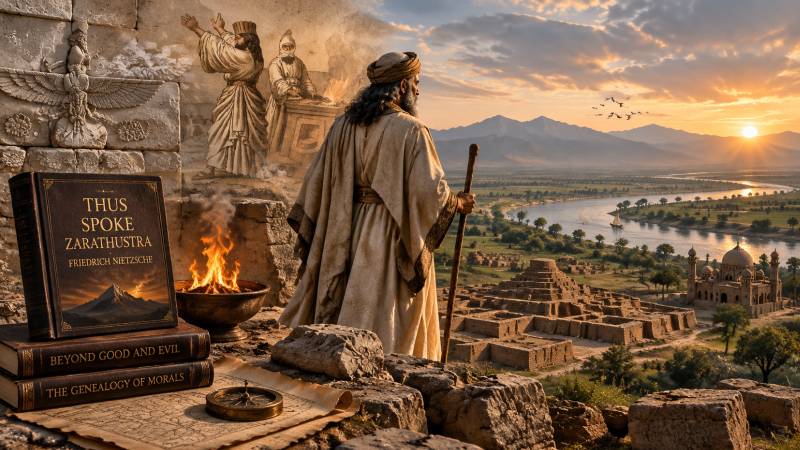
If Nietzsche’s Zarathustra came down from his mountain into Pakistan today, he would find plenty of people telling the country how to save itself. Politicians would promise a fresh start. Officials would ask for patience. Religious leaders would call for virtue. Economic managers would explain that the worst was behind us. He might reasonably wonder why a country with so many answers keeps returning to the same problems. Then he would ask the question we tend to avoid: what are those who demand change prepared to change in themselves?
The point is not that Pakistan should import Nietzsche’s philosophy wholesale. It is that his suspicion of inherited certainties can help expose a more local habit: demanding national renewal while protecting the private arrangements that make renewal difficult. Many of the assumptions held by Pakistan’s decision makers, especially within the bureaucracy and among those who exercise official power, are derived from a colonial past designed more for control than for public service. That legacy remains deeply embedded in how authority is imagined and used, and it is a large part of why progress remains so slow.
Nietzsche is an unlikely guide to Pakistan’s troubles, and invoking him is not meant to belittle Pakistani or Muslim philosophers whose own traditions have long wrestled with questions of justice, moral discipline, social responsibility and public order. The comparison is useful only because different thinkers, using different languages and images, often arrive at a similar warning: societies cannot improve by slogans alone. Unless the norms that govern everyday conduct begin to change, whatever improvements Pakistan makes in its political, social or economic life are likely to remain fragile, leaving the country to drift until the pressure becomes unmanageable. Given present circumstances, implosion is not an abstract fear; it is a plausible outcome if deeper habits remain untouched.
We do this whenever we defend an arrangement because it has always existed, accept a bad decision because of who made it, or excuse conduct in an ally that we would condemn in an opponent. Over time, these small accommodations become the way the country works. Pakistan has serious shortages of money, skills and public services. Yet money alone cannot close the gap between what we say we believe and what we are willing to surrender. We demand merit, then seek help with an appointment. We complain about privilege, then defend the concession that benefits our own sector. We want accountability, provided it begins somewhere else. This does not make every Pakistani a hypocrite. It means we have built systems in which doing the right thing can carry a penalty, while knowing the right person brings a reward. Appeals to better behaviour will have limited value if the rewards remain unchanged.
Many of the assumptions held by Pakistan’s decision makers, especially within the bureaucracy and among those who exercise official power, are derived from a colonial past designed more for control than for public service.
Nietzsche’s famous declaration that “God is dead” was about the weakening of religious authority in Europe. It does not describe Pakistan, where religion remains central to public life. Our difficulty is different. We speak readily about moral obligations but are much less consistent about honouring them when money or influence is involved. Faith gives many people the courage to serve others and stand against injustice. The difficulty begins when religious language, like patriotic language, becomes a shield against scrutiny rather than a source of ethical obligation. A citizen who asks why a policy failed should receive an answer, not a demand to prove his loyalty first. Nietzsche describes the spirit passing through three forms: a camel, a lion and a child. The camel carries burdens and obeys. The lion learns to refuse. The child can finally create something of its own.
Pakistanis know a great deal about carrying burdens. Families adjust their spending, businesses postpone investment, and people spend days securing services that should take hours. Their persistence deserves respect, but endurance should not become a public policy. There is something wrong when the strength of ordinary people becomes an excuse for leaving them with more to endure. We praise resilience so often that we have almost made it a substitute for competent government.
The habits begin early. Where a pupil is rewarded for repeating the approved answer, asking a difficult question becomes a risk. Later, in an office, the same calculation applies. An officer may know that a proposal is defective and still conclude that agreeing is safer. Eventually, those at the top hear what they want to hear and mistake the silence around them for agreement. The lion’s refusal matters in such a society because some abuses survive only while people continue to obey them. Pakistan has never lacked people willing to speak out, sometimes at considerable personal cost. But resistance has its own limits: we can become so absorbed in removing a leader that we neglect to ask what powers his replacement should be allowed to exercise.
The result is painfully familiar. A practice condemned in opposition becomes necessary in government. Supporters find explanations for behaviour they once found unforgivable. The person has changed; the permission to behave badly has survived. Moving beyond this requires the less exciting work of building institutions. A useful starting point would be to ask whether we would accept a proposed rule if our political opponents were the ones applying it. If the answer is no, we should hesitate before handing it to our friends.
The current argument over new provinces and administrative units belongs in the same category. This is under no circumstances an argument against creating smaller provinces or more manageable administrative units; they can serve a useful purpose by breaking the hold of entrenched elites in various parts of the country and bringing government closer to citizens. But similar, and in many cases better, results can also be achieved by empowering local governments and allowing each city to govern itself through an elected mayor with real authority over financing, budgeting and service delivery. City-led politics elsewhere shows that accountable local leadership can make government more visible, responsive and practical. Better boundaries and smaller units will not by themselves change the habits of administration. The more fundamental change required is not merely in Pakistan’s administrative structure, but in the way the country is administered and in the outlook of those who exercise authority. Without that shift, new units may simply reproduce old failures in smaller compartments.
The old divide between rural and urban Pakistan is disappearing faster than our politics admits. Much of this has happened through the sideways spread of cities rather than their upward development into denser, better planned spaces. That pattern has damaged the way Pakistani society treats commerce and innovation. It has also made our cities far less energy-efficient: spread-out urban settlements require longer travel, wider service networks and greater infrastructure costs, making them at least 40 per cent less efficient than cities that grow upward with density and planning. Around the world, a large share of innovation, new processes and commercial experimentation has come from major cities: places with multi-storey buildings, dense neighbourhoods and areas where work, residence, sport, recreation and public life overlap. Pakistan has too few such spaces where people can meet, exchange ideas and develop new methods. When cities spread without these shared spaces, they become settlements of distance rather than engines of creativity.
Nietzsche’s concern with power also helps explain why sensible reforms so often go nowhere. A reform may benefit the country while reducing someone’s income, influence or discretion. Those who stand to lose have good reason to organise against it. Those who stand to gain may never know what was blocked on their behalf. UNDP’s National Human Development Report 2020, launched in 2021, examined how privilege and public policy sustain inequality in Pakistan. It estimated elite privileges at roughly 8 per cent of GDP at the time. The estimate is historical, but the question it raises remains urgent: how much of what we call success depends on advantages others cannot obtain?
A business protected from competition may be profitable without becoming particularly productive. An exemption may be perfectly legal while shifting the burden onto people with less influence. No envelope needs to change hands for the public to lose out. The IMF’s 2025 governance diagnostic examined weaknesses across public finances, regulation, financial oversight and the rule of law. Its scope is a reminder that the problem reaches well beyond individual wrongdoing. We also need to examine the arrangements that make such wrongdoing possible and profitable. IMF.
Before announcing another reform, its sponsors should be able to explain whose privileges it will remove, what resistance that group can mount, and how the public will be protected while the reform is contested. Otherwise, we are asking the beneficiaries of a system to dismantle it out of public spirit. Experience suggests that may take a while. There are places, however, where Nietzsche is a poor guide. His impatience with weakness and comfort can sound callous in a country where so many people are simply trying to get through the month. A parent seeking a secure income and a decent school is making a reasonable demand on life. There is nothing spiritually inadequate about wanting the electricity bill to be affordable.
The World Bank’s 2025 poverty assessment describes the weaknesses of a growth model held back by low productivity and inadequate services. People need nutrition, education and a fair chance to develop their abilities. Lecturing them about ambition will not supply any of these. World Bank. The harder questions belong with those who have choices. When influential families can arrange private alternatives to failing services, they have less immediate reason to demand that those services improve. Their decisions are understandable. The collective consequence is that the people most dependent on public provision are often the least able to insist on better treatment.
That is where our promises of change will either become credible or fall apart: not in the next speech, slogan or rescue plan, but in the quieter moment when a person with influence decides whether the rule should also apply to him.
Nietzsche’s idea of eternal recurrence, living the same life over and over offers an uncomfortable analogy for our economic experience. Financing pressure brings an emergency response. Relief follows. Difficult decisions are postponed. Before long, we are back seeking relief again. The World Bank’s account of Pakistan’s short growth episodes and painful adjustments describes the economic foundations of this pattern. World Bank.
Stabilisation is necessary, but we have to ask what happens during the breathing space it provides. In energy, for instance, collecting more from consumers who already pay their bills cannot indefinitely compensate for losses, poor decisions and weak payment discipline. Our lack of imagination in dealing with the energy crisis is visible in the way policy often takes one step forward and two steps back. Allowing producers to sell 35 per cent of their gas directly from the fields to third-party industrial consumers, marketed through third-party operators on the basis of a transparent wheeling charge, may be presented as a market-development strategy and may help revive stalled exploration. But the benefit is undermined when industrial users are then burdened with levies that make the same energy uneconomic. If these contradictions remain untouched, the next tariff increase is not an exception to the cycle; it is already being prepared.
None of this means Pakistan needs Nietzsche’s exceptional individual arriving to rescue everyone else. We have placed too much hope in saviours already. A country cannot build a dependable future on the expectation that the next person in charge will be both unusually wise and unusually restrained. The same habit appears in our recurring expectations from supposed “game changers.” Politicians and bureaucracies regularly inflate projects, packages and corridors into proof that better days are just ahead, asking the public to wait a little longer for salvation from the next grand initiative. Some of these efforts may matter, but none can substitute for discipline, accountability and institutional repair. Pakistan must understand that there is no white knight on a steed coming to rescue it from the consequences of its own arrangements.
This faith in external rescue also appears in the way Pakistani intellectuals and politicians often defer to foreign consultants, treating outside advice as more credible simply because it comes from abroad. Some consultants are capable and useful; others arrive with limited understanding of local realities, while domestic expertise is overlooked in the very fields where it is often stronger, more grounded and more relevant. A country that distrusts its own knowledge while paying heavily for imported certainty should not be surprised when borrowed prescriptions fail to produce lasting reform.
The same exaggeration appears whenever Pakistan announces that it sits on trillions of dollars’ worth of minerals, hydel potential or other assets. These claims may contain some truth, but potential is not the same as commercialisation. The country has done too little to demonstrate that what it possesses can be developed, financed and brought to market. Commercialisation depends heavily on confidence, including foreign direct investment, and Pakistan has repeatedly damaged that confidence through its dealings with foreign investors in IPPs, LNG contracts, terminal arrangements and other long-term commitments. What is needed, therefore, is not another Planning Commission organised around grand projects, but a Reform Commission focused on the habits, incentives and assumptions that prevent execution. Our energies need to be redirected from announcing state-led projects to reforming how we think, govern and honour commitments.
It needs rules that hold when leaders are neither. It needs officials who can disagree honestly, businesses rewarded for competing, and citizens able to obtain their rights without a recommendation. Above all, it needs to give children the health and education that make a different life possible. If Zarathustra came to Pakistan, I suspect his most useful question would be a personal one. Before telling the country what it must give up, what are you willing to give up yourself? An exemption? The right to make an appointment? The convenience of silencing a critic? The belief that your own side deserves different rules?
That is where our promises of change will either become credible or fall apart: not in the next speech, slogan or rescue plan, but in the quieter moment when a person with influence decides whether the rule should also apply to him. So the final question is unavoidable: do we really want to change? If we do, why do we keep tying ourselves up in non-issues while avoiding the harder work of changing the social contract, our relationship with authority and our outlook on life? Until that changes, reform will remain something we demand from others while exempting ourselves from its cost.