

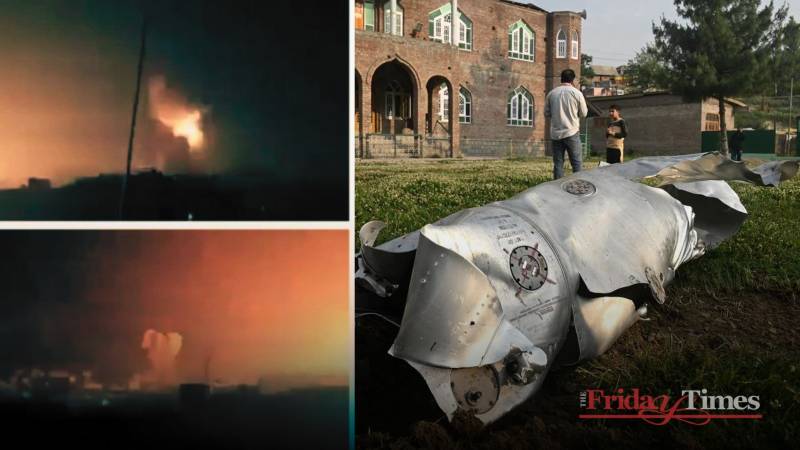
There are perceptive and well informed people in Islamabad who are of the opinion that Indian military strikes are deliberately timed to coincide with the of IMF review board meeting-the strikes took place on the night of May 7, while the board of IMF will meet on Friday, May 9, “to discuss the first review of the ongoing $7 billion bailout programme as well as a new $1.3 billion arrangement under a climate resilience loan programme”. Pakistan’s cash-strapped government and economy are expected to receive $ 2 billion on an immediate basis after the review. Pakistani people from the power corridors believe that India wants to use the IMF as leverage by using the influence of India’s western allies within the IMF board to pressurise Pakistan not to launch counter-strikes in response to India’s May 7 missile and rocket attacks on 6 Pakistani sites. This understanding of the Indian decision-making process is based on the assumption that India would not like to see Pakistan launching a counterstrike against targets deep inside Indian territory. I beg to differ with this understanding of the Indian decision-making process and its outcomes. India has committed a big and foolish mistake on the night of May 7, 2025, and would now like Pakistan to appear as foolish as it does in the wake of strikes which did not serve any political and military purpose except providing sadistic pleasures to its hardly politically literate Hindu extremist constituency.
Suppose the claim of the Indian military is true that they have destroyed the headquarters of militant organisations in different parts of Pakistan. This claim only indicates a symbolic military achievement, as even Indians know that militant organisations in this region have strong organisational structures, which, despite many blows inflicted on them by Pakistani state machinery, continue to flourish as underground organisations. There is hardly any doubt that Indians strikes have destroyed the whole edifice of military confidence building measures (CBMs) that were instituted in the wake of 1987 brass tack crisis and 1990 military crisis over Kashmir uprising and the mistrust it will generate between two most powerful militaries in South Asia will not heal for years if not for decades. What did India gain from the strikes? Perhaps, destruction of the skeleton headquarters of militant organisations, as their military claimed, and which by no means means destruction of the capabilities of militant organisations. What does India lose? Military and political stability on its western border--I don’t think the Pak-India international border could now be stabilised in the next ten years from now. This international border was stabilised after two countries signed a number of military CBMs, bodily lifted from pages of the Cold War between the Soviets and Americans.
Pakistani officialdom clearly sees behind Indian strikes a whole background of India trying to copy big power behavior in South Asia. India copied unilateralism in carrying out military strikes from its allies in Washington. India perceives itself as a state that has inherited the political consensus against terrorism and Islamic extremism from its allies in Washington. Washington itself has taken a step back from its status as an international policeman against international terrorism under President Trump. India believes it can replicate what Washington did in the wake of 911 and what Israel did in the wake of October 7, against its much smaller opponent, Pakistan. This is a mistake, a blatant mistake: The United States carried out two military operations in the wake of 911, first against a military non-entity, Afghanistan, second against a militarily weak state like Iraq.
A careful analysis of May 7 strikes would reveal that Indians do have a realisation that their relative military position in South Asia is not as strong as Washington’s position as a world hegemon or Israel’s position in the Middle East
In the wake of the October 7 attacks on Israeli cities, the Israeli Defense Forces carried out military strikes against a complete military nonentity, Gaza. India doesn’t enjoy that position in South Asia, where it is faced with one of the most professional and a very strong military force in the region, Pakistan. The Pakistani military is in possession of a very strong nuclear deterrent. It has a formidable conventional military force. Any attempt to treat Pakistan like Gaza or Afghanistan would lead to disastrous consequences. A careful analysis of May 7 strikes would reveal that Indians do have a realisation that their relative military position in South Asia is not as strong as Washington’s position as a world hegemon or Israel’s position in the Middle East. For this reason, India avoided hitting any military targets in Pakistan. They were careful not to hit any major cities in Pakistan.
Now Pakistan has two choices: First, consider the downing of five Indian fighter jets and destruction of one brigade and one battalion headquarters on the Line on the Line of Control (LOC) as a sufficient and potent response from the Pakistani side and leave it there. The way Pakistani government ministers were claiming victory after the first round, it appeared that the government of Pakistan would tell their people that they had sufficiently damaged Indian military assets and now no tit-for-tat response was needed. The second option is to go for full-fledged military strikes similar to what the Indians did. In case of the first option, Pakistan would have to give up its dependence on its edifice of deterrence, which its military establishment perceives to be a central pillar of its invincibility, at least at the regional level. Remember how Pakistan responded to the Iranian move to launch missile strikes inside Pakistan's territory by responding in kind within 24 hours.
If the Pakistani military establishment cannot spare a friendly and brotherly country when that particular country comes to challenge its notion of invincibility of nuclear deterrence, how can the world expect Pakistan to remain dormant in the face of Indian incursion into Pakistan's castle of nuclear deterrence? In case of exercising a second option and the escalation that will follow Pakistani counterstrikes, Pakistan might have to take the blame for starting the potentially deadliest war in human history. Or even if it doesn’t lead to war, there is every possibility that the longer this crisis will prolong, the harder the economic recovery plans of Prime Minister Shehbaz Sharif will be hit. In case Pakistan exercises the first option, it could possibly find the international community’s support on its side in convincing India to come to the negotiating table. Given the history and strong military character of the Pakistani state, and its heavy dependence on its notion of nuclear deterrence for the country's defence, one could easily predict that Pakistan would launch counterstrikes in the coming days. But then it should prepare for a longer and uglier war with India and should forget about economic recovery.
What appears as relentless aggression to a common man, on both sides of the border, could be discovered as carefully designed military strikes to avoid escalation
My own understanding is that the opinion in Pakistani officialdom is divided on this point. The National Security Council has authorised Pakistan military forces authorised to take necessary steps, “In consonance with Article-51 of the UN Charter, Pakistan reserves the right to respond, in self-defence, at a time, place, and manner of its choosing to avenge the loss of innocent Pakistani lives and blatant violation of its sovereignty.” Some of the government ministers are of the opinion that Pakistan’s military response on the night of the attack was sufficiently satisfactory and no more tit-for-tat response to Indian strikes was needed. I feel pity for Prime Minister Shehbaz Sharif as he is stuck between two impossible positions. If he goes for Counter-Strike, he will have to say goodbye to his economic recovery plans. And if he says no to counter strikes, he will have to say goodbye to his middle-class constituency in Central Punjab, where anti-India feelings are prevalent.
Launching military strikes across the international border into Indian territory could prove to be a useless exercise, a sin without pleasure kind of thing for the Pakistani military. There is almost a consensus in Pakistani officialdom that Pakistan should design its counterstrike in a way that no collateral damage to the civilian population in India should occur. What exactly would Pakistan pick as a target inside Indian territory? Pakistani national security discourse pinpoints the Indian security apparatus as the main culprit for terrorism that has been carried out inside Pakistan since the very beginning. We don’t have any non-military and non-security targets to pick inside India. Picking military targets could be perceived as an escalation by the Indians.
What appears as relentless aggression to a common man, on both sides of the border, could be discovered as carefully designed military strikes to avoid escalation. One military expert in Islamabad told me that preliminary reports indicate that Indians used a “combination of Israeli Rampage air-to-surface rockets and probably SCALP Cruise Missiles via Rafale” to target sites in Pakistani cities. “I doubt that they would deploy Brahmos in this operation because it is nuclear-capable and can cause confusion”. If Brahmos cruise missiles had been used in these strikes, the few minutes it would have taken the Pakistani military to discover what it was mounted with would have been hell of a time for the people on the radar. A military expert told me that Pakistan would be better if it would try something below the escalator y threshold in designing its response to India military strikes inside Pakistan territory that would inflict a damage equivalent to what Pakistani society has suffered but would be carried out without using missiles, either air to surface or surface to surface. My question to him was, “Suppose Pakistan tries something below the escalatory threshold and it is carried out in an effective manner, don’t you think its effectiveness will itself transform it into an escalatory step? Or will it not be perceived as an escalatory step by New Delhi?” His response was, “This risk is always there”.
Pakistani military planners and political decision makers should ponder three questions before making the final decision about counterstrikes. First, will their counterstrikes lead to a wider war between the two countries?. Second, even if the second strikes do not lead to war, can Pakistan’s economy sustain a period of prolonged military confrontation with India? In case the counter strikes do lead to war, how long could Pakistan sustain a prolonged military conflict with India? We must have a clear answer to these questions in black and white before we go for counterstrikes. I was not surprised when I read the press release of the National Security Council meeting in which the government authorised the military to take corresponding action in response to Indian air strikes. After all, Pakistan's political elite hardly has any experience or expertise in military matters. A trained and well-versed political ruling elite would never have left this war business, with too many political implications, in the hands of military generals. But Modi did the same. Two foolish mistakes do not add up, they multiply--and multiply in a very dangerous way.