

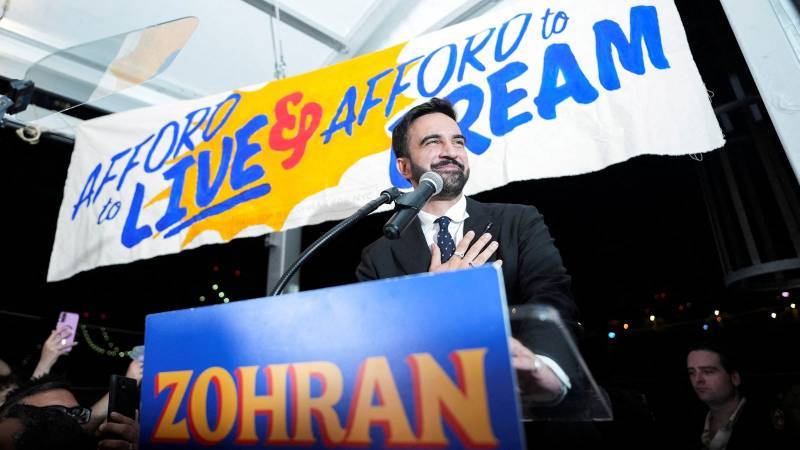
When, 10 months ago, Zohran Mamdani, an immigrant of South Asian heritage, launched his campaign for election as Mayor of New York City, he had only a 1% chance of success. But the results of the November 4 elections proved all calculations about his prospects of being elected as Mayor of New York City wrong. The qualities of being young, energetic, bold, courageous and charismatic enabled Mamdani to defeat the forces of retrogression, exclusiveness and capitalism.
With his outspoken and straightforward characteristics, supporting the Palestinian cause and the rights of the lower and middle classes, he won in a city of billionaires. As the youngest Mayor of New York City since 1892, and the first Muslim and African-born individual to hold the office, Mamdani achieved what many of his critics had perceived as impossible.
The first week of November caused a setback for U.S. President Donald Trump because the Democratic Party won the Mayor’s seat in New York City and the Governorship in New Jersey and Virginia. If such a trend continues, Republicans are likely to lose their majority in the House of Representatives and Senate in the November 2026 mid-term polls. This means that within a year of Donald Trump’s presidential victory, he and his party will lose heavily in Congress and the Governorships of various states.
How will the ‘Mamdani wave’ change the U.S. and pull the country away from Trumpism, which is anti-immigration, anti-non-white, and supportive of the privileged class? Mamdani resembles Barack Obama in terms of public speaking, charisma and powerful messages reflecting real issues faced by America. He also resembles outspoken independent Democrat Senator Bernie Sanders.
Mamdani, in the last 10 months, worked hard to gain the support of the people of New York City to defeat the forces of stagnation, the status quo and capitalism. His pledge to provide better health and transport facilities to New Yorkers by taxing billionaires will be a challenge once he assumes office on January 1, 2026.
In a write-up, “Mamdani seals remarkable victory – but real challenges await”, Anthony Zurcher, North America correspondent of the BBC, writes: “His ethnicity reflects the diversity of the party’s base. He hasn’t shied away from a political fight and has proudly espoused left-wing causes – such as free childcare, expanded public transportation and government intervention in free market systems.”
Unlike Obama, who compromised and pursued pro-establishment, status quo-oriented politics, Mamdani needs to be careful and stick to his principled politics
Furthermore, “Mamdani has also shown a laser-like ability to focus on the kind of core economic issues that have been a priority for working-class voters who have drifted from the Democratic Party recently, but he hasn’t disavowed the left’s cultural principles. But critics have warned that such a candidate is unelectable in broad swathes of America – and Republicans have gleefully held the self-avowed democratic socialist up as the far-left face of the Democratic Party. Still, on Tuesday night in New York City, he was a winner.” By calling him a “Communist” and threatening to cut off federal funding for New York City, President Donald Trump will further polarise American politics and give Mamdani an impetus to seek alternative sources of funding.
Mamdani ran against the establishment of both the Republican and Democratic parties and won because of his pro-people programme. If, 17 years ago, the Obama wave led to the surge of the Democratic Party, then in 2025, the Mamdani wave can pull the United States out of political stagnation, economic crisis and global isolation. Like Obama, Mamdani has proved that an ordinary American is not necessarily status quo-oriented and can vote for change if convinced that inclusive, rather than exclusive, political discourse can change the United States for the better.
But unlike Obama, who compromised and pursued pro-establishment, status quo-oriented politics, Mamdani needs to be careful and stick to his principled politics. Trump’s barrage of criticism against Mamdani failed to make any dent in his popularity, and he can certainly deal with threats made by the U.S. President that he will not let him govern New York City. Unlike Obama, Mamdani is not a U.S.-born citizen and, according to the U.S. Constitution, cannot contest for the presidency, but he can, like Dr Henry Kissinger, another non-U.S.-born American national, reach the position of Secretary of State or seek other U.S. offices except President or Vice-President. Mamdani, despite calling himself a Democratic Socialist, was endorsed by the Democratic Party to run for the Mayorship of New York City in June this year.
If given space by the Democratic Party establishment, he can certainly revitalise the party and ensure its electoral victory in the 2026 mid-term and 2028 Presidential elections. Like Obama, who established himself in the Democratic Party as a Senator, Mamdani, as the Mayor of New York City, can have his eyes on the position of Speaker of the House of Representatives or Chairman of the Senate.
Critics have labelled Mamdani as inexperienced and likely to cause damage to New York City, but they have overlooked the fact that his vision and competence will enable him to meet the challenges of being Mayor. Mamdani has also shattered the myth that no strong voice supporting the rights of Palestinians can survive in the U.S. because of the ultra-right and Jewish lobby. According to Al Jazeera in its report of November 5, “The US Campaign for Palestinian Rights (USCPR) says Mamdani’s success in the mayoral race, despite relentless attacks over his criticism of Israel, points to a larger shift in US politics, with voters more likely to share those views than punish candidates who express them.
Mamdani’s victory will provide impetus to all those in the United States who want to defeat Trumpism with the power of the vote
Zohran’s historic win in the largest city in the US proves that the people support Palestinian rights. They’re fed up with establishment politicians who arm Israel by the billions while Americans can’t afford groceries.” USCPR director Ahmad Abuznaid said in a statement that “They want their tax dollars to fund care for their communities, like food, housing, and healthcare not sent to a foreign apartheid state to fuel endless war and genocide.” According to the same report, “support for Israel, already facing a sharp decline among Democratic voters, has dropped across the political spectrum over the last several years amid Israel’s brutal war on Gaza, which a majority of U.S. voters believe is a genocide.”
How the “Mamdani wave” can change America needs to be analysed from three angles. First, despite the surge of Trumpism leading to his election in 2016 and 2024, there is a vast majority of Americans who are against his exclusive mode of politics and governance. America is a country of immigrants, and the narrative of the Republican Party, along with white supremacists, that the influx of non-whites is a threat to Western civilisation, is not acceptable to the majority of Americans.
If Trump had a landslide victory in the 2024 presidential elections, it was the outcome of a weak Democratic Party candidate, Kamala Harris, rather than the popularity of Trumpism. Within less than one year, Donald Trump has become so unpopular that, according to The Guardian, his approval rating is now 37%, and the Republican Party is losing elections in New York City, New Jersey and Virginia. A similar trend is expected in the mid-term elections scheduled for next November.
It is a positive sign that Bill Clinton and Barack Obama have expressed delight over the victory of Zohran Mamdani. The Democratic Party establishment needs to understand that the narrative of Mamdani, despite its left-oriented leaning, is the need of the hour. Failure of the Republican Party to deal with the severe economic crisis and the federal government shutdown for the last three weeks provides a valuable opportunity for the Democratic Party to re-establish its popularity and perform better in elections. Second, Mamdani can be the wave of the future in America if, after assuming charge as Mayor of New York City, he acts in a cautious, prudent and strategic manner in order to implement his election manifesto.
The strengthening of right-wing white groups as a reaction to the victory of a non-white, Asian and Muslim Mamdani is also a possibility, as was the case when Barack Obama won the presidency twice. White nationalists, with the support of Donald Trump, will carry out all sorts of propaganda against Mamdani and try to undermine him with negative politics.
But if Mamdani can retain the support of the majority of New Yorkers and counter Trump’s threats of depriving New York City of federal funding, his success will become a source of strength for all Americans who oppose the politics of hate and discrimination. Finally, what matters is how the first 100 days of Mamdani’s administration set the tone for his leadership. If, in his first 100 days, he achieves progress in implementing his election manifesto, America’s most populous and richest city will become an example for other cities and states in the U.S.
Positive change in America is the need of the hour, and Mamdani’s victory will provide impetus to all those in the United States who want to defeat Trumpism with the power of the vote. After all, America’s success is rooted in its inclusiveness, creativity and innovation, attracting talent from all over the world.