

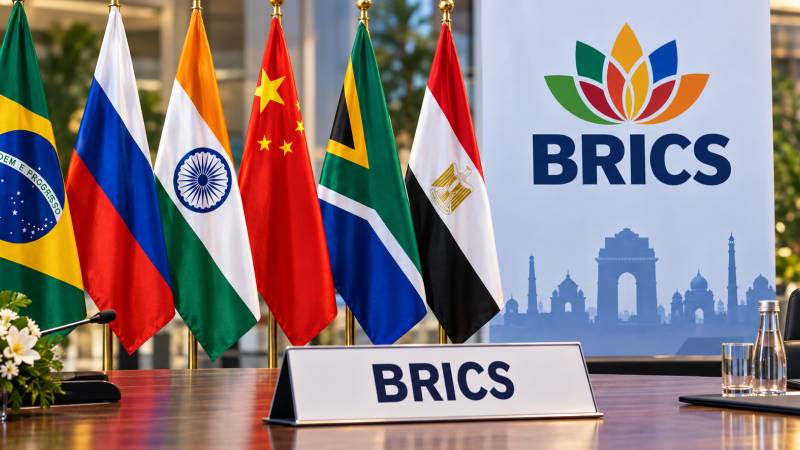
On the first day of the two-day 18th BRICS Summit in New Delhi, members of the bloc unanimously adopted the New Delhi Declaration. This decision spoke for a group that accounts for around 50% of the world’s population and about 40% of global GDP in purchasing power parity terms. However, this economically powerful group did not include Pakistan. Despite its application in 2023, Islamabad’s bid for membership has been stalled for the past three years. Needless to say, Pakistan’s determination to join the bloc rests on tangible economic interests and substantive reasoning. The first reason could be identified as the need for finance. The recent declaration called for more local-currency financing, primarily through the New Development Bank. The Pakistan Economic Survey puts Pakistan’s GDP growth rate at just 3.7%. This, coupled with the country’s continued reliance on IMF programmes, justifies an additional source of development finance, which would serve as an economic fallback.
Moreover, the declaration also posits that IMF voting shares and quotas should correspond to each country’s respective economic standing, while affording protection to the poorest members. Quite evidently, Pakistan is also a recurring borrower from the institutions that BRICS seeks to reform. Yet, it remains unable to gain a seat at the table where such reform is being negotiated. Additionally, it is posited that Pakistan’s pursuit of BRICS membership is a means of diversifying its textile-heavy trade. To put this into context, the textile sector accounted for 58.32% of Pakistan’s total exports in August 2026 alone.
Pakistan’s strategic position at the intersection of South, Central, and West Asia, combined with its role in CPEC and its established participation in institutions such as the AIIB and SCO, could strengthen BRICS’ connectivity with the wider Eurasian region.
This raises the critical question of why Pakistan has been unsuccessful in joining this bloc despite the evident benefits that such membership could offer. In our view, the major hurdle lies in the procedure itself. BRICS operates on the principle of consensus. This means that a single objection from an existing member can halt Pakistan’s application, thereby granting India, Pakistan’s archrival, the power to block the latter out.
Nonetheless, given Pakistan’s interest in joining BRICS, of which China, Pakistan’s all-weather strategic partner, is a member, we build a case for Pakistan’s inclusion in BRICS in the following. To begin with, the case for Pakistan’s inclusion extends beyond its own national interests. First, the bloc’s stated aim is to amplify the voice of the Global South in global economic governance, a claim that sits uneasily with the exclusion of the world’s fifth most populous country and a big market that is home to over 240 million people with a predominantly young population. Second, BRICS has already demonstrated that political rivalry need not preclude new membership. For example, India and China, whose relations remain strained by an unresolved border dispute, sit together within BRICS, as do Egypt and Ethiopia, which are divided over the Grand Ethiopian Renaissance Dam. Thus, a bilateral disagreement with a single member does not constitute a principled criterion for exclusion for key countries such as Pakistan.
Third, Pakistan’s position at the intersection of South, Central, and West Asia, together with its role as a principal node of the China–Pakistan Economic Corridor (CPEC)—which is a crucial component of China’s Belt and Road Initiative (BRI)—would strengthen BRICS’ connectivity and its economic links with the wider Eurasian region. Islamabad is also already embedded in comparable non-Western institutions, having been a founding member of the Asian Infrastructure Investment Bank (AIIB) and an active and responsible member of the Shanghai Cooperation Organization (SCO) since 2017, which indicates a record of institutional participation compatible with BRICS norms. In addition, engagement with countries such as Pakistan is likely to prove a more effective instrument for realizing regional peace, market connectivity, and internalizing values of a shared future.
Noticeably, Pakistan has itself borne considerable human and economic costs from terrorism, and the SCO precedent shows that meaningful counterterrorism commitments can be negotiated within a multilateral framework that includes Islamabad and New Delhi. Hence, Pakistan’s entry into BRICS would accord the bloc a degree of leverage that permanent exclusion does not.
Finally, Pakistan’s acceptance into BRICS is evidently contingent upon India, whose leadership does not seem in the mood to have talks with Pakistan on any issue. This then calls for a re-evaluation of the lobbying strategy Pakistan has employed since 2023. Islamabad needs to, on the one hand, keep urging the key members of BRICS for its consideration into the former and, on the other hand, also try to get partner country status. Notably, it is also well established that rivals can share a table; the SCO attests to this. The Tianjin Declaration condemned both the Pahalgam attacks and the Jaffar Express attacks. Pakistan should likewise take substantive steps to counter terrorism within its own territory. Additionally, BRICS needs to consider whether it is justifiable to exclude a major developing economy with a sizeable market from what is supposedly an economic platform for the Global South.