

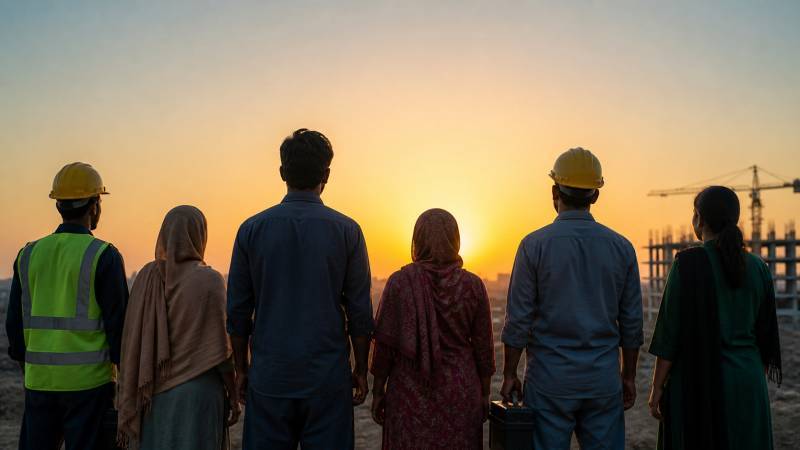
As unions, NGOs, students and progressive formations across Pakistan and the globe mobilised this last Friday for May Day, or International Workers’ Day, the figure of the worker must be rethought beyond the factory. Naseer Humayun, a Railways Worker Union organiser and a close comrade who passed away in 2014, often remarked that May Day was his Eid because it marked the sacrifices of the labour struggle and was the one day dedicated to workers.
This is an attachment that belongs to a political tradition built through struggles over wages, dignity, job security, and collective power, as well as upon the memory of workers who proactively made themselves visible by organising in the workplace. That tradition, however, now sits within a recalibration and reorganisation of the concept of work, where labour has been intensified, diversified, and made more heterogeneous under contemporary capitalism.
At the same time, it leaves outside its frame the wider field of debt, housing, migration, informal earnings, unpaid care, and social reproduction through which working life is now organised. It is in this context that May Day’s political force today depends on whether it can move beyond ritualised speeches and inherited slogans towards the fractured and dispersed conditions in which labour is actually lived.
Over the past year, PIA’s privatisation, following the defeat of the country’s largest and most active trade union after a protracted struggle against privatisation, marked one major form of attack. Pakistan Railways, backed by longstanding World Bank and IMF policies, announced the abolition of thousands of key posts and saw months-long salary delays.
The same logic appears in efforts to evict thousands of katchi abadi residents whose labour keeps Islamabad functioning as domestic workers, guards, sanitation workers, drivers, construction labourers, vendors, and other low-wage workers who make elite life possible while being treated as removable from the city they sustain. May Day rallies and mobilisations foregrounded demands around living wages, contract labour, social security, pensions, union rights, women workers’ protections, and opposition to privatisation.
However, they have remained unable to take up eviction, debt, migrant precariousness, household survival, and unemployment as part of the same broader struggle for worker rights and dignity.
May Day can only be made meaningful when it starts from the contradiction of a day dedicated to workers being almost absent from the lives of those whose days are consumed by the search for work
In Pakistan, most working people survive through mixed and unstable forms of earning that rarely settle into a single wage relation and therefore rarely become legible within the inherited language of rights, unions, and formal employment. Labour appears through short-term arrangements, subcontracting, domestic work, vending, platform work, daily-wage work, and household economies shaped by the vacuum left by state retreat.
The wage has survived, but increasingly as one source of income among others, while survival is secured through rent, remittances, informal income, borrowing, and coercive debt rather than guaranteed through rights. The worker, then, includes not only the male factory worker but also women in domestic and home-based work, vendors, riders, sanitation workers, guards, cleaners, and others whose labour keeps households, markets, and cities functioning without rights or recognition.
Pashtun daily-wage contract workers in Lahore who clear large transport containers once had more consistent work, but amidst war and economic crisis, now spend days without steady employment, waiting for intermittent calls without any guarantee of work. Other migrant workers described struggling to secure Rs 300 or Rs 400 a day, with nothing left to send home to their families.
Two young Pashtun men working around Shah Alam Market had to sell the motorcycle that made work reachable because transport had become too expensive. The question of unemployment is not simply about work being unavailable; rather, it also functions as a form of discipline, forcing workers to remain available, mobile, indebted, and cheapened even when there is none.
Within this horizon, capitalist extraction expands beyond natural resources to include the capture of value from daily survival itself, while finance and real estate become central sites through which dispossession and rent extraction are organised. The work of keeping households alive also becomes a site of extraction because capitalism depends on unpaid and underpaid labour that feeds, cleans, cares, raises children, manages illness, stretches wages, absorbs debt, and keeps workers able to return to work.
This labour is carried mostly by women, and it is not only a burden placed on households but also a site of political struggle, especially as debt, inflation, rent, food costs, and austerity push more of the crisis into everyday life.
Existing trade unions and labour practices begin from the power of workers to organise collectively around wages, contracts, hours, safety, benefits, job security, and the capacity to interrupt production. Liz Mason-Deese’s account of Argentina’s unemployed workers’ movements and feminist strikes shows how those practices are forced beyond the workplace by the conditions they confront.
The piquete, or roadblock movement, became central to Argentina’s unemployed workers’ movements not simply because it blocked circulation, but because it allowed unemployed workers to appear as workers despite their exclusion from stable employment. These struggles emerged amid austerity, debt, mass unemployment, and the collapse of secure work, turning unemployment itself into a terrain of organisation rather than a condition outside labour politics.
The women’s strike extended this challenge further by insisting that labour also includes the unpaid and underpaid work of cooking, cleaning, caring, raising children, managing households, surviving violence, and absorbing the costs of crisis. This also points to a broader crisis of inherited organisational forms, where the question is not simply how to repeat the union, party, rally, or movement, but how to build forms of struggle adequate to dispersed labour, fractured survival, and political life beyond narrow recognition.
Pakistan’s crisis demands a similar refusal of narrow recognition, not because organised labour no longer matters, but because it is being broken while labour itself is scattered across markets, homes, settlements, transport routes, and debt relations. In Shah Alam Market, the distance between May Day as a ritual and May Day as a lived condition appeared when one worker I spoke to did not know the day had been set aside for labour because his own day had been absorbed by the search for income.
May Day can only be made meaningful when it starts from the contradiction of a day dedicated to workers being almost absent from the lives of those whose days are consumed by the search for work.