

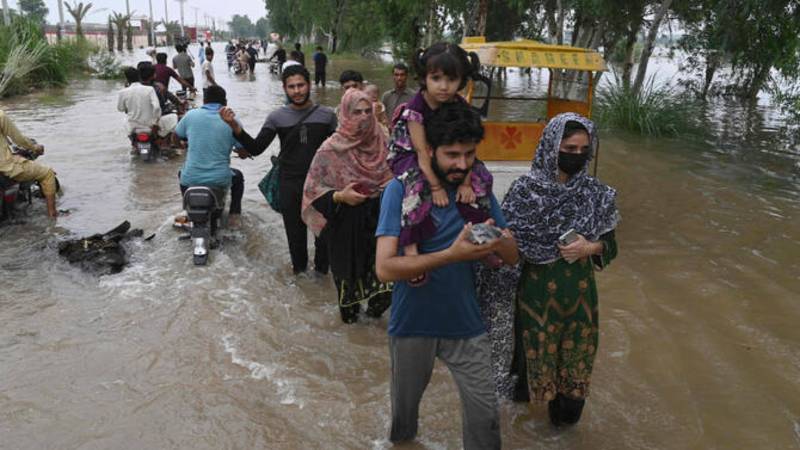
The floods of 2025 have once again exposed Pakistan’s fragile communication networks and the limitations of its media in handling national disasters. Vast stretches of land in Punjab, Sindh, and Khyber Pakhtunkhwa lie submerged, with over 12 million people displaced and more than 1.7 million acres of crops destroyed. Nearly 40 districts have been declared calamity-hit by the authorities. Yet the way information flows between government, media, and citizens reveals persistent and damaging weaknesses.
In Shahdara, Lahore, residents were stranded for days because evacuation announcements arrived far too late. Entire neighbourhoods had no access to official warnings, relying instead on word of mouth or scattered WhatsApp messages. The same story unfolded in Rajanpur and Muzaffargarh, where riverside villages reported that they had not been informed in time to move livestock or harvest standing crops. Such delays transformed a natural disaster into a communication disaster.
The role of the mainstream media has been equally troubling. Instead of pressing officials for accountability or demanding transparent figures about the scale of the losses, most television channels and newspapers reproduced government handouts almost word for word. Coverage focused heavily on dramatic visuals of inundated areas and helicopters dropping food packets, but rarely asked why relief arrived late, why embankments were not reinforced, or why the early warning system failed yet again despite billions being spent on disaster management authorities.
This tendency is not new. Bennett’s indexing theory, which explains how media narratives often align with official perspectives during crises, is clearly at work here. Pakistani media, rather than functioning as a watchdog, normalised the crisis by echoing the state’s version of events, leaving little space for critical debate.
Communication in disaster management is not an accessory; it is the difference between life and death
By contrast, the digital media landscape told a different story. Citizens used Facebook groups, WhatsApp networks, and TikTok live streams to share updates about rising water levels, missing persons, and blocked roads. In Kasur, volunteers circulated real-time drone footage on Twitter to guide rescue boats towards stranded families. In southern Punjab, civil society groups created Telegram channels to coordinate relief supplies. These efforts reveal the transformative potential of digital platforms when mainstream media falters. Yet they also highlight the uneven access to technology. Poorer regions, especially in Sindh and Balochistan, remain digitally excluded and dependent on delayed state communication.
The failure is not only one of infrastructure but also of mindset. Disaster communication in Pakistan remains reactive rather than proactive. Warnings are issued in bureaucratic language, often inaccessible to ordinary villagers. Media houses, instead of investing in disaster journalism training, rely on sensational imagery. Universities produce graduates who can edit packages but are rarely trained in crisis reporting or policy-level communication. This gap becomes deadly when entire communities are cut off from timely, life-saving information.
The floods have also laid bare the absence of a coordinated communication policy between federal and provincial governments. While the National Disaster Management Authority announced certain figures, provincial authorities contradicted them within hours. Media outlets, instead of interrogating the discrepancies, simply aired both versions without clarification, leaving citizens confused about the scale of the disaster. The absence of a unified command voice diminished credibility and fuelled rumours on social media.
Meanwhile, international agencies have raised concerns about Pakistan’s ability to utilise relief funds effectively. Billions of dollars pledged after the 2022 floods were never fully absorbed because projects were delayed or not submitted. This undermines both public trust and international confidence. Yet the media has largely failed to pursue these stories with the persistence they demand.
The lessons are stark. Communication in disaster management is not an accessory; it is the difference between life and death. Pakistan’s media must redefine its role beyond images and official statements. It must learn to question, to demand transparency, and to hold policymakers accountable for failures that repeat year after year. Digital media has shown how communities can bridge gaps, but without institutional support and equitable access, these innovations remain patchy and insufficient.
Floods are no longer occasional events; they are part of Pakistan’s climatic reality. With global warming intensifying, such disasters will recur with greater frequency. The task before policymakers, media professionals, and academics is not merely to respond to the next flood, but to rethink the entire communication architecture of disaster governance. Without this shift, Pakistan will continue to relive the same cycle of silence, normalisation, and avoidable suffering.