

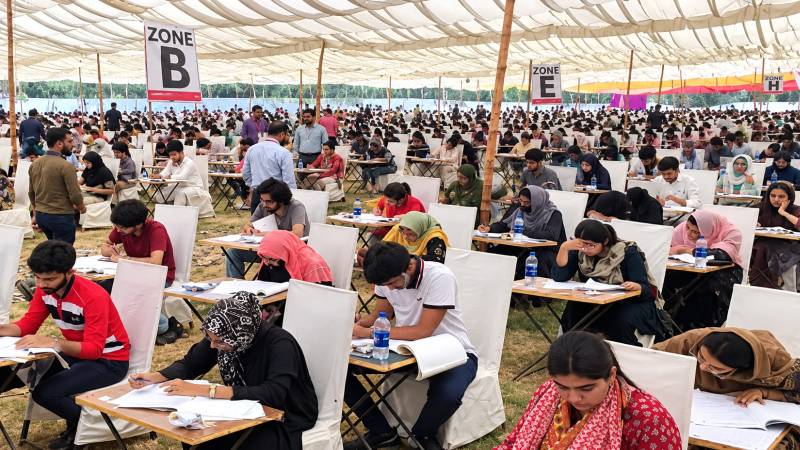
It is Sunday morning. A student stands outside an examination centre with his parents. Roll number slip is in his hands, long years of struggle lie behind him, and there is a single dream in his eyes - to become a doctor. Money has been spent on tuition fees, coaching has been done, sleep may have been sacrificed and some other requirements may have been delayed in order to achieve this dream. Within a few hours, the result of one test will decide whether he takes one more step towards his future that he has dreamed about. However, there is a bigger question that needs to be asked - both of students and of the society as a whole. Has the youth become disinterested in pursuing the field of medicine, or is it the difficulty in joining the medical profession that is making them lose their interest?
The total number of candidates registered for the MDCAT examination on 20th September 2026 is 138,158, which shows that there has been a drop in the number of those who were registered four years ago, which stood at 204,253. There has been a reduction of about 32 percent. The number of those who applied in 2021 was 194,133, rising to 204,253 in 2022, falling to 180,534 in 2023, and around 182,000 in 20. The Pakistan Medical Association attributes the drop to the lack of interest among youth in the medical field.
However, one point needs to be made clear. A decline in MDCAT candidates alone cannot prove that young people have completely turned away from medicine. Career choices are influenced by many factors. Yet when this decline is considered alongside the rising cost of medical education, limited postgraduate training opportunities, financial concerns, delays in stipends and better opportunities abroad, the issue becomes much larger than an entrance examination.
According to the Pakistan Medical Association, some of the factors affecting young people's interest in medicine include the high fees charged by private medical colleges, limited financial prospects for young doctors, delays in house-job stipends and a shortage of paid postgraduate residency positions. The organization has also raised issues about violence and insecurity experienced by health care professionals. The organization has said that some pre-medical students are becoming interested in professions like computer science, artificial intelligence, biotechnology and health care analytics since there are better career prospects in these professions. These are assessments presented by the PMA and should therefore be viewed as part of the current professional debate rather than as the single explanation for the decline. The problem begins with the cost of education, but it does not end there.
The government has taken steps to regulate the fees charged by private medical colleges. In March 2025, a basic annual tuition fee cap of Rs1.8 million was set for private MBBS and BDS programmes, while institutions meeting certain financial conditions were allowed to seek approval for higher fees. The PM&DC's March 2026 notification also shows approved fees above Rs1.8 million at some institutions, with some exceeding Rs2 million. This means that although fee regulation exists, medical education remains a major financial decision for many middle-class families.
Then comes the next question: what happens after a student manages to enter medical school? This is where the system faces its second test. More medical graduates have been produced by the country but the numbers for the postgraduate positions have not been rising at the same rate. It is interesting to note that in March 2026, the Pakistan Medical & Dental Council also admitted to the considerable disparity between the two. According to the council, a large number of qualified doctors compete for limited residency slots, particularly in the public sector. PM&DC recommended increasing training positions and using district and tehsil headquarters hospitals as postgraduate training centres. At this point, the question for a young doctor is no longer simply, "Will I become a doctor?" It becomes, "What comes next once I become one?"
The problem begins with the cost of medical education, but it does not end there. Limited postgraduate positions, delayed stipends, insecure working conditions and uncertain career prospects shape what comes after medical school.
Human resources in Pakistan's healthcare sector also face problems of distribution and retention. PM&DC's current statistics show more than 300,000 registered medical practitioners in the country. But the number of registered doctors alone cannot tell us whether the healthcare system is functioning effectively. Where these doctors are working, what level of healthcare facilities they are serving, how many have access to training and career progression, and how many eventually leave the country are equally important questions.
Migration is another part of this discussion. According to the OECD, around 29,689 Pakistan-born doctors were present in OECD countries around 2020 - 21. The movement of doctors abroad should not automatically be described as a failure of Pakistan's healthcare system. Better training, specialisation, income and personal career opportunities are all legitimate reasons for professionals to move abroad. However, where a nation finds it difficult to retain its trained professionals, then that nation has to think about whether the system in their nation itself is offering adequate inducements to remain. Certain developments in recent times have only brought another dimension to the discussion.
The PM&DC Disciplinary Committee, in September 2026, imposed sanctions on 15 doctors based on references made by the Punjab government. The reasons cited by the council included disruption of patients' treatment, blockage of roads and closure of wards and emergency departments. However, there are some concerns raised by the Pakistan Medical Association and Pakistan Islamic Medical Association in regards to this policy and the demand for dialogue.
Both the points of view must be considered. Protests should not put patients' lives or emergency services at risk. At the same time, legitimate professional grievances cannot be resolved simply through disciplinary action. A strong healthcare system needs institutional mechanisms through which disagreements can be addressed before they escalate into conflicts that ultimately affect both doctors and patients. Perhaps this is where the larger problem lies. In Pakistan, we often treat each crisis as a separate incident.
When MDCAT candidates decline, it can be described simply as a matter of students changing their career choices. When fees rise, it can be treated as a private-college issue. When residency slots are insufficient, it becomes a postgraduate-training problem. When doctors protest, it becomes a matter of discipline. But when these issues are viewed as parts of the same chain, the picture becomes different. The candidate requires more than just an entrance examination for getting admission into a medical college. He/She requires affordable education, honest admission procedures, good training, clear prospects for the house job, opportunities for postgraduate residency, secure work environment, and a career that doesn’t make all his/her efforts worthless. The government's responsibility is therefore not limited to conducting an examination transparently. PM&DC issued directions for the transparent, secure and smooth conduct of the 2026 MDCAT, while parliamentary discussions have also addressed issues such as medical seats, MDCAT weightage and consultation with stakeholders. But the real success of any reform will ultimately be measured by whether the path from admission to specialisation and professional practice becomes clearer, more accessible and more reliable for students and young doctors. Society also has a role in this conversation.
For years, medicine has been presented to young people as a prestigious and respectable profession. But respect cannot be sustained by words alone. It also depends on a professional environment in which doctors can learn, work and progress with dignity. If we want capable young people to continue seeing medicine as a viable future, it is not enough to tell them, "Become a doctor and serve the nation." We also need to ensure that those who spend some of the most important years of their lives preparing for that profession have a structured and dignified professional future waiting for them. The 138,158 candidates who appeared for the 2026 MDCAT are evidence that the dream has not disappeared. It would be too simplistic to say that young people no longer want to become doctors. The more important question is whether we are making that dream realistically achievable for the generations that follow. The real danger for a country is not simply that fewer young people may choose medicine. It is the possibility that society begins to treat the dreams of talented young people as individual responsibilities, while the system that is supposed to turn those dreams into reality is considered nobody's responsibility. And if every generation has to find its own way through such an important profession, then the question is no longer only about what young people want. It is also about what kind of system we are building for them.