

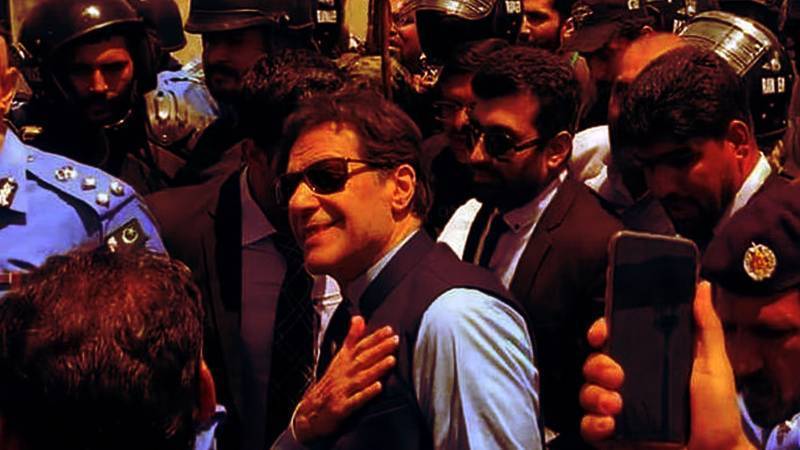
As a critical observer of constitutional law and politics, this author had never found it worthwhile to professionally analyse the social and political phenomenon that is Imran Khan. It was always hoped that he is a fad so far as the ruling circles in Pakistan are concerned. While that hope did materialise very well, its fallout has produced several unintended consequences that require scholarly treatment from the point of view of constitutional law and politics.
Let us first state the problem at hand. Imran Khan became the Prime Minister of Pakistan after the July 2018 General Elections, with the full support of the civil, military, and judicial bureaucracies of Pakistan, in addition to a sizable number of ordinary voters. However, when the very top of Pakistan’s ruling powers decided to suddenly kick him out of office through a vote of no confidence after only three and a half years of his five-year tenure, the middle and lower rungs of his supporters suffered a psychological shock of almost Biblical proportions. The situation had required a shock therapy for the jilted supporters of Imran Khan inside and outside the state institutions.
Specifically, since the decision to remove Imran Khan from office was ostensibly taken by the same state institutions that had wholeheartedly supported his coming into office, an effective shock therapy would have required these institutions to honestly explain their reasons for taking both these steps and apologise accordingly so far as the blame lay at their door. However, all Pakistanis as a rule are loath to accept their mistakes and apologise accordingly.
Consequently, Pakistan’s politics has stood at an impasse ever since the vote of no confidence in April 2022 because the jilted supporters inside and outside the state institutions are unable to understand whether to give up or hold on to Imran Khan – whether he is the new Altaf Hussain to be forgotten soon or the new Zulfiqar Ali Bhutto to be resurrected in near future. It is this prolonged political impasse that this author hopes to resolve in this article.
With the election of Donald Trump as President of the United States in 2016, the whole world became aware of the many pitfalls of letting a non-political celebrity cash in his fame directly in a democratic election for the head of government
In this regard, firstly, let us remind ourselves that, in September 2020, this author had outlined ten basic and universal principles of politics and political leadership and concluded that, according to these principles, Nawaz Sharif effectively stood retired from politics. In summary, these principles were as follows: having absolute certainty about one’s political ideas, creating durable legacy, avoiding being exposed as an impostor, dealing with clergy at arm’s length, relying on people to avoid downfall, making incremental progress, having a vision to reverse-engineer, never buying judges, planning for the weakest link, and always remembering the Machine that is the State. Nawaz Sharif, it was contended, had scored two out of ten points on the above scale (making incremental progress and raising a successor as legacy) but still stood retired because he wavered from one of the core principles of his declared policy in the wake of Panama Papers and was exposed as an impostor, a political error for which there is no forgiveness in the eyes of the people.
Now, it is readily obvious that Imran Khan has a score of zero on the above scale. His speeches and actions make it abundantly clear that he never understood or practised any of the above ten principles. Specifically, he:
- Utterly lacked certainty in his political ideas and famously defended U-turns.
- Made no effort to raise a potential successor from within or outside his family.
- Brazenly exposed himself while indulging in corruption, most brazenly in the Malik Riaz affair.
- Openly and unhesitatingly courted the clergy like Bushra Bibi and Tariq Jameel.
- Tried to rely on institutions to save his government instead of dissolving the assemblies and relying on people to come back into power.
- Delivered no project for incremental progress and instead mocked professional planners with outlandish and unsustainable pet projects like “Ehsaas Koi Bhooka Na Soye” and “Murghi Pal” scheme.
- Took absolutely no steps to reverse-engineer his grand vision to eliminate corruption from Pakistan, and instead publicly demanded that civil servants should continue working on their low salaries.
- Co-opted judges who gave him a clean chit of “sadiq and ameen”, especially during the tenure of Chief Justice Saqib Nisar, and even tried to victimise independent judges like Qazi Faez Isa.
- Never planned for the weakest link and instead refused to even attend funerals of victims of terrorism in Quetta, and lastly.
- Never bothered to understand, much less remember, that even as Prime Minister, he is just one cog – though the most prominent one, in a vast machine that we call the “State” or “Government”, in which the most he could do was start the domino/snowball effects.
Thus, in light of the above matrix, and just like Nawaz Sharif, Imran Khan effectively stands retired from politics. It may be noted however, that even if he had failed on the other nine principles, Imran Khan could have saved his political future if he had at least avoided being exposed as an impostor by indulging in corruption and thereby violating his only and most famous stated principle of policy.
Now, in addition to the above matrix, there is one more principle that is specific to people like Imran Khan, and which came to light only after the publication of my aforementioned article in September 2020. This is “the rule against celebrity Head of Government (HoG)”.
A celebrity politician would succeed most likely when there is general dissatisfaction with traditional political parties and leaders
With the election of Donald Trump as President of the United States in 2016, the whole world became aware of the many pitfalls of letting a non-political celebrity cash in his fame directly in a democratic election for the head of government (unlike, for example, Ronald Reagan who was a celebrity turned politician but served first as governor of California before becoming the President of the USA). Three of the major pitfalls in this regard are listed below:
- Personality: A celebrity HoG necessarily lacks the experience to acquire the humility, empathy and realism that is necessary to understand and address political issues. Instead, a celebrity HoG is always and necessarily proud, selfish and idealistic.
- Professionalism: A celebrity HoG would necessarily come from a background in entertainment or sports, which are fields reserved for people with average or below-average IQ compared to high IQ professions like lawyers, doctors and engineers. Indeed, that is the reason why most successful politicians around the world are educated and trained as lawyers, for that is the profession most closely related to politics.
- Cult Effect: A celebrity politician, if allowed to directly contest general elections for the head of government, would necessarily and easily capture the imagination of the ordinary masses through his already established personal fame and charisma. He is bound to deliver soundbites and make unrealistic and outlandish campaign promises, which would easily sway the minds of voters in times of general dissatisfaction with traditionally established political parties and leaders. Such voters would still support the celebrity politician even if he were to accept his inability and incompetence to govern as a political leader. This is precisely the case with supporters of Imran Khan as well as Donald Trump. The relatively free political landscape of the USA has even allowed Trump to come back into power through the sheer cult effect of his personality on ordinary voters, despite the best efforts of the conventional ruling circles in America to prevent his return.
Thus, electing a celebrity politician directly as the head of government is akin to, as the saying in Punjabi goes, giving a matchbox to a monkey, and should always be avoided at all costs.
Now, while the USA has a State and two-party system strong enough to withstand and never repeat the blunder of electing a celebrity politician as HoG (through the two-term constitutional limit, if nothing else), Pakistan is a different game. The solution that needs to be reverse-engineered here requires scratching not just a celebrity politician but an entire national political party that has morphed into a mindless cult from the political landscape of the country. The State of Pakistan has tried all the traditionally successful methods of repressing a political party but none have been effective, primarily because of the extant support for Imran Khan within the state institutions.
However, thankfully, and luckily, the basic natural design of constitutional law and politics around the world and throughout history is such that it is capable of turning even a seemingly impossible challenge into an even bigger opportunity for reform, and that is the way forward for Pakistan too. That is, instead of directly attacking Imran Khan and his Pakistan Tehreek-e-Insaf (PTI) as they have been doing for the past three and a half years, the State and Government of Pakistan should use the indirect approach of plugging the biggest loopholes that allowed the rabid support for Imran Khan to build up in the first place.
As already indicated above, a celebrity politician would succeed most likely when there is general dissatisfaction with traditional political parties and leaders. It is this dissatisfaction that needs to be addressed. In the context of Pakistan and Imran Khan’s anti-corruption narrative, this dissatisfaction, in this author’s view, is located at the point where practically all people, big or small, feel disrespected in government offices where they have to pay bribes and arrange references even to secure most ordinary and lawful services from the State and Government.
Corruption in government offices, no doubt, has been a major issue in Pakistan and around the world. However, this author has already argued that such corruption in Pakistan is mostly need-based, rather than greed-based, in light of the fact that almost all career public officials here are paid embarrassingly low salaries that can never sustain even the most basic needs of such officials. Moreover, this author has also proposed a universally acceptable benchmark for pay, pension and performance of government officials, which has already been accepted by parliamentarians in Islamabad, Lahore and Karachi through their salary increases since December 2024 according to minimum-wage indexed pay scales (for a more detailed elaboration of this point, please read the aforementioned two articles as well as a third article in that series being published simultaneously with this article).
It is important to mention here that elected local governments are usually the most natural avenue to give respect to the people. However, given the extant political support for Imran Khan, it is difficult to hold free and fair elections – whether local or general – and avoid a landslide victory for PTI, until and unless the State and Government of Pakistan resolve the core and genuine issue of the Imranist cult, as well as of most other ordinary citizens of Pakistan – that is, disrespect because of systemic need-based corruption – by adopting the minimum-wage indexed pay scales across the Federal and Provincial Governments.