

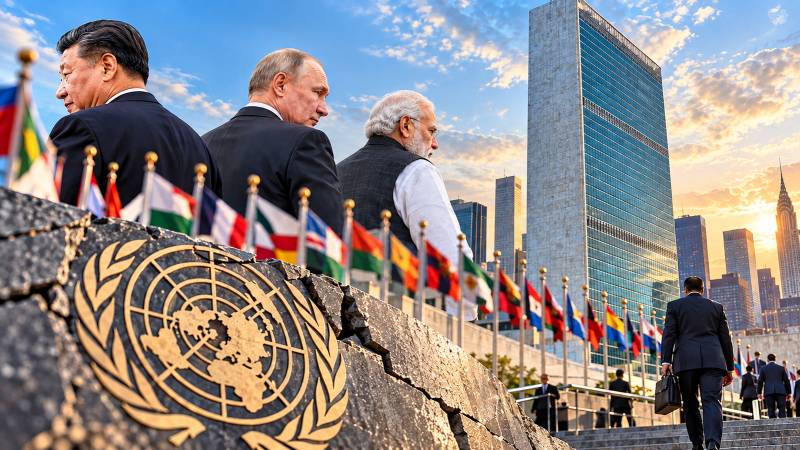
The most revealing diplomatic event of this year's UN General Assembly didn't happen in the marble halls of Turtle Bay. It happened two hundred miles south, in Washington. While delegates in New York took the podium to make their appeals for international solidarity, Xi Jinping landed on American soil for a state visit, sat down with Donald Trump, and never once showed up at the UN. He hadn't addressed the General Assembly in person since 2015. This year he didn't bother sending regrets — he just went to Washington instead. Add the absences of Vladimir Putin and Narendra Modi, and you have leaders of nearly half the human species deciding, in the same week, that the trip to New York wasn't worth making. That wasn't a scheduling conflict. It was an eviction notice.
For eighty years, the UN's founding bet was that raw power could be made to answer to collective norms that the Security Council and the International Court of Justice could keep the strong from simply doing what they wanted to the weak. Nobody who's watched the last few years believes that anymore. The UN hasn't collapsed in some dramatic final vote. It has done something quieter and more humiliating: it has become background noise.
You can see the paralysis in every conflict that matters. Weeks into Russia's 2022 invasion, the ICJ ordered Moscow to suspend military operations in Ukraine. Russia ignored the order and kept its Security Council veto in its back pocket, and that was that. In February of this year, US and Israeli strikes on Iran killed more than 150 people — most of them children — when missiles hit the Shajareh Tayyebeh primary school in Minab. A UN fact-finding mission concluded last week that there are reasonable grounds to believe the United States committed a war crime. The finding will likely join the long list of UN conclusions that change nothing.
A middle power doesn't have the domestic market size, the technology monopolies, or the carrier groups to survive an era of naked bilateral coercion on its own. Multilateral forums, for all their built-in bias, at least let smaller states pool their votes and make a case.
Nowhere is the selective enforcement clearer than in Gaza. Over three years of documented devastation, the UN system ran through its entire playbook — General Assembly resolutions passed by landslide, rapporteurs cataloguing violations, an ICJ ruling ordering Israel to prevent acts of genocide. None of it moved a single tank. Western vetoes made sure of that. The message this sends to the Global South isn't subtle: the "rules-based international order" isn't a legal architecture that applies equally. It's a tool that gets used on the weak, sometimes used on the middling, and never used on nuclear powers or their clients.
Once legal norms become optional for the powerful, multilateral institutions stop being instruments and start being furniture. The real business of geopolitics has moved to Washington dinners, Beijing summits, and blocs like the Shanghai Cooperation Organization and BRICS, where sovereignty gets negotiated through leverage and supply-chain pressure rather than through anything resembling a vote. The UN is left to clean up after crises it was never actually equipped to prevent.
For a country like Pakistan, this isn't an abstract diplomatic disappointment — it's closer to losing a roof. A middle power doesn't have the domestic market size, the technology monopolies, or the carrier groups to survive an era of naked bilateral coercion on its own. Multilateral forums, for all their built-in bias, at least let smaller states pool their votes and make a case. Take that away, and what's left is patron-client bargaining: trade your foreign policy for protection, and hope the protection holds.
The United Nations won't disappear in some formal act of dissolution; any more than the League of Nations did. Its agencies will keep issuing reports, hosting climate conferences, running refugee camps. But as an instrument for keeping the peace, its time has already passed and everyone involved knows it, which is exactly why fewer and fewer of them bother to show up. An institution whose court orders get shrugged off with equal indifference in Moscow, Washington, and Tel Aviv isn't governing anything. It's still standing in New York, but not as a parliament of nations. It's a stage set — the place where the weak still come to ask for something, while the powerful do their actual business somewhere else entirely.