

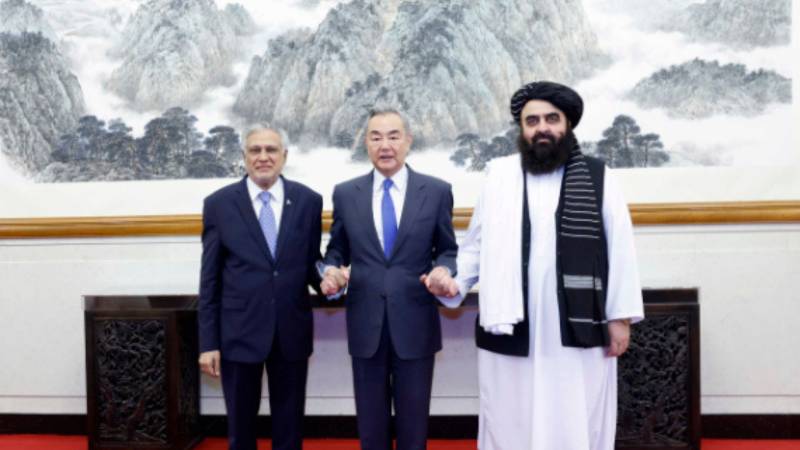
In the aftermath of an all-out war between Pakistan and India in May 2025, many feared New Delhi’s outreach to the Taliban-led Afghan government as tantamount to sandwiching Pakistan between two potential adversaries. The Indian external affairs minister Jaishankar reiterated that India will build a relationship with Afghanistan “if it takes anything.” However, the much-anticipated bilateral ties between India and Afghanistan dropped significantly with Chinese involvement in mending the links between Islamabad and Kabul. Beijing’s recent mediation overshadowed Indian efforts on Pakistan’s western front. The trilateral meeting between China, Pakistan, and Afghanistan, which took place in Beijing on 21 May, has raised a beacon of hope on the regional political landscape as China once again committed to its multilateralism and win-win development principles, fortifying regional connectivity and peace by bringing Islamabad and Kabul back to the table. The meeting signals China’s growing influence in the international arena, particularly to secure its Belt and Road Initiative through forging bonhomie and exerting its soft power.
In the latest trilateral meeting, Pakistan and Afghanistan’s agreement to exchange ambassadors is a positive message for regional and international warmongers as it sets the way for negotiations on shared issues such as terrorism and trade. The meeting also provided space for building mutual confidence between the two neighbouring countries amid the looming regional crisis. Moreover, Afghanistan and China’s engagement has vast potential for stability, regional integration, and development. Kabul has long sought recognition from the international community; however, Chinese favour can be a decisive step in that direction, provided Afghanistan is ready to demonstrate its commitment to actively engage in crafting a regional cooperative environment by taking harsh measures against terrorism and bringing radical change in its domestic policies regarding civic rights, particularly girls’ education and an inclusive governmental setup.
Pakistan, however, has always wanted a stable government in Afghanistan as instability there has often resulted in cross-border terrorist attacks, illegal smuggling, and immigration influx into Pakistan’s western provinces. An unstable neighbourhood becomes a breeding ground for terrorist infrastructure development, safe havens, and logistical support. The most striking indictment for Islamabad is the insurgents’ more proactive role following peace disruptions on the eastern border, signalling a blatant link between terrorist attacks and New Delhi’s obsession with downplaying Islamabad.
If the current development is analysed with impartiality and reason, the most proactive role for peace, constructive engagement, and regional development can be credited to China
Nonetheless, in the trilateral meeting, another important development was Beijing’s integration of Afghanistan into its Belt and Road Initiative. China’s multilateral approach to regional development and cooperation is countering US hegemonic norms and principles in Asia. More and more countries are coming under China’s influence via its international institutions and initiatives such as the Shanghai Cooperation Organization, Asian Infrastructure Investment Bank, and BRI, ample proof of China’s growing influence in international governance. In Far East Asia, China has engaged several nations under its banner of BRI, diminishing US influence and opening ways for cooperation and economic development. Beijing is also reducing its vulnerabilities to US-dominated strategic points like the Malacca Straits by developing alternative maritime routes and ports, including Gwadar Port and the soon-to-be-completed Kyaukphyu port in Myanmar, significantly reducing shipping distance to China.
The US and its allies in the West are closely monitoring this development and trying to contain China through their alliances in the Indo-Pacific region, such as the Quad. The US's excessive reliance on and confidence in New Delhi has also suffered a dent as the latter’s wishes to be backed by the US in its latest military adventurism faltered when Washington declared its neutrality. Trump has also been criticised vitriolically for his neutrality by the Indian media on multiple occasions. Even Indian Prime Minister Narendra Modi, in his repetitive appearances on TV, has not named President Trump for his ceasefire efforts, indicating that Modi is not pleased with the president’s role in the recent conflict. Possibly, New Delhi is saved by Washington from Beijing.
However, if the current development is analysed with impartiality and reason, the most proactive role for peace, constructive engagement, and regional development can be credited to China. The US has always benefited from wars and never seriously pursued reconciliation and diplomacy in conflicts. The Iraq invasion and Afghanistan war following the 9/11 security lapse could have been avoided had the US given diplomacy a chance, but its unilateralism has always caused widespread destruction.
The current Israel-Palestine conflict has the active backing of Washington, and that is where its principles of human rights and non-violence collide. On the other hand, China helped broker a peace deal between Saudi Arabia and Iran in 2023, putting an end to their seven years of hostility. Last year, China also helped sign a unity deal between Palestinian groups and Hamas in its capital. These developments not only underline China's diplomatic prowess but also its ability to shape the global arena on the principles of multilateralism, peace, and prosperity. India must also learn from Chinese principles; warmongering and hostility have bred nothing except destruction, retrogression, and hopelessness.