

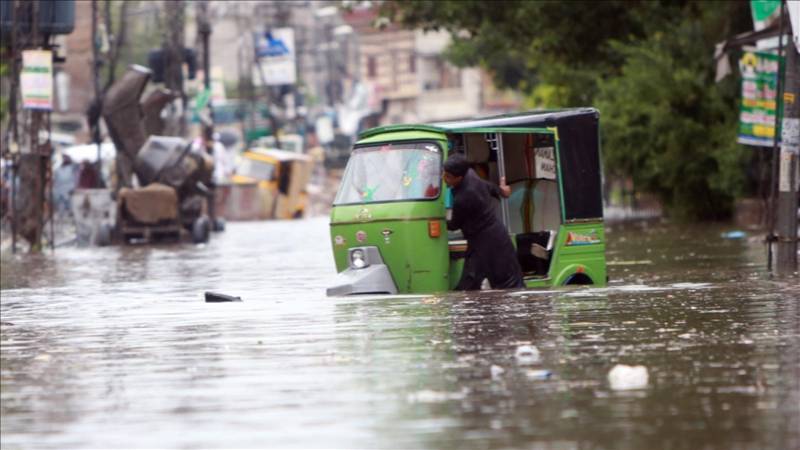
The water isn’t coming. It’s returning. In Pakistan’s drowned cities and vanishing glaciers, climate change isn’t a future threat — it’s a present-day executioner. As monsoon rains lash the country in July 2025, swallowing neighbourhoods and washing away highways, the world watches a nation of 240 million people being methodically dismantled by forces it did not create. With every hour, the statistics grow grimmer: 193 confirmed dead since late June, including 93 children in Punjab province, where rainfall has exceeded 2024 levels by 124 percent. These numbers aren’t anomalies. They are the arithmetic of collapse for a country the 2025 Climate Risk Index ranks as Earth’s most climate-vulnerable nation.
The cruellest irony? Pakistan contributes just 0.51 percent of global carbon emissions — a negligible fraction compared to industrial giants — yet now stands on the frontlines of an existential war against environmental annihilation. This is the story of how natural fury, human negligence, and global indifference conspired to push a nation to the brink.
Walk through Lahore today, and you’ll witness urban planning’s grotesque failure. Once called the "City of Gardens", Lahore’s green cover has plummeted from 70 percent in 2000 to a suffocating 15 percent today. Concrete and asphalt now dominate 85 percent of its surface, creating a hydrological death trap. When July’s rains came — 124 percent heavier than 2024 — stormwater had nowhere to go. Colonial-era drains, designed for a cooler, greener city, choked on the deluge. The result? A 286 percent increase in runoff turned streets into rivers within hours. In the affluent neighbourhood of Gulberg, Mercedes sedans floated like toys. In low-lying Shahdara, sewage mixed with floodwater, poisoning drinking wells.
This isn’t an act of God. It’s the consequence of developers bribing officials to build over 1,200 natural waterways since 2005, transforming Greater Lahore into a 1,200-square-kilometre floodplain. Similar tragedies unfolded in Karachi, where 870 kilometres of natural storm drains — nature’s plumbing system — were illegally occupied by shopping malls and apartment blocks. When the clouds burst this July, water cannibalised the city. In the coastal slum of Rehri Goth, residents stood knee-deep in seawater contaminated with industrial waste. "Our children are drinking poison," said one fisherman, "while the builders who stole our drains vacation in Dubai."
The 193 bodies recovered by late July 2025 are not just storm victims but casualties of a triple betrayal — a warming planet, a captured state, and a world that profits from disaster
The catastrophe extends beyond cities. In Pakistan’s mountainous north, a slower but more sinister disaster unfolded. Gilgit-Baltistan, home to 7,253 glaciers — the most outside the poles — recorded a jaw-dropping 48.5°C in June 2025. For perspective: this temperature matches the Sahara Desert’s peak heat. The result was catastrophic glacial melt. Ice that accumulated over millennia vanished in weeks. The Shisper Glacier, already destabilised, haemorrhaged meltwater into nearby valleys. On 3 July, a glacial lake outburst flood (GLOF) devoured the village of Hassanabad. Houses built from stone and timber disintegrated like sandcastles. Three generations of a family vanished beneath the sludge. Scientists confirm such events are now 300 percent more frequent than in the 1990s.
Worse, the Indus River — fed by these glaciers and providing 90 percent of Pakistan’s irrigation — faces a death sentence. Short-term flooding will give way to permanent drought as glaciers disappear. Projections indicate river flows could drop 40 percent by 2050, collapsing agriculture across Punjab and Sindh. Wheat yields may plummet 40 percent by 2040; rice exports could cease entirely. The World Bank estimates this alone could push 12 million more Pakistanis into extreme poverty.
Why is this happening? Look to failed governance. The National Disaster Management Authority (NDMA), tasked with protecting citizens, admitted in June 2025 it faced a 60 percent funding gap for monsoon preparedness. Shelters went unbuilt. Medical stockpiles sat empty. When floods hit Khyber Pakhtunkhwa, provincial agencies wasted 72 hours arguing over jurisdiction along the Kunhar River. "They were debating paperwork while my mother drowned," testified a farmer from Balakot.
Corruption bleeds the system dry. After 2022’s cataclysmic floods caused $30 billion in damages (10 percent of GDP), international donors pledged $10 billion for recovery. By 2024, only $2.8 billion had reached victims. A blockchain audit this year traced $1.2 billion to "infrastructure projects" — roads built on floodplains that washed away in 2025. Another $800 million vanished into private accounts. Local officials demand bribes even for emergency rations. In Sindh’s displacement camps, women report trading food for "protection" from police.
This institutional rot has consequences: 45 percent of flood-affected children now suffer acute malnutrition. In rural Sindh, paediatric wards overflow with infants dying from waterborne diseases. "We’re treating cholera with bandages," confessed one doctor in Sukkur.
The injustice transcends borders. Pakistan’s per capita CO₂ emissions are 0.82 tonnes — 5.9 times lower than the global average. America’s are 13.83 tonnes; China’s 9.24. Yet Pakistan suffers disproportionately. While warming averages 3.7°C globally, its northern regions hit 5.3°C — a death sentence for glaciers. Climate finance compounds the inequity: 85 percent of global adaptation funds flow to the top ten emitting nations. Pakistan receives less than 0.5 percent.
The result? A projected 18 to 20 percent GDP loss by 2050 versus 5 to 15 percent for major polluters. Coastal communities epitomise this asymmetry. Rising seas have swallowed 4.3 million acres along the Indus Delta. The fishing village of Keti Bandar, inhabited for 400 years, now sits underwater at high tide. Saltwater intrusion has contaminated aquifers, destroying farms. "Our soil is now poison," lamented a sixth-generation farmer near Thatta. Over 2,000 families have fled to Karachi’s slums, where they live in cardboard huts. When July’s rains flooded these informal settlements, children slept standing up in toxic water. The psychological toll is crushing: suicide rates in displacement camps jumped 22 percent last year.
Solutions exist but require revolutionary action. In cities, Karachi and Lahore must reclaim 2,400 kilometres of storm drains from illegal occupiers. Modular flood barriers successfully deployed in Bangladesh’s cyclone zones could shield 3 million people. In glacial regions, installing 200 IoT sensors would provide real-time GLOF warnings. Such systems already cut evacuation times by 70 percent in Shangla. For outdoor labourers — brick kiln workers, farmers, rickshaw drivers — wet-bulb temperature protocols are non-negotiable. When humidity and heat combine to hit 31°C, a lethal threshold where sweat can’t cool the body, paid rest must be mandatory.
Governance demands radical surgery: dissolve 12 overlapping disaster agencies and create a National Climate Resilience Authority with constitutional power to veto ecologically reckless projects. Enforce 200-metre buffer zones along all rivers. Prosecute officials who approve construction on floodplains. Fund relocations through "Rebuild Elsewhere" grants modelled after Canada’s disaster response. Crucially, every climate dollar must flow through blockchain-tracked digital wallets to end corruption.
Globally, Pakistan must lead the climate justice movement. The G20, responsible for 80 percent of emissions, owes reparations, not aid. Specifically, demand $100 billion annually from America and China, responsible for 45 percent of cumulative emissions, for the Loss and Damage Fund. Negotiate debt-for-climate swaps. Forgive Pakistan’s $30 billion foreign debt in exchange for mangrove restoration and solar-powered irrigation. This isn’t charity. It’s ecological restitution.
The 193 bodies recovered by late July 2025 are not just storm victims but casualties of a triple betrayal — a warming planet, a captured state, and a world that profits from disaster. Pakistan’s suffering offers a terrifying preview of our collective future. If this nation, the canary in Earth’s coal mine, suffocates, no one is safe.
The monsoon will end in September. The reckoning has just begun.