

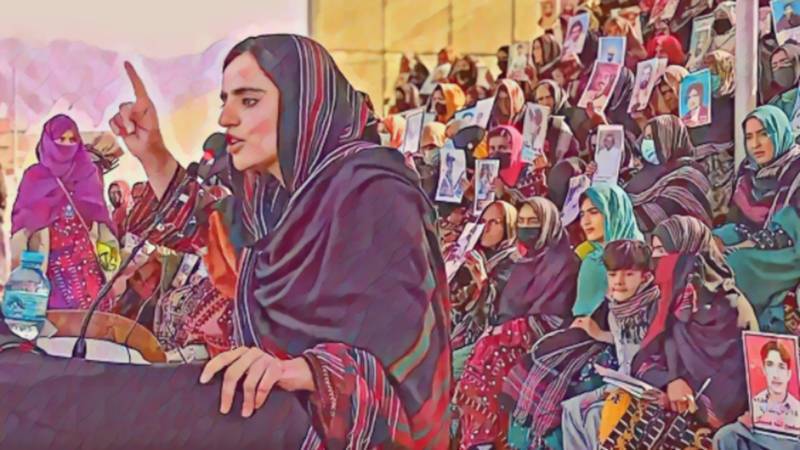
In March 2025, following the Jafar Express incident claimed by the Baloch Liberation Army (BLA), the Pakistani state forces launched a political crackdown that disproportionately targeted peaceful dissenters, particularly the leadership of the Baloch Yakjehti Committee (BYC).
While mainstream narratives focused on insurgency, the true casualties were peaceful Baloch activists, especially women, who have become the moral conscience of the Baloch resistance. What followed was not justice but the continuation of a war on memory, motherhood, and movement-building.
On March 21, BYC organised a peaceful sit-in on Sariab Road, Quetta, against enforced disappearances and extrajudicial killings. According to BYC and eyewitnesses, police opened fire, killing three protestors. By dawn, the protest camp was violently dismantled. Dr. Mahrang Baloch, Beebow, and others were arrested under Section 3 of the Maintenance of Public Order (MPO). Even the bodies of the slain were seized by the police, not as part of law enforcement, but as a symbolic act of domination. Later, they arrested Gulzadi from Quetta.
BYC leadership like Sibghatullah Shah G, along with Beebgr Baloch and several people are behind bars, under preventive detention laws.
What was once an exception, the arrest of women protestors, is now a strategy. The state has normalised the criminalisation of women who resist.
Dr. Mahrang, Gulzadi, Beebow and Dr. Sabiha, students, doctors, daughters, have been treated not as citizens, but as national threat.. Their crime is resistance, which is not armed.
Despite global scrutiny, the state continues its war, not just against dissent, but against the women who carry its memory and its future
When security forces failed to arrest Dr. Sabiha, they abducted her father. The ultimatum was clear: surrender yourself, or your family will disappear into the state’s black holes.
This is not an isolated tactic. In Balochistan, collective punishment has become a standard doctrine. Homes are raided, relatives abducted, and entire communities penalised for the political beliefs of a few.
Women as Strategic Actors
For too long, the state has viewed women through patriarchal lenses, emotional, apolitical, and silent. But Baloch women have dismantled this script. They’ve collapsed the boundary between grief and political action, transforming mourning into organising and home into a site of resistance.
Women like Mahrang, Sammi, Sabiha, Gulzadi, Beebow and Shali are no longer just the relatives of the disappeared, they are the architects of a new political grammar.
“I am nobody’s daughter — I am everyone’s daughter.”
This is not only a rejection of patriarchal control but a bold articulation of collective identity. Where the state uses family to control, these women use community to resist.
Behind bars, Dr. Mahrang continues to write letters to siblings, comrades, and communities. In her Eid message, she emphasised nonviolence and collective hope. In her recent letter published on X (April 22), she writes of violence, and what defeat means, not arrest, but the surrender of principles.
Likewise, Gulzadi’s letter, published in The Balochistan Post, details her commitment to resistance. These letters are not just dispatches, they are sacred texts of a movement that has no space in the state’s script.
The State’s Narrative Machine
In February 2025, Army Chief General Asim Munir declared that the armed forces would “hunt down terrorist proxies of foreign masters” in Balochistan. He linked resistance to foreign agendas and emphasised militarised development projects like Reko Diq.
At the April 15 Overseas Pakistanis Convention, he went further: “Ten generations of terrorists cannot harm Pakistan.” These statements erased the distinction between peaceful protest and armed insurgency, casting BYC’s nonviolent movement into the counterterrorism framework.
This is not new, the vocabulary of “proxies,” “handlers,” and “foreign agendas” has always been used to criminalise Baloch dissent. But in 2025, it has taken a distinctly gendered turn.
The accusation by Chief Minister Sarfaraz Bugti that activist Sami Deen Baloch burned the national flag, later proven false, and apologised for — was not a misstep. It was part of a larger campaign to delegitimise BYC through dangerous and gendered slander.
Dr. Mahrang Baloch was arrested under MPO, then charged with terrorism, sedition, and murder. International condemnation followed. The United Nations Working Group on Arbitrary Detention has launched a formal review of her case.
Despite global scrutiny, the state continues its war, not just against dissent, but against the women who carry its memory and its future.
Late last night at Hudda Jail, BYC’s Sabiha and Nadia — sister of Dr. Mahrang — reported that Mahrang, Beebow, and Gulzadi were brutally beaten by the Counter Terrorism Department (CTD), after which Beebow was taken away.
Journalist Kiyya, via his X account, wrote: “A Balochistan government official told me the CTD separated Mahrang Baloch and Beebow to psychologically torture Mahrang.”
The official added that the action was in response to growing international pressure, especially from the European Union. “Beebow has been transferred to Chaman Jail,” he claimed.
Twelve hours later, Kiyya confirmed via X: “It is now verified that missing Baloch rights activist Beebow is being held in Pishin District Prison. Her family and friends have been denied visitation.”