

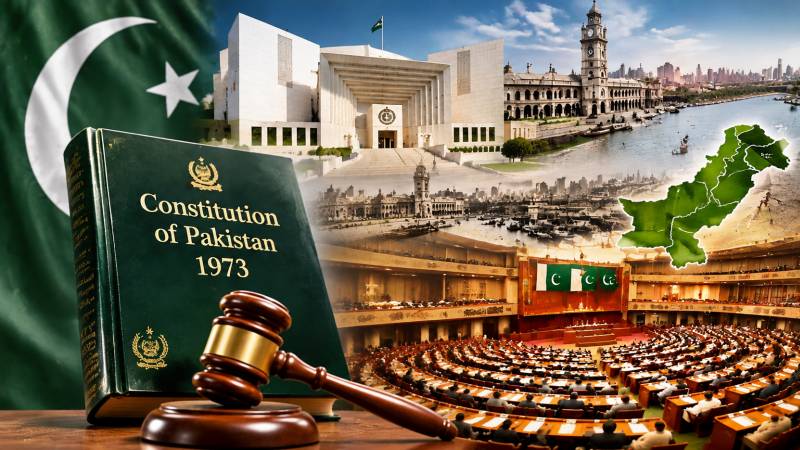
Justice Wajihuddin, in his interview the other day, shocked social scientists, constitutional and law experts by making many misleading statements to elaborate his views about constitutional process for carving new provinces from within the existing federating constituents, status of Karachi from 1948 to this day, the adoption of 1973 Constitution etc. Each and every point he made is challengeable by the historical, legal and constitutional facts available with scholars. This is highly regrettable that a person of his stature and caliber indulged audaciously in misleading the nation in constitutional and legal matters.
For instance, he says that only a minor addition or alteration in the legal ordinance of Martial Administrator General Agha Muhammad Yahya restoring the province of Sindh with Karachi as its capital in 1970, will again federalize the metropolis, and that there is no need to go through the constitutional rigmarole of the two-third majority approval of the Provincial Assembly or making any amendment to the relevant Constitutional clauses for change in the geographical boundaries of provinces.
After retirement, it is natural to lose contact with the ground realities or to have impaired capacity to see past events in a proper perspective and sequence. But the interview of Justice Wajid smacks more of intellectual dishonesty rather than any impairment of memory. He has jumped back to General Yahya Khan’s Legal Framework Order ignoring the Interim Constitution enforced on 21 April 1972 which superseded all the previous legal orders. The country was run according to this interim legal framework until the next constitutional stage.
It ceased to exist after the 1973 was promulgated on 14 August 1973. The Justice claims that the 1973 Constitution was adopted by a simple majority. There could not be a more brutal murder of history than this blatant distortion. Both the treasury and opposition benches in the National Assembly unanimously adopted the Constitution barring only two abstentions from the ruling party. Even all the religious parties including Jamaat Islami Syed Maudoodi, Jamiat e ulema Islam of Mufti Mahmood and Jamiat e Ulema Pakistan of Shah Ahmed Noorani had voted for the Constitution.
He will be well advised to rethink his stance on resurrecting the dead legal framework of the Martial Administrator General Yahya Khan and ignoring the 1973 Constitution and its relevant clauses in the current debate on the contentious issue of new provinces. The nation needs correct guidance instead of legal trickeries.
He says Karachi was made the capital of the federal government in 1948, and also declared as a federal city. It should have not been made part of Sindh. Very strange argument. He should have let the nation know the entire truth. What does he try to prove by ignoring the pre-partition historic status of Karachi? Was Karachi not part of Sindh before the creation of Pakistan? Karachi has been part of Sindh throughout its evolutionary growth from a small village to its capital after fall of Sindh in 1843.
The capital of the federal government began moving to Rawalpindi from 1960. Rawalpindi served as the Interim capital of Pakistan from 1960 until the country officially declared Islamabad as its capital on14 August 1967. Like the province of Sindh, Karachi also merged into the West Pakistan. It was not kept or listed as a separate federal territory. When General Yahya, responding to the unanimous demand of political parties, dissolved the One-Unit and restored the provinces in this part of Pakistan in 1970, Karachi emerged with its historical status as the capital of Sindh.
The 1973 Constitution recognize the four provinces including Punjab, Sindh, KPK and Balochistan as component territories of Pakistan. Pakistan is a federal and not a unitary country. This constitutionally implies that the provinces within the federation of Pakistan are not mere administrative unit. These are federating units, and, by their own consent, have surrendered some of their autonomous authority to the Federal government. These constitutional, legal, and administrative domains have been clearly defined and delineated by the 1973 Constitutions.
The NFC Award enforced in the wake of the 18th Amendment has remained indigestible for the Centre. It has been taking part of the provinces’ financial awards back as grants by coercion and blackmail.
Some subjects were placed in the concurrent list authorizing both federal and provincial governments to legislate on them subject to first priority to the former in case of any clash of legal or constitutional interests. However, the 18th amendment to the Constitution has abolished the concurrent list making clear delineation of subjects between the federal and provincial governments. This was done to ensure provincial autonomy. It is an entirely different question whether or not all the provincial subjects have since been transferred to the provinces.
Some of these subjects and divisions are still retained by the Central regime despite constitutional delineation and budgetary constraints. The member of the Senate Committee on Devolution, Senator Zamir Ghumro says that the federal government spent over Rs.4 billion last year from the Federal budget on these Ministries and Divisions which otherwise have been the liability of the provinces.
Kurram Hussain, in his recent articles, writes that the provinces are made to hand over Rs.1.00 trillion as grant to federal regime every year. He further adds, almost 30% of the federal deficit is being financed by provincial resources, and the demand from the centre for more is continuing to grow. Despite such economic constraints, the establishment wants to create new provinces. Is it logically fathomable?
Is all this fuss about the reversal of the financial empowerment of the provinces through the National Finance Commission Award? It seems so. The federal establishment dominated by the bigger province by over 70% - has been accustomed to feeding and fattening over the resources of the small provinces. The NFC Award enforced in the wake of the 18th Amendment has remained indigestible for the centre. It has been taking part of the provinces’ financial awards back as grants by coercion and blackmail. In the meanwhile, it is not prepared to curtail its non-essential expenditures or get rid of the provincial subjects.
Sardar Akhtar Jan Mengal, President of the Balochistan National Party, has announced that their homeland has no option than seceding from the federation of Pakistan. Under the social contract (Constitution), the federating constituents have surrendered their sovereign right to the centre as elaborated earlier. The denial of political, economic and financial autonomy to the federating units and the coercive measures employed the federal authority in their homelands pushes moderate leaders like Sardar Akhtar Mengal to a point of no-return.
The social contract implies that the federating constituents have willingly agreed to become components of the federation. It describes clear and unambiguous procedures for any geographical change in their territories, and makes it a constitutional imperative to seek their consent through their Assemblies. Legal trickeries as propounded by Justice Wajihuddin will further complicate the situation.