

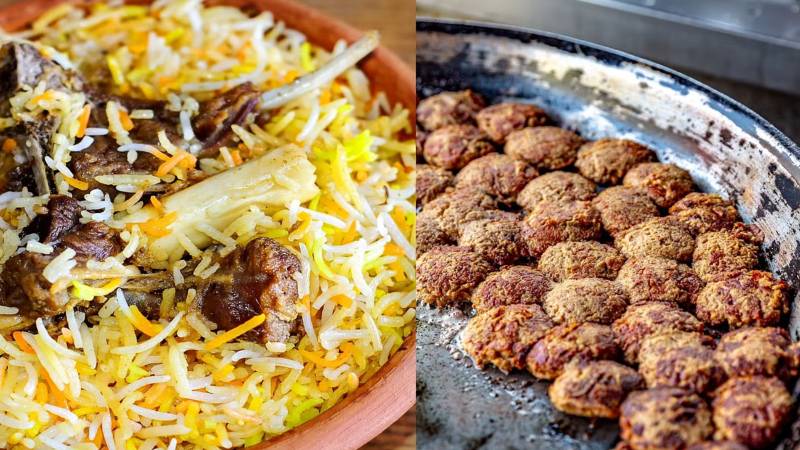
Earlier this month, the city of Lucknow earned a spot in the UNESCO Creative Cities Network (UCCN) under the category of gastronomy. The recognition was a tribute to its rich culinary heritage, an ode to the city’s famed kebabs, kormas, biryanis, and the slow-cooked marvels of Awadhi and Mughlai cuisine, which are part of the Awadhi cultural identity.
But, before Lucknowites and gourmets across the subcontinent could fully savour this global honour, a tweet by Indian Prime Minister Narendra Modi to mark this achievement soured the celebration for many. Modi tweeted a photo of a vegetarian thali, whose spread bore no resemblance to the culinary traditions for which Lucknow was honoured.
Uttar Pradesh Chief Minister Yogi Adityanath followed suit. The omission of the city’s iconic meat-based dishes raised eyebrows and sparked a flurry of responses on social media, with many reminding the leaders that it was Lucknow’s non-vegetarian legacy that had earned the UNESCO nod.
Experts argue that the move reflects a broader ideological pattern. It is an attempt to recast India’s diverse food culture through a singular, upper-caste vegetarian lens. In Bharatiya Janata Party (BJP)-ruled states, meat bans during Hindu festivals like Navratri have become routine. Butchers are often compelled to shut shop, and the sale of meat and fish is prohibited in designated ‘holy’ zones. Even school midday meals in states like Maharashtra, Madhya Pradesh, and Goa, which are governed by the BJP, have excluded eggs from the meals being served to children, aligning with notions of dietary purity rooted in upper-caste Hindu traditions.
In India, the political messaging around Lucknow’s UNESCO recognition appears less about celebrating culinary excellence and more about reinforcing a Hindu cultural narrative. For the BJP, meat in particular dishes like biryani is often portrayed as emblematic of the ‘other’, a symbol of Mughal or Muslim identity. Just last year, Prime Minister Modi accused opposition leaders of harbouring a ‘Mughal mindset’ and equated the opposition to the Muslim League, after they were seen eating fish during the Navratri festival.
But food cannot be boxed into binaries. Lucknow is only the second Indian city, after Hyderabad, to receive the UNESCO gastronomy tag. Both cities are celebrated for their meat-rich culinary traditions. Hyderabad, with its Deccan fusion of haleem and biryani, and Lucknow with its tunde ke kebabs and galouti. Across the border, Karachi too lays claim to this shared culinary heritage, shaped by the migration of muhajirs from North India during Partition.
Let the aroma of kebabs and haleem do what politics has failed to. It is the food that can bring us back to the same table
For millions across India, Pakistan, and the diaspora, dishes like biryani, kebab, and nihari are more than meals. They are edible archives of memory, migration, and identity that they have lived with and continue to nurture. Karachi’s famed street food culture, from Bihari kebabs to haleem in Burns Road, owes much to the flavours carried by migrants from Awadh and other parts of North India.
Karachi today is known for its biryani, but also for its variety of kebabs that trace their lineage back to the United Provinces of British India. While homes, possessions, and properties were left behind, the flavours of the nihari and kebab were carried by the migrants, which built the vibrant food culture of Karachi.
“We have inherited the spices, the techniques, the soul of Awadhi cuisine,” says chef Zeba Naeem, who runs a cloud kitchen in Karachi serving traditional Awadhi dishes. “But what you get on the streets today is a diluted version. The real taste survives only in the homes of old UP families.”
Karachi-based chef Ali Abbas, whose family migrated from Lucknow, recalls, “My grandmother and aunts were the true patrons of the Awadhi food. Karachi in the pre-Partition era was known just for its seafood. The richness you see today in our food and spices, the nihari, kebabs, biryani, all of this came with the muhajirs. We brought the recipes and the reverence for food.”
In Lucknow, food was once a royal pursuit. “The nawabs treated their kitchens as laboratories, where the royal cooks were encouraged to experiment with meats, lentils, and spices. No other city in the subcontinent has approached food with such imagination and devotion,” says Lucknow-based dastango Himanshu Bajpai.
This UNESCO honour is not just a feather in Lucknow’s cap; it is a recognition of a shared cross-border culinary legacy. It also reopens the age-old debate on which city is the true culinary capital of South Asia. Is it the Chowk of Lucknow, the Char Minar of Hyderabad, or the Burns Road of Karachi?
Food remains a powerful bridge. “Among the many things lost in Partition, food was one of the most intimate. The shared heritage was torn apart,” says Professor Amit Jhulka of Ashoka University. “But it also holds the potential to reconnect us. Food is a repository of memory, a soft power that can heal and be the bridge between the two countries.”
Indian cricketers like MS Dhoni and Sourav Ganguly have spoken fondly of Pakistani biryani and nihari, while Wasim Akram has professed his love for South Indian cuisine. Ganguly even revealed how he had breached his security and sneaked out of his hotel to get the flavour of the street food of Karachi.
Recalling Indian leader LK Advani’s visit to Pakistan in 2005, senior Pakistani journalist Mazhar Abbas said that the central part of the diplomatic conversation was around food. “Unfortunately, we have explored music, art, and sport as tools of peace, but food remains an underused language of reconciliation.”
And while the two countries can continue to stake their claim over the nihari and biryani, one thing is clear: it is not just about taste. It is about identity, memory, and belonging. “Who really owns biryani: the Lucknow walas, the Hyderabadis, the Karachiites, or the Sindhis? Perhaps the answer lies not in ownership, but in shared inheritance,” says Professor Vivek Kumar of Jawaharlal Nehru University.
As Chef Abbas puts it, “We need food exchanges not in Dubai or London, but in Lahore and Delhi. Let the aroma of kebabs and haleem do what politics has failed to. It is the food that can bring us back to the same table.”