

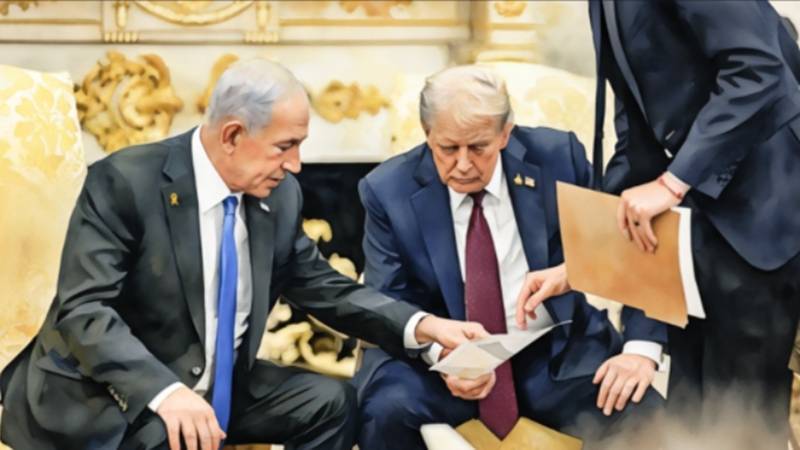
The war in West Asia has taken a new turn as President Trump, on 25th May 2026, requested the mandatory Islamic states of Saudi Arabia, Qatar, Türkiye, Pakistan, Egypt & Jordan to sign the Abraham Accord with Israel to normalise their ties with the Jewish state & establish peace in the region, along with a peace agreement with Iran. The states of Saudi Arabia & Pakistan have rejected Trump’s request until an independent Palestinian state is created.
The Trump administration wanted to use the Iran war as leverage to advance Israeli objectives and establish normalisation of ties with regional states. The Abraham Accord was initially proposed during Trump’s first tenure in 2020 when the UAE, Bahrain, Morocco and Sudan signed the agreement.
The Accords were formalised due to increased cooperation between Sunni Muslim states and Israel against the growing threat of Iran since the 2010s. The Accords were used as a bargaining chip to advance the objectives of economic & security cooperation. In contrast, the UAE Accord talked about the suspension of Israeli plans to annex parts of the West Bank.
The process of normalisation continued as Riyadh and other states were engaged in the process, but the Gaza War of 2023 ended the further prospects of the normalisation process in the Gulf.
The Trump administration, in its second tenure, has tried to bring other Gulf states to join the Accord, and Trump has used the Iran war as leverage to achieve his objectives.
Meanwhile, the Gulf kingdoms have viewed it with concern and maintained strategic restraint towards Tehran’s aggression in the war, and Pakistan’s peace initiative to facilitate talks has played a significant role in diffusing the situation between the United States & Iran.
Meanwhile, the Trump administration used the ceasefire period to renew its strength and re-strategise policies & tactics to deal with Tehran.
The blockade of the Strait of Hormuz continued to put pressure not only on Tehran but also on Beijing and Gulf states to play an active role in ending the conflict.
The fresh proposal by Trump and the renewal of attacks on Iran and Oman will bring instability to the region as the peace process is derailed, and Trump’s Abraham Accord proposal will antagonise its own allies and public opinion against the United States for advancing Israeli objectives in the Muslim world.
Trump’s goal is to formulate a United States-led political order in the region to advance Washington’s interests, deal with threats through a security nexus led by the United States and Israel, end the isolation of Tel Aviv, and bring economic integration in the region to foster hope for projects like IMEC.
The United States’ inability to deal with Tehran has raised serious questions about its role in the region, and Gulf states have started to explore new avenues to strengthen their defences through cooperation and the formation of defence alliances, as well as looking towards Beijing as a reliable partner in the region
He also seeks to portray the image of Netanyahu as a peace-loving leader who is ready to deal with radical groups and states and defend Western civilisation from Islamist radical elements.
Another objective is to divide the Muslim world into two camps—pro and anti-Iran—and declare the United States a major security provider in the region despite its failures to defend the region.
Trump wants to be recognised as a prominent United States President and the best deal-maker in global politics. He aims to use his deal-making approach to bring states together on a platform to resolve disputes which his earlier predecessors have not been able to achieve.
The real problem lies in the political and ideological differences which Trump refuses to consider, and this creates a dilemma for the Gulf kingdoms.
The lack of any real development on the independence of Palestine since the 1993 Oslo Agreement, and Israel’s continued control and annexation of Palestinian territories, as well as continued violence in the region, have made public opinion against normalisation of ties in the Muslim world.
Saudi Arabia’s Crown Prince Mohammed bin Salman, during his last tour of the United States in November last year, rejected hopes of normalisation of ties, and other allies, including Pakistan, have strictly called Israel an illegitimate entity, and its passport even mentions that it is prohibited from being used for Israel.
The situation in this scenario seems hopeless as Riyadh and Islamabad have refused to accept Trump’s proposal until an independent Palestinian state is formed.
Netanyahu’s actions in Gaza and alleged war crimes will not be forgotten easily, and Muslim states will not bow down to the United States demands to give a clean chit to Israel and Netanyahu for all its atrocities and wars in the region to advance the Greater Israel dream.
The Gulf states have realised that diplomatic recognition of Israel by Gulf states will end leverage over Tel Aviv for the establishment of a Palestinian state.
It will also promote Trump’s objective to isolate Tehran and initiate a new conflict between Iran and Gulf states over their participation in a United States-led security architecture and their closeness with Tel Aviv.
The United States and Israel will be the largest beneficiaries of the conflict, as increased United States involvement in the region means further defence deals, continuation of petro-dollar hegemony, and reduced influence of China in the region.
The Gulf monarchies need to devise an independent foreign policy based on cordial ties with Tehran, maintain a delicate balance between Washington and Beijing, find a credible guarantor of peace between Iran and Gulf kingdoms, and establish a suitable defence alliance with Pakistan and Türkiye to defend against continued aggression from Tel Aviv and blackmail by the Trump and Netanyahu nexus.
As the Abraham Accord is unable to fulfil its objectives, as was promised—that Tel Aviv would suspend its expansion in the West Bank—despite assurances, Tel Aviv has continued to expand Jewish settlements in the West Bank from 117 to 144.
It has also established the E1 settlement project in East Jerusalem in May 2023, which divided the West Bank into two parts.
The violations of Israeli commitments under the Abraham Accords are another source of concern for Gulf kingdoms regarding Tel Aviv.
It is in this background that states are not eager to develop ties until concrete steps towards an independent Palestine have been taken.
President Trump is putting pressure on Gulf states, Riyadh and Doha, to sign the Abraham Accords to settle a deal with Tehran and end the war in the region.
The war, which was not even initiated by the Gulf kingdoms but by the United States on the behest of the Netanyahu government, aimed at regime change in Iran, ending its nuclear and missile programme, and establishing a puppet regime in Tehran.
It was the Gulf kingdoms’ strategic restraint that prevented them from responding to Tehran’s retaliatory strikes on United States bases and Gulf state oil and gas infrastructure in the region.
Arab kingdoms did not want to escalate the war or further antagonise Tehran into responding against the kingdoms.
The United States’ inability to deal with Tehran has raised serious questions about its role in the region, and Gulf states have started to explore new avenues to strengthen their defences through cooperation and the formation of defence alliances, as well as looking towards Beijing as a reliable partner in the region.
The United States tilt towards Tel Aviv has completely transformed the regional scenario, as the Trump administration continues to threaten regional peace & stability to further Netanyahu’s objectives of diplomatic recognition, economic integration, and dividing and weakening the Muslim world to achieve his Greater Israel dream.
In this backdrop, the role of regional peace initiatives is key, and governments in Riyadh and Doha need to engage Tehran to diffuse the situation through third parties, including Pakistan and China, to counter the blackmail of Trump/Netanyahu tactics.