

After clearing the luggage, when the passengers came out of the desolated airport lounge, about a dozen American soldiers were patrolling outside. Imagine you land in a country and the first human beings you encounter are fair-skinned, tough-faced American soldiers in gray uniforms. It was a dull morning in Kabul in late August 2010. The sky was gray, the soil was gray, it was all unpleasant and gray. The rainy season in Pakistan had created a flood situation, but it was a dry day in Afghanistan.
A car was already there to take us straight to our hotel in Shahr-No. On the way, my emotions gradually changed. I saw the city of Kabul, sometimes with wonder and sometimes with love. The roads of Kabul resembled a combination of Peshawar and some underdeveloped parts of Islamabad, but there was no traffic jam. Almost every other building was under construction. There were billboards on both sides of the roads, displaying advertisements for Pakistani products in Farsi. One such advertisement featured Nadia Khan feeding her son with a Pakistani baby food brand, with text in Farsi underneath. General elections were just around the corner, banners of candidates asking for votes, with images of female contestants in headscarves were telling the story of a progressing Afghanistan. Upon seeing an American soldier on a billboard holding the hand of an Afghan elderly man with reverence and respect, my heart immediately said that it was all a facade, they were all colonisers and occupiers.
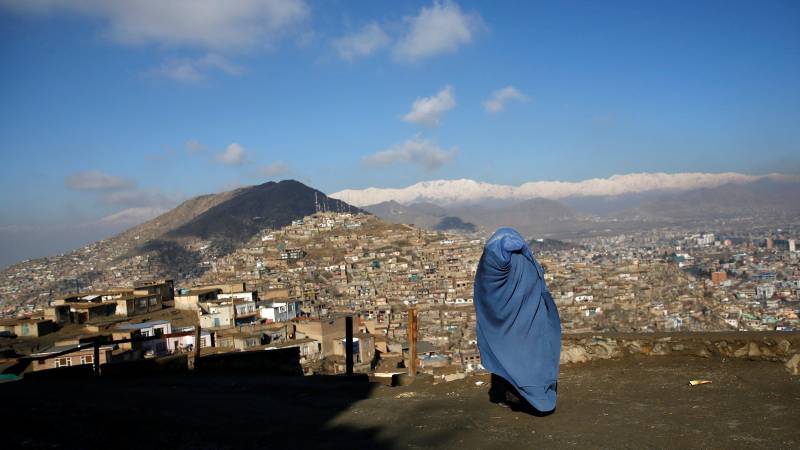
My eyes were looking for the blue burqa-clad woman mentioned in "The Sewing Circles of Herat". Their presence is a constant reference to Afghanistan in the international media. During our whole stay, we saw just five women dressed in blue burqas.
Whether they were taxi drivers or passengers, shopkeepers or buyers, teachers or students, cooks or diners, none of them was unhappy with the presence of American soldiers on their soil
Initially, I did not like the presence of the US Army in Afghanistan, but as time passed, my opinion changed. As an eyewitness, I can attest that during my stay in Kabul I met nobody complaining. Whether they were taxi drivers or passengers, shopkeepers or buyers, teachers or students, cooks or diners, none of them was unhappy with the presence of American soldiers on their soil. It is also true that they were not praising America, but the lamentation of the oppression of the Taliban was on every tongue. The way the war and the Taliban destroyed Kabul, everyone was in sorrow. The sense of desolation was in the air. In 2010, the Kabul rupee was worth twice as much as the Pakistani rupee. Though everyone knew that this was the result of America's presence and was temporary, it was still something pleasant for the fractured economy of a war-torn country.
We saw Najeebullah’s Afghanistan in the female students at Jamia Kabul, with their heads covered in scarves but wearing jeans or skirts. Many departments in the university were still in the process of completion, a multi-storied building called Iqbal Auditorium was also under construction which housed a library, department of fine arts and a spacious auditorium.
Roads were being built to connect the cities, ruins were being transformed into buildings again, and contentment was coming back on the faces. Indian dramas were shown on television with Persian subtitles. Markets were bustling with activity, with shops selling copies of Adidas shoes alongside traditional Afghan clothing. This Kabul was a Kabul of Pashtuns, Hazaras, Uzbeks, Tajiks, Sunnis, and Shias. This Kabul was fundamentalist, traditionalist, and liberal at the same time. This Kabul wanted to escape foreign domination, but it was also afraid of returning to the Stone Age. The Kabul I saw in 2010 was a hopeful and progressive Kabul with a desire to move forward.
Today in 2025, I read in a report issued by the Associated Press that the de facto Taliban regime has forbidden international NGOs from hiring Afghan women. Earlier, they had issued warning orders for women to receive medical training. Afghanistan is the only state in the world that prohibits female education. Organisations providing humanitarian assistance to Afghanistan are at risk. Afghanistan is just an economic desert with coercive governance, poor masses, feeble infrastructure, and weak institutions.
When U.S. forces left Afghanistan, many Afghans left with them. According to a report issued by UNHCR around 2.6 million Afghans fled since 2021. Their villages and cities are emptying. There is nothing but distress and disappointment in the future. Almost no family in Afghanistan remains together, either half or more of their members have already sought asylum elsewhere. Now, as I see thousands of Afghan refugees seeking asylum and humanitarian visas in Australia, I ask myself: for whom are they bringing Sharia? On whom will they impose it? Who will they persecute when no one is left?