

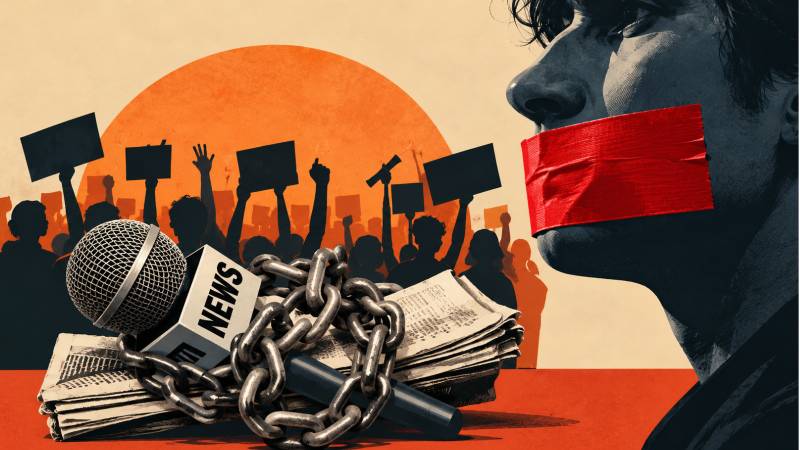
Once I am in the land of the free, I will be able to think aloud and say whatever I feel like. This was my naïve thought before I came to the United States. I used to think the free world had no restrictions on freedom of thought and expression. The Constitution guarantees these rights in letter and spirit. When I was in Pakistan, reading scholars like Edward Said, Howard Zinn, and others critical of the “American Empire”, it felt soothing to imagine a world where people could think loudly and say whatever they wanted. However, that doesn’t feel like the case anymore. The world is moving toward binary thinking as the norm; put simply, it is either you are with us or against us.
Pakistan’s society and educational system are repressive, where students cannot say what they want to in the classrooms. I still remember once getting slapped in class because I was thinking aloud; the punishment I got for asking what I thought was the right question. The teacher disliked the question, offended that we would question at all, and I got slapped. The slap was not by the teacher; he asked a friend of mine to slap me, which I remember to this day. Probably, it was meant to torture my soul, not my body. However, I was not charged with blasphemy and therefore did not become Junaid Hafeez, who is spending the golden years of his life behind bars.
Junaid Hafeez is a teacher from Multan who was put behind bars for raising questions in a society that believes in blindly following its forefathers' customs. Anyone who asks questions is disliked by all and can be martyred, just like Mashal Khan. Mashal Khan was brutally killed by his fellow classmates not because he said something blasphemous, but because he was speaking against the authoritarian culture of his university. In Pakistani society, the punishment for the questions or words coming out of one’s mouth is weighed against one's life, and life is taken in kind if it balances the scale. These societal contexts shaped my thoughts and repressed critical thinking. I thought the land of the free would be something else.
In Pakistani society, the punishment for the questions or words coming out of one’s mouth is weighed against one's life, and life is taken in kind if it balances the scale.
The land of the free is not what it is advertised as. Or maybe it was, but it’s no longer the case. Reporters Without Borders’ 2025 World Press Freedom Index supports this: the United States has slipped to 57th of 180 countries, and for the first time, the organization rated the global situation for press freedom as “difficult.” Recently, the President of the United States banned news channels from coming to the White House, which did not happen during the Watergate Scandal, the Iran-Contra nexus, or other state-of-the-art investigative journalism that put the executive under the microscope. Now, under the current administration, they cannot cover presidential briefings or press conferences. This happened as world leaders came to speak at the 81st session of the United Nations General Assembly. They came to speak their mind and shake the conscience of the global community on questions like Palestine, and to put moral and ethical boundaries on Artificial Intelligence. However, something else is awaiting them. America seems to be entering an Orwellian order.
George Orwell, in his novel 1984, described how autocratic leaders will define the meanings of words. Whatever they say becomes the meaning. Take a hint from the film The Dictator, where the word “Aladeen” is simultaneously used for both good news and bad news. Citizens are left paralyzed, whether it is good news or bad news. The war on Iran seems to be a case like this, where, for the nth time, the U.S. has declared victory and where grocery prices are skyrocketing. This assault is not only in the United States but globally.
India, which claims to be the global guru, perhaps is setting an example. In its backyard, Indian Prime Minister Narendra Modi is pushing back against dissent. India itself sits at 151st of 180 on that 2025 index, still in the “very serious” category. Since he assumed office, countless examples of his high-handedness have emerged, starting with his time as Chief Minister of Gujarat. Claiming to be the global guru while giving no thought to international norms or what international law says in such matters, he is killing citizens on international soil, violating treaties and agreements. This is not only India’s problem, but the European far right is also making it hard for people to voice their concerns. Raising questions in the U.K., Germany, or other European countries is like going against the Pope during the Middle Ages, where you can be excommunicated, and no one will come to your aid.
I came to the United States thinking of a land of the free, but that seems to be a dream gone sour because the whole order is Aladeen right now. I will take refuge in a verse by Ghalib, a classical Urdu poet:
Bak raha hoon junoon mein kya kya kuch
Kuch na samjhe Khuda kare koi
In my frenzy I rave, God knows what all;
May God grant that no one understands a word.