

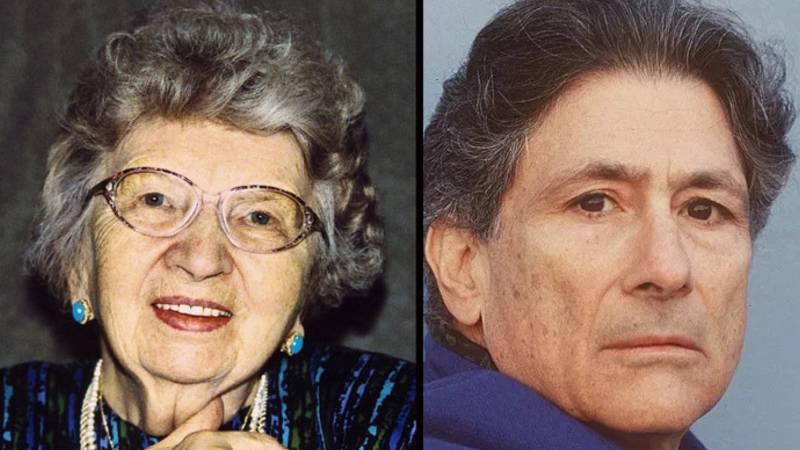
The name of Annemarie Schimmel occupies an unusual place in the intellectual history of modern Oriental Studies. Few European scholars of Islam achieved her degree of public admiration in the Muslim world, not merely academic respect, but genuine reverence. From Pakistan to Iran, from Turkey to Central Asia, she remains a beloved figure, invoked as a scholar who “understood the East from the inside,” who celebrated the beauty of Islamic poetry, mysticism, and literary tradition with a warmth rarely found in Western academic writing. In these regions, Schimmel is remembered not as a philologist but as a sympathetic interlocutor, almost a cultural emissary who praised rather than dissected, adored rather than analysed.
Admiration and Its Intellectual Costs
Yet this adoration raises important questions. What is the nature of her sympathy? What was its intellectual cost? And what happens when we re-examine Schimmel with the critical tools developed by Edward Said—tools that reshaped the entire discourse on Western representations of the Islamic world? Said’s project did not target individual intentions; it dealt with structures of thought. And it is precisely Schimmel’s sentimentality, her refusal to interrogate, that invites scrutiny. Her oeuvre stands at the intersection of two contradictory impulses: the desire to humanise and the refusal to critique.
The Breadth of Schimmel’s Scholarship and the Limits of Her Perspective
Schimmel’s corpus is vast and diverse—writings on Sufi poetry, Indo-Muslim mysticism, Turkish literature, Islamic calligraphy, Persian lyricism, and Urdu ghazal tradition. She wrote with an extraordinary command of languages and a remarkable intimacy with poetic forms. To many Muslim readers, her work felt like an antidote to Western condescension: here was a Westerner who did not pathologise the Islamic world but praised its artistry, metaphorical subtlety, and spiritual richness. The appeal was undeniable. At a time when much Western writing on Islam hovered between suspicion and misrepresentation, Schimmel offered a portrait of cultural grace.
But to read her closely is to recognise a deeper limitation. Her admiration does not deepen into critique; it remains suspended at the level of cultural affection. The Islamic world appears in her works as an aesthetic horizon, a pastoral of mysticism, a landscape of luminous metaphors and timeless devotions. History dissolves into poetry; politics evaporates under the glow of symbolism. Her Islam is not lived but lyrical; not contested but harmonious. She foregrounds the nightingale and the rose, the lover and the Beloved, the mystic and the divine—yet the social worlds in which such metaphors were produced often vanish into abstraction.
Where classical orientalism infantilised the East through critique, Schimmel infantilised it through idealisation
Schimmel and Power: A Troubling Proximity
This tendency becomes more troubling when we recall Schimmel’s proximity to political power. She cultivated relationships with rulers and state elites—military dictators in Pakistan, monarchs in the Middle East—with no visible discomfort regarding their authoritarian practices. Her praise for the cultures of the Muslim world coexisted with a striking silence about the political violence, censorship, and repression enacted by the very regimes that celebrated her. The scholar of Sufi love-poetry who wrote warmly about tolerance remained unmoved by the persecuted intellectuals, silenced minorities, or disappeared dissidents living under the governments she befriended.
Said’s Framework and the Problem of Romantic Orientalism
Here is where Edward Said’s conceptual apparatus becomes indispensable. Orientalism is often reduced to a critique of hostility—how Europe misrepresented the East as inferior, backward, irrational. But Said’s argument is broader and more unsettling: Orientalism is a structure of representation capable of producing romantic idealisation just as easily as negative stereotyping.
In Said’s schema, affection is not innocent. Romanticisation can be as distorting as denigration. The soft orientalist who sentimentalises the East participates in the same epistemological structure as the hard orientalist who pathologises it.
Schimmel’s work fits precisely into this category. She is the orientalist of reverence, not the orientalist of domination. But reverence, too, imposes limits. In her hands, Islam becomes aesthetic rather than historical, mystical rather than political, poetic rather than social. Her sincerity becomes a vehicle of erasure.
Representation Without Conflict
Said famously noted that the Orient of orientalism is always a representation, never the lived complexity of societies. In Schimmel’s oeuvre, Islam appears as a civilisation of sublime metaphors, yet not as a world of political struggle, ethical conflict, or intellectual dissent. The Sufi saint is central; the modern Muslim woman navigating patriarchy is absent. The metaphysical poet is celebrated; the dissident crushed by the state is invisible. For Schimmel, the aching beauty of the ghazal outweighs the turbulent realities of history.
This raises a crucial question: if Said critiqued orientalist negativity, what do we make of orientalist positivity—the praise that flatters but also simplifies? Schimmel represents the reverse face of orientalist representation, a mirror polished to reflect admiration rather than disdain. Where classical orientalism infantilised the East through critique, Schimmel infantilised it through idealisation. Her tone is that of the affectionate interpreter, but her affection is curiously apolitical.
Even admiration can become a form of control when it smooths over conflict and turns living cultures into comforting images
Why Said Did Not Mention Schimmel
Why, then, does Said not mention her? Perhaps because his project aimed at dismantling structures tied to imperial power, Schimmel’s work circulated more deeply within Muslim societies than within Western institutions. Or perhaps her idealising tendencies were not yet recognised as part of the orientalist continuum. But rereading her today reveals that she fits Said’s thesis in ways that were simply overlooked: she constructs an Orient that is lovable but harmless, aesthetically rich but politically sanitised, spiritually profound but socially static. She domesticates the East rather than confronting its complexity.
The Political Consequences of Cultural Praise
The consequences of this domestication are far-reaching. For readers within Pakistan, Iran, or Turkey, Schimmel’s books offered validation from a Western scholar who celebrated “our” traditions. Yet this validation came at the cost of critical autonomy. These societies were themselves undergoing intense political turmoil—from Zia-ul-Haq’s Islamisation in Pakistan to the aftershocks of the Iranian Revolution to Turkey’s internal fractures. In such contexts, Schimmel’s praise served as a convenient cultural balm, a way for elites to claim aesthetic legitimacy even when suppressing political freedoms. A scholar who celebrated Rumi while ignoring the incarceration of intellectuals proved politically useful.
The Paradox of Empathy Without Critique
The paradox is striking. Schimmel was welcomed as a voice of cultural empathy, yet her empathy contributed—unintentionally—to a form of intellectual escapism. She reinforced a vision of Muslim societies as culturally rich but politically unproblematic, spiritually deep but historically unthreatening. Her work became beloved not for its analytical insight but for its capacity to shield its subjects from criticism.
Rereading Schimmel with Said reveals that her work is best understood not as the antidote to Orientalism but as its inversion. Both approaches flatten reality: where one disparages, the other idealises. Where one exaggerates backwardness, the other exaggerates beauty. Neither fully sees.
The Flip Side of Orientalism
Said’s argument would suggest that Schimmel is indeed the flip side of orientalism, the orientalist of praise rather than the orientalist of judgement. Her domain was mysticism, metaphor, and lyric imagination, all of which she approached with aesthetic devotion. But her devotion placed a veil over the social world. The Islam she loved was an Islam of saints, poets, and mystics, not of citizens, dissenters, women, or political activists. It was a world suspended in rosewater, untouched by the abrasive texture of lived history.
None of this negates the contributions Schimmel made to the study of Sufi literature, nor does it diminish the admiration she commands. But it requires us to re-situate her within the broader history of representation: to see the limits of her sympathy, the ideological comfort she offered to those who celebrated her, and the ways she inadvertently sustained an image of Islam that was harmonious, timeless, and apolitical.
What Said Allows Us to See
Reading Schimmel through Said reveals an uncomfortable truth: that romantic Orientalism may feel kinder, but it is no less an Orientalism. It replaces domination with devotion, critique with praise, but both simplify. Schimmel’s Islam exists in beauty; Said’s critique demands that we see it also in difficulty. Reading Schimmel through Said yields a single lesson: representation is never innocent. Even admiration can become a form of control when it smooths over conflict and turns living cultures into comforting images.