

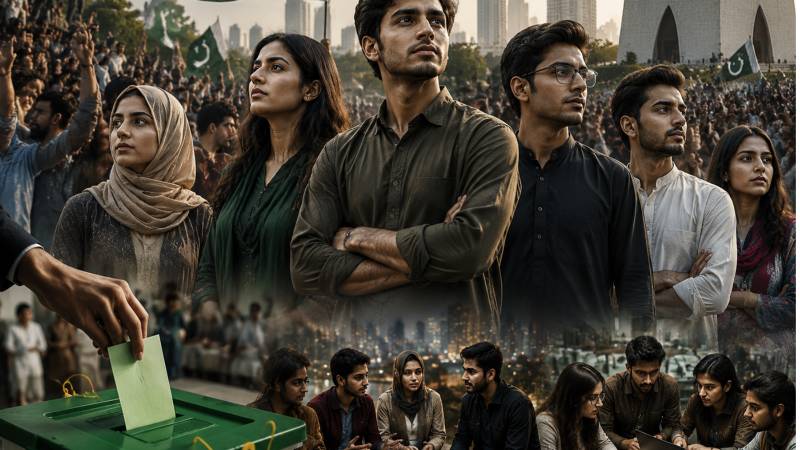
Pakistan's Gen-Z is politically energetic, digitally connected, and increasingly vocal. Yet despite its visibility, it has struggled to produce a movement capable of uniting young Pakistanis across ideological divides. The reason, I believe, is not a lack of passion, but the kind of causes around which that passion has been mobilized.
Any Gen-Z-led movement in Pakistan is far more likely to become effective and sustainable when it mobilizes around shared civic grievances rather than the cause of a single political party or leader. When youth mobilization narrows itself to the release of one politician, the fortunes of one party, or an election campaign, it almost inevitably fragments along ideological and partisan lines from the outset.
Political scientist Mancur Olson argued that broad public causes often struggle to mobilize, since individuals can benefit from collective action without participating in it. Successful movements reduce that cost of participation, allowing shared grievances to become collective action. Charles Tilly and Sidney Tarrow, in turn, showed that social movements become politically influential when their demands are broad enough to create coalitions across ideological divides. The broader the grievance, the broader the coalition.
It is equally important to distinguish political parties from social movements. Political parties exist primarily to compete for state power through elections and governmental institutions. Social movements, by contrast, seek to shape public opinion, influence institutions, and redefine political priorities. The two may cooperate, but they are not the same phenomenon. Once a movement becomes identified with a single party or political personality, it inevitably loses much of its ability to attract people from different ideological backgrounds.
Recent youth mobilizations in India illustrate this dynamic. Whether around unemployment, educational reforms, judicial controversies, or the NEET examination paper leak, the most influential protests gained momentum when they were framed as civic grievances rather than the electoral agenda of a single political party. Because these issues affected broad sections of society, they attracted support well beyond traditional partisan boundaries.
Pakistan's Gen-Z is politically energetic, digitally connected, and increasingly vocal. Yet despite its visibility, it has struggled to produce a movement capable of uniting young Pakistanis across ideological divides.
History repeatedly demonstrates this pattern—from the American Civil Rights Movement and Poland's Solidarity Movement to Chile's student movement. Despite their different contexts, each drew strength from broad civic grievances rather than narrow partisan loyalty. Pakistan suffers no shortage of such collective issues. Education, healthcare, unemployment, inflation, and the treatment of teachers and students affect citizens across political and ideological boundaries. The continued contraction of the education budget, the deteriorating condition of public schools and universities, and official rhetoric directed at teachers are not the concerns of one party; they affect every household connected to public education.
Yet no sustained national movement emerged from these shared concerns. What makes this striking is that these were precisely the kinds of civic grievances capable of bringing together people who might otherwise disagree on almost every political question. The challenge, therefore, is not the absence of grievances but the absence of a civic framework capable of transforming those grievances into sustained collective action.
My argument is not that politics is undesirable. Politics is indispensable to democratic life. The point, rather, is this: when youth mobilization begins from narrowly partisan objectives, it tends to reinforce existing political divisions. When it begins from shared civic problems, it has the potential to create civic solidarity that transcends party identities.
That, in my view, is the real test of Pakistan's Gen-Z. Its significance will not be measured by how passionately young people campaign for one political leader or another, but by whether they can transform widely shared public grievances into sustained civic action. That is the moment a generation ceases to be merely a political constituency and becomes a genuine social force.
Alexis de Tocqueville observed that democracies are strengthened not merely by elections, but by citizens' ability to form voluntary associations around shared public concerns. The success of a generation should therefore not be measured by the size of the rallies it attends for political leaders, but by its capacity to organize around problems that affect society regardless of ideology, ethnicity, religion, or party affiliation. Civic consciousness begins where partisan identity ends. Politics is indispensable to democracy, but not every democratic transformation begins with party politics. Some begin when citizens unite around problems before they divide over solutions.
A political party asks people to choose sides; a genuine social movement asks people to solve a common problem. That distinction explains why parties often divide societies, while movements have the potential to unite them. Nations are transformed by the latter, not the former. The real question, therefore, is not whether Pakistan has a Gen-Z capable of changing politics. It is whether Pakistan's Gen-Z is prepared to build a movement larger than politics itself. When that day comes, Pakistan's Gen-Z will no longer be remembered as a voting bloc. It will be remembered as a generation.