

Last week in these pages, I argued that the Mecca defence pact, for all its ceremony, was only a beginning, and that a beginning was all it was. This week, I want to set out my own understanding of the harder question it leaves behind. How does one turn a photograph into something that can actually defend the people who posed for it?
Let me try to answer.
The limits are real, and I will not repeat the whole list. Three countries that cannot build their own jet engines, cannot fabricate an advanced chip, cannot launch their own satellites, and whose armies do not yet speak the same technical language. Money can rent capability of this kind. It cannot own it. And the road from renting to owning runs through one thing, which is people.
Begin with the honest short-term move, because a roadmap that ignores the next five years is a daydream. For now, the three have no choice but to buy, and to buy from everyone. Saudi Arabia, with the deepest pockets, and then Turkey and Pakistan, will have to keep purchasing arms from China and from the West, the United States included, and to do it without embarrassment.
Dual sourcing is not disloyalty. It is insurance. A country that buys only from a single master has merely chosen in advance which embargo will one day ground its air force. But buying is a bridge, not a place to live. What you cannot buy, at any price, is the ability to make the next thing yourself, and that is grown rather than purchased.
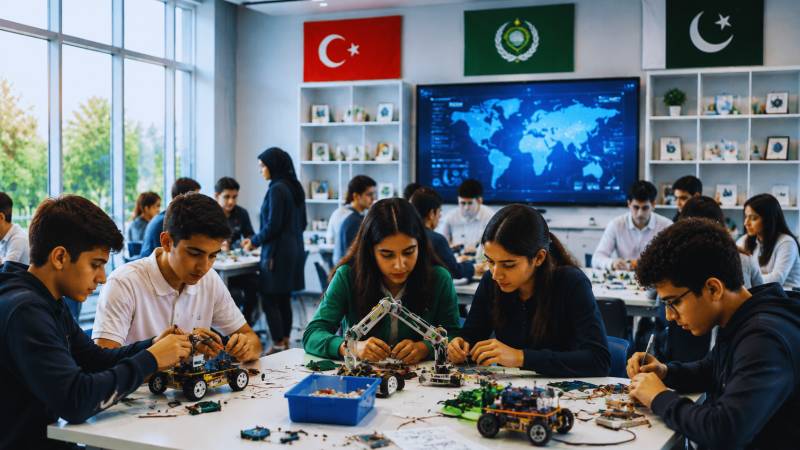
So here is the argument I most want to make, and it will sound very unglamorous next to a stealth fighter. The single most important defence investment these three states can make over the next ten to twenty years is not a weapon at all. It is a classroom.
A university whose head is a political appointment and whose syllabus is a battlefield will produce graduates, but it will not produce scientists.
Turkey’s fine defence industry was not conjured out of oil or slogans. It was built by engineers. Pakistan’s more modest one, the same. The engines, chips, and satellites the alliance lacks will be designed, if they are ever designed, by people who are sitting in a lecture hall today. Which means the real question is not what these countries buy this year. It is what they teach this decade.
My proposal is simple to state and hard to do. For the next twenty years, Saudi Arabia above all, because it can most afford to, and Turkey and Pakistan alongside, should pour money and seriousness into educating their young in mathematics, physics, engineering, computer science, and artificial intelligence, and into raising a handful of their universities to a genuine international standard. Not a respectable regional standard. A world one.
Saudi Arabia already has the template in its own backyard. KAUST was built with real money and, just as importantly, real academic freedom, and it competes globally. Turkey has METU, Bilkent, and İstanbul Technical. Pakistan has NUST, GIK, and LUMS. Link them. Shared laboratories, joint doctorates, common research programmes wired directly into the defence industries that will hire the graduates.
The talent, remember, already exists. It simply works in California, London, Toronto, and Dubai. Saudi Arabia, then Turkey, then Pakistan, should go and bring it home, with serious salaries, serious laboratories, and the one thing rarer than either, the freedom to work without a bureaucrat reading over the shoulder.
Because international standard is not a marble building or a large budget. It is merit in who gets hired, autonomy in how the place is run, and freedom in what may be asked and questioned. A university whose head is a political appointment and whose syllabus is a battlefield will produce graduates, but it will not produce scientists. If we are serious about the rest, we must be serious about that.
And here I must go one step further, to the part these governments will least enjoy reading. You cannot fence freedom inside a laboratory. A mind trained to question the laws of physics but forbidden to question anything else does not become half free. It soon learns where the walls are, and it stops walking toward them.
Real discovery is disobedient by temperament. It doubts the textbook, the supervisor, the received wisdom, and now and then the state itself.
Which is the uncomfortable truth none of the three will care to hear. In all of them, there is, at present, little genuine democracy, with Turkey a partial and uneven exception. Authority rests with one man far more than with any collective, and one man’s wisdom, however real, is a thinner and more brittle thing than the pooled judgment of a free people arguing in the open. I do not expect Saudi Arabia to remake its politics inside the twenty years I am describing. But Turkey and Pakistan can do a great deal better than they are doing, and they should, because it is precisely the societies with the most talent to unlock that pay the steepest price for muzzling it.
Freedom of speech and freedom of thought, then, are not ornaments to be hung once the laboratories are finished. They are the soil the laboratories grow in. Fund the physics and jail the questioner, and you will raise capable technicians who reproduce what others have already invented, and almost nothing that is truly new. No nation has ever out-thought its rivals by decree.
And twenty years is longer than any government any of the three will have. So the money must be endowed and insulated, placed beyond the reach of the next election, the next budget crisis, or the next upheaval, the way one would protect a constitutional guarantee. A fund that a finance minister can raid in a bad year is not a plan. It is a press release with a shelf life.
Now let me return to the clause that gave the pact its headline, the one that says an attack on one is an attack on all. As I argued last week, geography makes that promise, taken literally, close to hollow. Pakistan cannot realistically march an army to defend Riyadh, nor Turkey to defend Lahore, across borders that do not touch and seas that are not theirs to command. Pretending otherwise is how alliances lose their credibility on the very first day they are tested.
So let us mean something we can actually deliver. Let the clause commit each member, when another is attacked, to bring every instrument short of its own soldiers to bear on getting the matter resolved. Diplomatic weight, economic pressure, intelligence, weapons, money, and the combined voice of three consequential states. Promise what you can honour. A treaty that overpromises does not deter anyone; it simply schedules its own humiliation.
This is where the comparison with NATO ought to sober us. NATO holds together because its members are physically joined and, above all, because a superpower stands behind the guarantee. This alliance has neither. What it has, for the moment, is that superpower’s blessing, and a blessing is not a treaty. Washington’s interest is real today and could be gone the morning the region’s map shifts, which in our part of the world it does with unnerving speed. You do not build your house on another man’s goodwill, however warm it feels this season.
Which is the whole point of the classroom. The only guarantee that cannot be cancelled from a foreign capital is the one you grow at home, in your own laboratories and your own graduates. Self-reliance is not a slogan for a rally. It is a generation of patient, expensive, unglamorous work, and there is no shortcut around it.
A few other things belong on the same list. A joint defence-industrial fund, Saudi capital married to Turkish engineering and Pakistani production, aimed squarely at the three gaps we cannot yet close on our own: engines, advanced semiconductors, and an independent way into orbit. And a shared technical language for the three militaries, common data links, and standards, which is a training problem long before it is a hardware one.
None of this is quick, and none of it photographs as well as a signing ceremony. That is rather my point. The men in Mecca lit a candle. Whether it becomes a fire will depend far less on what they buy this year than on what they teach this decade, and on whether they have the patience to fund a result none of them will be in office to inaugurate.
Educate the generation that will inherit this pact, and the beginning acquires a meaning. Neglect it, and the photograph will yellow on the wall while the capabilities it promised are quietly bought from others, and just as quietly switched off by them. The beginning belongs to the three who signed. The meaning is for the rest of us to build. And it will be built, if it is built at all, in the classroom before the factory, and in the factory before the field.