

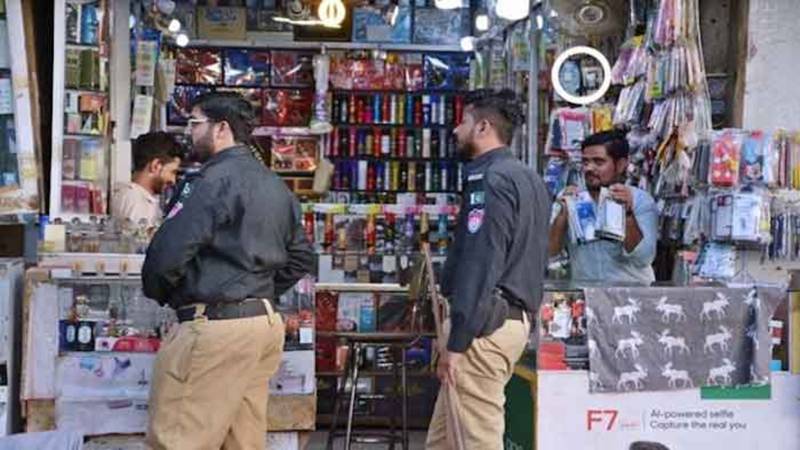
The car stopped beside the vegetable stall. Before its black window had fully lowered, the vendor abandoned his weighing scale and hurried towards it. A hand emerged from behind the dark glass and passed him some banknotes. Within seconds, the car disappeared into the traffic. The vendor returned to his stall, picked up his scale, and resumed his work.
“SHO sahib is a regular customer,” he remarked, almost to himself. An SHO, or Station House Officer, heads a police station. The vendor explained that the officer would collect his vegetables when he came off duty.
I asked him the officer's name.
“Whoever comes here is a sahib to us,” he replied.
When I pressed him gently, he offered an explanation that stayed with me.
“Saeen, do you think someone of my status can ask his name?” He paused and continued, “Once I asked him, he told me he was an SHO instead of giving me his name.” I understand the vendor’s position.
The exchange took place last Friday in Qasimabad, Hyderabad. I visit the vendor once or twice a month, and he knows me well. He even remembers my usual shopping list. But his remark revealed something about the social world we inhabit: an official title can create distance between two people and induce the weak to accept the other's authority.
I pointed out that the officer had a name and that SHO was his job title. Then I teased the vendor. Did that mean every resident of the area was either a sahib or an SHO? He smiled. I collected my vegetables and left, but the encounter brought back an observation I had carried for sixteen years.
The Floods of 2010: When Titles Precede Identity
I first noticed this pattern during the floods of 2010, when I worked with a well-known organisation in Tharparkar, Sindh. My work involved relief activities in Dadu, Jamshoro, and Umerkot, where teams provided food, sanitation, and other essential services to flood-affected communities. We received numerous calls about rescue operations and relief supplies. The callers approached us in different ways.
Flood-affected villagers formed the largest group. They reported rising water levels, described their difficulties, and requested assistance. Their calls were usually brief, direct, and focused on immediate needs. Other callers included NGO representatives, journalists, revenue officials, junior judicial staff, and people claiming to speak on behalf of senior officers. Some sought information or offered assistance. Others tried to influence relief decisions, while a number of calls proved misleading or threatening.
Among these callers, I noticed a particular pattern. Some introduced themselves through their official positions rather than their names. One might begin, “SHO of such-and-such police station is speaking.” Another would announce, “President of XYZ Press Club wants to speak to you.” A third might say, “Mukhtiarkar of ABC taluka is calling.” In these calls, the office came first; the person came second. It was a common pattern in the calls of this category.
I began to wonder why these callers relied so heavily on their designations. Were they following professional conventions, or did they expect their titles to influence the response? Perhaps they wanted the listener to recognise their authority before considering the substance of their message.
Calls from junior staff members made the pattern more intriguing. Some claimed to convey instructions from senior officers. “The Superintendent of Police (SP) has left a message for you,” one might say. Another would report, “The Deputy Collector called, but your telephone was switched off.” Some callers claimed that senior officers had directed us to send relief supplies to particular villages or individuals.
During relief operations in Tharparkar, callers seeking assistance frequently mentioned their official titles - such as SHO, President, or Mukhtiarkar - expecting their rank to expedite aid
When I checked these claims with the officers or their personal staff, some proved false. In certain cases, junior employees had recommended their own villages for relief, even though those villages did not meet the eligibility criteria. By invoking their superiors' names and positions, the callers appeared to lend authority to requests that might otherwise have received less attention.
These experiences left me with two questions: why did some people invoke official positions instead of introducing themselves by name, and why did they expect those positions to influence decisions?
The Magic of Office over Name
I discussed the matter with friends and sought explanations from people interested in psychology. One friend dismissed the habit as an ordinary feature of conversation. I disagreed. Over the years, I read around the subject and emailed professors at public universities in Sindh. None acknowledged my messages. The question remained unresolved until the vegetable vendor's words of the last week revived it. Remember: in the 2010 floods, callers led with their offices; at the vegetable stall, an officer acted with his rank. In both situations, status preceded identity.
My search eventually led me to Erving Goffman's The Presentation of Self in Everyday Life, published in 1959. Goffman (1922–1982), a Canadian-born sociologist, examined how people present themselves in everyday encounters and manage the impressions they create. His work helped me see that communication involves more than exchanging information. People also signal who they are, what they represent, and how they expect others to treat them.
Consider two introductions. One person says, “My name is Ahmed.” Another announces, “I am the SHO of this police station.” Both provide information, but the second introduction also invokes institutional authority. In such cases, the listener may become more attentive, choose words carefully, or hesitate to disagree. Simply by stating a position first, the speaker influences how others should respond.
Goffman's work offers a useful framework for examining this behaviour. People manage the impressions they create, sometimes consciously and sometimes through habit. They choose words, gestures, and forms of address that present them in a particular light. Introducing oneself through an official position can form part of this process, especially when the speaker expects the designation to command attention or respect, or even favour.
However, a title-first introduction does not always signal a desire for power. In professional settings, identifying one's role can be necessary. A doctor, judge, or government official may need to establish their professional identity. However, the question arises when a title overshadows the message or becomes a means of claiming special treatment.
A related perspective appears in Mark R Leary, K P Jongman-Sereno, and K J Diebels's chapter, “The Pursuit of Status: A Self-Presentational Perspective on the Quest for Social Value,” published in The Psychology of Social Status (2014). The chapter explores how people present themselves while seeking recognition and social value or undue favour. An official designation offers a quick way to communicate institutional standing. Someone who introduces themselves as an SHO, SP, or president of a press club may expect a different response from someone who gives only their name. The title can signal authority before the conversation develops.
I call this recurring pattern “Office-Name-Magic”. I use the phrase as my own descriptive term, not as a recognised psychological diagnosis. It refers to the habit of foregrounding an official position or social rank before one's personal identity, particularly when the title appears to carry more weight than the name. Several factors may explain this behaviour. Professional conventions encourage people to identify the offices they represent. Cultural expectations can reinforce respect for seniority and rank. Personal pride may lead someone to emphasise an achievement, while a desire for recognition may prompt another to use a title to command attention. In some cases, speakers deliberately invoke their designations to establish authority.
The problem begins when an office becomes the principal source of a person's identity. The designation then becomes more than a means of identification; it becomes a claim to social importance.
When Deference Replaces Accountability
This habit can reinforce inequalities in everyday communication. An officer may receive immediate attention, while someone without an impressive title struggles to be heard. Junior employees may hesitate to question superiors, and citizens may avoid asking officials for explanations. Over time, people can learn to accept these differences as natural features of social life.
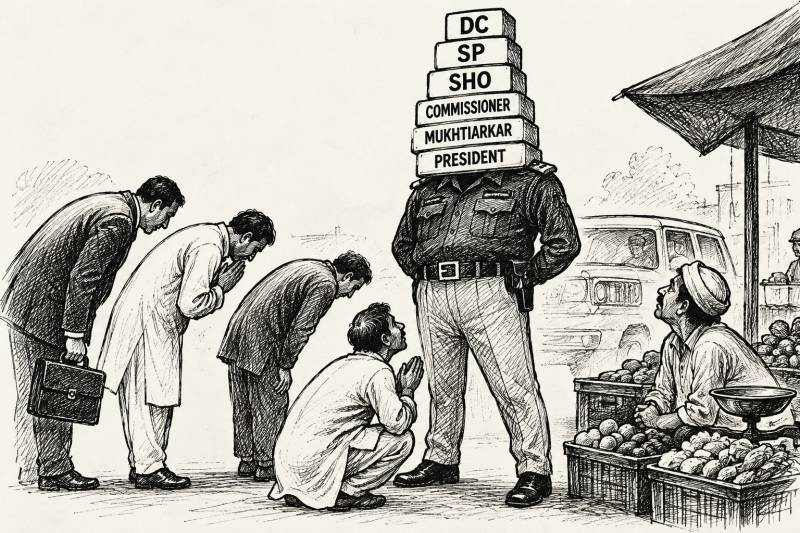
The vegetable vendor's response illustrates this imbalance. He did not deny that the SHO had a name. Instead, he questioned whether someone of his own standing could ask for it. In his understanding, the officer's position established a boundary that made an ordinary question seem inappropriate.
Respect for public office is not the problem. The difficulty arises when respect for an office becomes unquestioning obedience to its occupant. A designation may establish someone's formal authority, but it cannot guarantee that every statement they make is correct or every decision they take is justified.
Excessive deference can also weaken critical thinking. When people treat a title as proof of knowledge, competence, or moral authority, they may stop examining what the officeholder actually says. A claim may go unchallenged simply because an SHO, SP, DC, or senior administrator makes it. Instead of checking the evidence, listeners may focus on the speaker's rank. Such a habit has to be checked at all levels, because when a title replaces an argument, authority begins to take the place of evidence.
If that habit is continued, then officeholders may invoke their positions to discourage scrutiny, while others may hesitate to question decisions for fear of appearing disrespectful. People can confuse formal authority with sound judgement and institutional standing with personal merit. When a title shields someone from reasonable questions, errors can go uncorrected and unfair decisions can pass without scrutiny.
My experience during the floods made these concerns particularly concrete. Relief distribution required decisions based on need and eligibility. A caller's designation, personal connections, or claim to speak for a senior officer could not replace those criteria. We needed to verify information and apply the same rules to everyone. People have to remember that public institutions depend on this principle: people must be able to question decisions, check claims, and hold officeholders accountable.
Conclusion
Returning to the vegetable stall, I see the vendor's response as more than a personal remark. His words reflected his understanding of the social distance between himself and the police officer. Whether that distance arose from personal experience, local conventions, or the authority associated with the office, it shaped his conduct. He believed that knowing the officer's designation was enough and that asking for his name might cross an unwritten boundary.
This pattern deserves attention in government departments, press clubs, universities, NGOs, and other organisations. Why do people sometimes announce their offices before introducing themselves? When does this practice simply identify a professional role, and when does it become a way of claiming status? More importantly, how does it influence the people who hear it? The answer is not to abolish titles or insist that everyone must always state their name first. A position may confer authority, but it does not automatically confer wisdom, honesty, competence, or moral worth. A name identifies an individual; a title identifies a role.
My observation began during the floods of 2010 and remained at the back of my mind, overshadowed by the daily demands of work. Sixteen years later, a brief conversation with a vegetable vendor brought it back into focus. The encounter reminded me that the relationship between names and titles is more than a matter of conversational style. It can reveal how people understand authority, negotiate social distance, and decide whom they can question.
Perhaps we should ask not merely why people place their positions before their names, but unpack what they expect to achieve. A title can identify responsibility, but it should not silence a question. A designation can establish authority, but it should not replace an argument. An office can confer power, but it should never place its occupant beyond scrutiny. After all, an office is a role, not a person. We can respect the office without surrendering our judgement to the person who holds it. No title should place anyone beyond a reasonable question.